The PromptsRush journal
AI ToolsThe Promptsrush AI Builder Stack: Models, Skills, MCP & Video
The AI builder stack we'd pick for late 2026, layer by layer: Claude Opus 5.5 and Gemini 4 Argon, AGENTS.md and skills, MCP servers and subagents, Firecrawl and Genspark for research, and a Kling, HeyGen, ElevenLabs, Descript and Remotion video layer.
Advertisement
Short version: the AI builder stack we'd pick in late 2026 has four layers: a frontier model that does the thinking, skills and an AGENTS.md that tell it how you work, MCP servers and subagents that give it hands, and a video layer that turns finished work into something people watch. Claude Opus 5.5 is our default model, Gemini 4 Argon is the second opinion, Firecrawl and Genspark feed research in, and Kling, HeyGen, ElevenLabs, Descript and Remotion handle video. A solo developer can run the core of it for about $20 a month.
This post closes our 30-post October calendar. Every piece of the month covered one slice of the stack in depth, from what's new in Claude Opus 5.5 to multi-agent workflows and design.md files. Here we put the slices back together: which tool owns which job, how the layers talk to each other, and what to buy first depending on whether you ship code, content or client work.
Sources: Anthropic's pricing docs, model pages and Claude Code docs, Google's Gemini API pricing and model pages, Z.ai's pricing page, the Model Context Protocol site, agents.md, and the pricing pages of Firecrawl, Genspark, Kling, HeyGen, ElevenLabs, Descript and Remotion, all checked on October 31, 2026. We haven't run a fresh test of this exact stack for this post, so every price comes from the vendor and every total is our own arithmetic from list prices.
The Promptsrush AI Builder Stack at a Glance
| Layer | Tool | Job in the stack | From (vendor list price) |
|---|---|---|---|
| Models | Claude Opus 5.5 | Default brain for coding, writing and agent work | $4 / $20 per million tokens (API); Claude Pro $20/mo |
| Models | Gemini 4 Argon | Second opinion, multimodal input, very long outputs | $2 / $10 per million tokens through Nov 30, 2026 |
| Models | Claude Sonnet 5.5 / Haiku 5.5 | Cheaper workers for subagents and bulk tasks | $2 / $10 and from $0.10 / $0.50 per million tokens |
| Models | GLM-5.3 (Z.ai) | Budget coding model | $1.40 / $4.40 per million tokens |
| Skills | AGENTS.md, CLAUDE.md, Agent Skills | Project rules and reusable procedures | Free (open formats) |
| MCP | MCP servers + subagents | Live data, actions and isolated side work | Free protocol; servers vary |
| Research | Firecrawl | Search, scrape and clean the web for agents | Free 1,000 credits/mo; Hobby $19/mo |
| Research | Genspark | Agent workspace for research, slides, docs and sheets | Free; Plus $24.99/mo |
| Video | Kling | Generated B-roll and cinematic shots | Standard $8.80/mo after a $6.99 first month |
| Video | HeyGen | AI presenter and avatar segments | Creator $29/mo ($24 yearly) |
| Video | ElevenLabs | Voiceover and voice cloning | Starter $6/mo |
| Video | Descript | Edit, captions, audio clean-up, export | Creator $35/mo ($24 yearly) |
| Video | Remotion | Code-built video your agent can write | Free for individuals and teams up to 3 |
| Design | design.md | One file that pins your UI tokens for AI coders | Free on Promptsrush |
Prices are monthly billing unless noted. Promo first-month prices change often, so budget with the renewal price.
The Four Layers of an AI Builder Stack
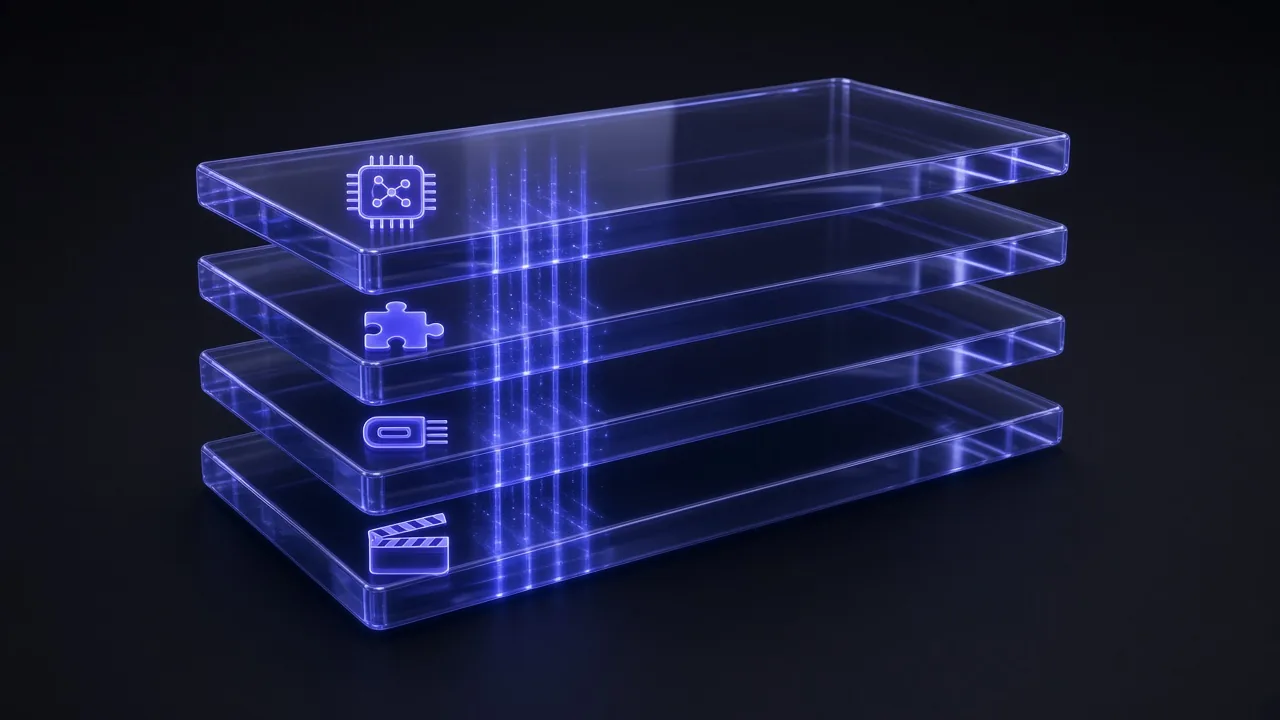
Think of the stack as four layers stacked on top of each other. Models decide how smart the work is. Skills (plus AGENTS.md and the rest of your context) decide whether the model works the way you do. MCP servers and subagents decide what the model can reach and how much it can do in parallel. Video is the output layer that turns code, research and scripts into something you can publish. Research tools and design.md sit across the layers as shared inputs.
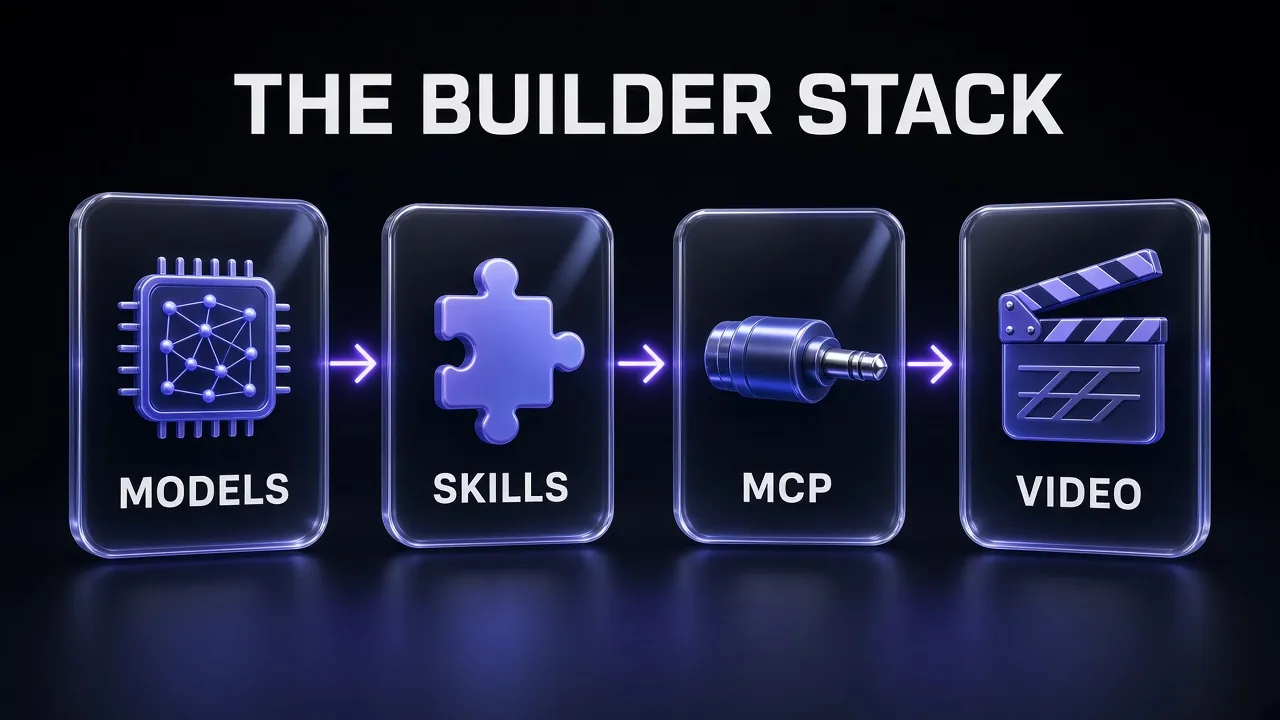
The order matters when something breaks. Bad output from a strong model is usually a context problem, not a model problem, which is the core argument of our context engineering patterns for Claude Code. Fix the skills layer before you pay for a bigger model.
Layer 1: Frontier Models
Honest answer: most builders need one default model and one backup, not five subscriptions.
Claude Opus 5.5: the default
Anthropic's own model guide says to "start with Claude Opus 5.5 for most workloads", and we agree. It has a 1M-token context window, 128K tokens of output, adaptive thinking that's always on, and a default effort of medium. On the API it costs $4 per million input tokens and $20 per million output tokens, and a cache hit costs $0.20, just 5% of the input price. That deep cache discount matters for agents, because a coding session re-reads the same files every turn. Our Opus 5.5 pricing breakdown works through fast mode, batch and caching in detail.
If you live in the Claude app instead of the API, Pro costs $20 a month ($17 a month billed yearly) and includes Claude Code. Max is $100 a month for 5x Pro usage, and the new Ultra tier is $200 a month with no 5-hour limit for verified accounts.
Gemini 4 Argon: the second opinion
Gemini 4 Argon is Google's flagship reasoning model. It takes text, images, video, audio and PDFs, has a 1,048,576-token window shared between input and output, and can write past its normal 65,536-token output cap with long decode. Its thinking levels are low, medium and high. Through November 30, 2026 it costs $2 in and $10 out per million tokens; from December 1 that doubles to $4 and $20. It isn't on the free tier. We'd use it as the reviewer for Claude's plans and the reader for long video or PDF inputs. Our Gemini 4 Argon explainer covers long decode, including when the extra output is worth paying for.
Cheaper workers: Sonnet 5.5, Haiku 5.5 and GLM-5.3
Not every call needs the flagship. Claude Sonnet 5.5 costs $2 in and $10 out, Haiku 5.5 starts at $0.10 and $0.50, and both are good fits for subagents that search, summarise or lint. Outside Anthropic, Z.ai's GLM-5.3 lists at $1.40 in and $4.40 out per million tokens, which makes it the budget pick for high-volume coding. Our GLM-5.3 coding prompts show how to brief it.
Layer 2: Skills, AGENTS.md and Context Engineering
The skills layer is where the stack stops being generic. It has three parts, and each one has a different job.
- AGENTS.md (or CLAUDE.md): the always-on rules for a repo. AGENTS.md describes itself as "a README for agents" and says it's used by over 60k open-source projects; it's now stewarded by the Agentic AI Foundation under the Linux Foundation. Claude Code reads CLAUDE.md at the start of every session, can read AGENTS.md in its place, and recommends keeping each CLAUDE.md under 200 lines.
- Skills: reusable procedures that load on demand. Anthropic's docs put it plainly: "a skill's body loads only when it's used, so long reference material costs almost nothing until you need it." Only the description sits in context by default, and the docs suggest keeping each SKILL.md under 500 lines.
- Context discipline: what you leave out. Long sessions drift as the window fills, which we covered in what context rot is and how to spot it.
My take: write AGENTS.md first, then turn any procedure you've pasted into chat three times into a skill. Anthropic's own trigger is the same: when you paste the same playbook for the third time, capture it as a skill. Our guide to writing AGENTS.md and CLAUDE.md files has templates for both.
Pro tip: Keep one shared AGENTS.md for every tool and put a CLAUDE.md next to it that only contains @AGENTS.md plus Claude-specific notes. Claude Code's docs describe exactly this import pattern, so you maintain one file instead of two.
Draft an AGENTS.md From a Repo Summary
You are writing an AGENTS.md file for a coding agent. Using the project summary below, write a file under 150 lines with these sections: Project overview (3 sentences), Build and test commands (exact commands in code blocks), Code style (only rules a linter does not already enforce), Project structure (key folders and what lives in each), Boundaries (what the agent must never do, including never committing secrets), and Definition of done. Use short imperative bullets. Do not invent commands; if something is missing from the summary, add a TODO line instead.

Project summary:
[PASTE STACK, FOLDERS, COMMANDS AND TEAM RULES]
Layer 3: MCP Servers and Subagents
The Model Context Protocol is "an open-source standard for connecting AI applications to external systems", and its own site compares it to a USB-C port for AI apps. An MCP server gives your agent a live connection: a database, a browser, GitHub, a scraper. Anthropic's rule of thumb is that if you keep copying data from a browser tab Claude can't see, that system should be an MCP server.
Two details from the Claude Code docs shape how many servers you can run. First, tool search is on by default: "Only tool names and server instructions load at session start, so adding more MCP servers has minimal impact on your context window." Second, Claude Code warns when one MCP tool returns more than 10,000 tokens and caps output at 25,000 by default. The docs also note that CLI tools such as gh and aws are still more context-efficient than MCP servers, so don't wrap a CLI you already have. Our best MCP servers for Claude Code list covers which ones earn a slot.
Subagents solve a different problem. Each one "runs in its own context window with a custom system prompt, specific tool access, and independent permissions", and only its summary comes back to the main conversation. Use one when a side task would flood your session with output you won't read again. One catch: subagent requests count toward the same usage limits as your main chat, so ten parallel agents burn ten times the tokens.
How the Layers Wire Together
The layers only pay off when they're connected to one agent with clear roles. Here's the pattern we'd use for a Claude Code project, and it maps cleanly onto Gemini-based agents too.
One coding agent, three helpers
The main agent runs on your default model and reads AGENTS.md at startup. Around it sit three helpers. Skills hold the how: your release checklist, your API conventions, your blog template. MCP tools hold the reach: the database, the scraper, the issue tracker. Subagents hold the side work: research, test runs and reviews that would otherwise clutter the main window. Anthropic's docs describe the combinations directly: "MCP provides the connection; a skill teaches Claude how to use it well", and a subagent can preload specific skills through its skills: field.
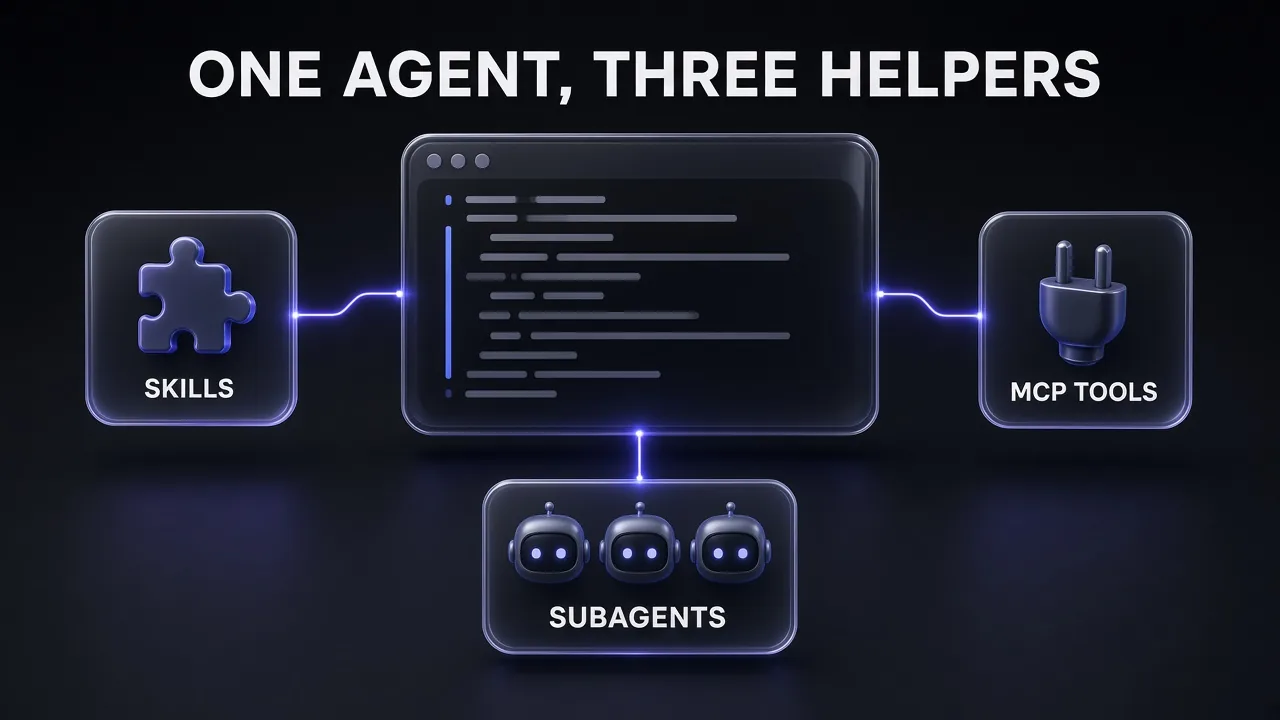
A concrete flow looks like this. You ask for a feature. The main agent loads the matching skill, sends a research subagent (on a cheaper model) to read the docs through the Firecrawl MCP server, gets a short summary back, writes the code, and hands a reviewer subagent the diff. Your main context only ever holds the plan, the summaries and the code. Our Claude skills vs MCP vs subagents guide has the decision table, including where each one costs context.
Pro tip: By default a subagent can spawn its own subagents up to three layers below the main conversation. Remove the Agent tool from a subagent's tool list if you want it to do the work itself instead of delegating again.
The Research Layer: Firecrawl and Genspark
Agents are only as current as what they can read, and the research layer is where most stacks are thinnest.
Firecrawl is our pick for the agent side. It turns pages into clean Markdown and exposes search, scrape and crawl as tools. You can try it in Claude Code with one command and no key: claude mcp add --transport http firecrawl https://mcp.firecrawl.dev/v2/mcp. That keyless server is rate limited and only exposes Search, Scrape and Parse; an API key unlocks the rest. The free plan gives 1,000 credits a month with no card, Hobby costs $19 a month ($16 yearly) for 5,000 credits, and Standard is $99 ($83 yearly) for 100,000. We covered the full search-scrape-write loop in Firecrawl + Claude.
Genspark covers the human side of research. It's an agent workspace with Super Agent, AI Slides, AI Sheets, AI Docs and Deep Research in one place. Plus costs $24.99 a month or $19.99 a month billed yearly, with 10,000 credits and a weekly Free Quota for Standard-mode agent tasks. We'd use it to turn a research brief into a client deck or a sourced doc, while Firecrawl feeds raw pages into your coding agent.
Audit Your AI Builder Stack
Act as a pragmatic AI tooling consultant. I build [WHAT YOU BUILD] as a [SOLO DEV / CREATOR / AGENCY OF N PEOPLE]. My current tools and monthly costs are: [LIST TOOLS AND PRICES]. Map each tool to one of five layers: models, skills and context files, MCP servers and subagents, research, video. Then: 1) flag layers with two tools doing the same job, 2) flag empty layers that block my workflow, 3) suggest the single cheapest change that would remove the most manual copy-paste, 4) list what I should cancel. Answer in a table followed by five bullet recommendations. Check current pricing on each vendor's own pricing page before quoting any number.
Layer 4: The AI Video Layer
The video layer is where builders publish what they make: demos, explainers, launch clips and courses. We broke it down shot by shot in the best AI video stack; here's the short version of who does what.
- Kling for generated footage. Standard is $6.99 for the first month, then $8.80 a month for 660 credits. Pro is $32.56 a month after a $25.99 first month. Kling's paid plans list commercial use of generated content.
- HeyGen for the presenter. Creator costs $29 a month ($24 yearly) with 600 credits; Pro starts at $49 with 1,000 credits and 4K export. Avatar credit rates differ by model, so check the in-app estimate before a long render.
- ElevenLabs for voice. Starter is $6 a month with 30k credits, a commercial license and instant voice cloning; Creator is $22 a month and adds Professional Voice Cloning.
- Descript for the edit. Creator costs $35 a month ($24 yearly) with 30 media hours, 800 AI credits and 4K export.
- Remotion for code-built video. It's free for individuals and teams of up to 3 people; bigger companies pay $25 a month per person who writes Remotion code, including people who write it with agentic coding tools. Install its agent skills with
npx skills add remotion-dev/skills, and follow our Remotion + Claude Code tutorial for a full build.
Remotion is the bridge between the layers. Because the video is React code, the same coding agent, skills and MCP tools that build your app can build its launch video.
design.md: The Glue for UI Work
The most common complaint about AI-built interfaces is that every screen looks slightly different. A design.md file fixes that by giving the agent one source of truth for colours, fonts, radii and shadows. The Promptsrush design marketplace has 38 approved themes you can download as a design.md and paste into Claude, Cursor or v0. Drop it in the repo next to AGENTS.md and reference it from there, so every session picks it up. The design.md marketplace guide shows the pick, preview and ship workflow.
Starter Stacks by Builder Type
You don't need every row of the table on day one. Here's what we'd buy first, priced on monthly billing from the vendors' list prices (totals are our arithmetic).
| Builder type | Starter stack | Monthly total |
|---|---|---|
| Solo developer | Claude Pro (Opus 5.5 + Claude Code), AGENTS.md + 2-3 skills, Firecrawl Free, Remotion (free license) | About $20 |
| Content creator | Claude Pro, Kling Standard, HeyGen Creator, ElevenLabs Starter, Descript Creator | About $98.80 |
| Agency (per builder) | Claude Max, Firecrawl Standard, Genspark Plus, HeyGen Pro, Descript Business, Remotion Creators seat | About $362.99 |
Solo developer
Spend on the model and nothing else. Claude Pro at $20 gets you Opus 5.5 in Claude Code; Firecrawl's free 1,000 credits cover docs lookups; Remotion is free while you're a team of one. Add Gemini 4 Argon on pay-as-you-go API pricing when you want a second opinion on a plan. Your real investment is an AGENTS.md and a few skills, which cost nothing but an afternoon.
Content creator
Here the money moves to the video layer. Claude writes the scripts and shot lists, Kling generates B-roll, HeyGen renders presenter segments, ElevenLabs voices the rest and Descript assembles and captions. Pay yearly on HeyGen and Descript and the total drops noticeably. If you publish long videos, lock your character references before you generate, because every re-roll spends credits.
Agency
Agencies pay for headroom and seats. Claude Max ($100) covers heavy daily coding, Firecrawl Standard ($99) handles client research at volume, and Genspark Plus turns that research into decks. Once you're more than three people, Remotion needs a $25 Creators seat per person writing Remotion code. Check team plans from each vendor before you multiply our per-builder number by headcount, because seat pricing often differs.
Mistakes to Avoid When Building Your AI Stack
- Buying a bigger model to fix a context problem. If Opus 5.5 keeps breaking your conventions, write the rule into AGENTS.md or a skill before upgrading.
- Turning every CLI into an MCP server. Anthropic's docs say CLIs like
ghare more context-efficient. Add MCP for systems the agent can't otherwise reach. - Bloated instruction files. Keep CLAUDE.md under 200 lines and SKILL.md under 500, per Anthropic's guidance. Long files cost tokens every session.
- Spawning subagents for everything. Each one spends its own tokens against your limits. Use them for noisy, self-contained work, not quick edits.
- Connecting MCP servers you don't trust. Anthropic warns that servers fetching external content can expose you to prompt injection. Stick to official or well-known servers.
- Budgeting with promo prices. Kling and ElevenLabs both show discounted first months. Plan around the renewal price, and note that Gemini 4 Argon's API price doubles on December 1, 2026.
Our Verdict
The stack that wins in late 2026 isn't the one with the most tools. It's the one where each layer has a single owner: Opus 5.5 as the default brain, Gemini 4 Argon as the reviewer, AGENTS.md and skills as the memory, MCP servers and subagents as the hands, Firecrawl and Genspark as the eyes on the web, and a video layer of Kling, HeyGen, ElevenLabs, Descript and Remotion as the voice. Start with the $20 solo setup, write your AGENTS.md this week, and add a layer only when you hit a job the current stack can't do.
Frequently Asked Questions
Frequently Asked Questions
10 questions answered
@AGENTS.md. Anthropic recommends keeping each CLAUDE.md under 200 lines.