The PromptsRush journal
AI ToolsAI Model Decision Matrix 2026: Which Model for Which Job
Which AI model should you use for coding, long documents, research, writing, cheap bulk tasks, images and video? Our 2026 decision matrix maps each job to a pick and a budget option, with per-token prices from OpenAI, Anthropic, Google and Z.ai.
Advertisement
Short version: there is no single best AI model in late 2026, but there is a best model for each job. For coding and agents we'd start with Claude Opus 5.5. For long documents and anything with video, audio or PDFs in the input, Gemini 4 Argon. For clean writing and screen work, GPT-6.1 Terra. For high-volume grunt work, GPT-6 Luna or Claude Haiku 5.5 at $0.10 in and $0.50 out per million tokens. For a budget coding model you can also self-host, GLM-5.3. For video, Kling 4.0 when the shot matters and Wan 3 when the price per second matters.
The current lineups are crowded. Anthropic sells Opus 5.5, Sonnet 5.5 and Haiku 5.5, plus Fable 5.1 above them. OpenAI leads with GPT-6 Astra, the GPT-6.1 Sol and Terra models, and GPT-6 Luna. Google puts Gemini 4 Argon on top of Gemini 3.8 Flash. Z.ai offers GLM-5.3 as an API and as open weights. Picking by brand no longer works. Picking by job does. This guide is the model layer of our AI builder stack, turned into a matrix you can actually use.
Sources: OpenAI's API pricing and model pages, Anthropic's pricing and models overview, Google's Gemini API pricing and model pages, Z.ai's pricing and GLM-5.3 docs, the GLM-5.3 Hugging Face card, and Kling's and Alibaba's video pricing docs, all checked on October 31, 2026. We didn't run new benchmarks for this post. The picks are our opinion, built on what each vendor publishes about price, context and inputs.
The AI Model Decision Matrix at a Glance
Most teams don't need one model. They need four or five jobs covered, and each job has a different bottleneck. Coding agents need judgement over many steps. Research needs fresh sources. Long documents need a big context window that stays affordable. High-volume tasks need a tiny per-token price. Start with the job, then pick the model.
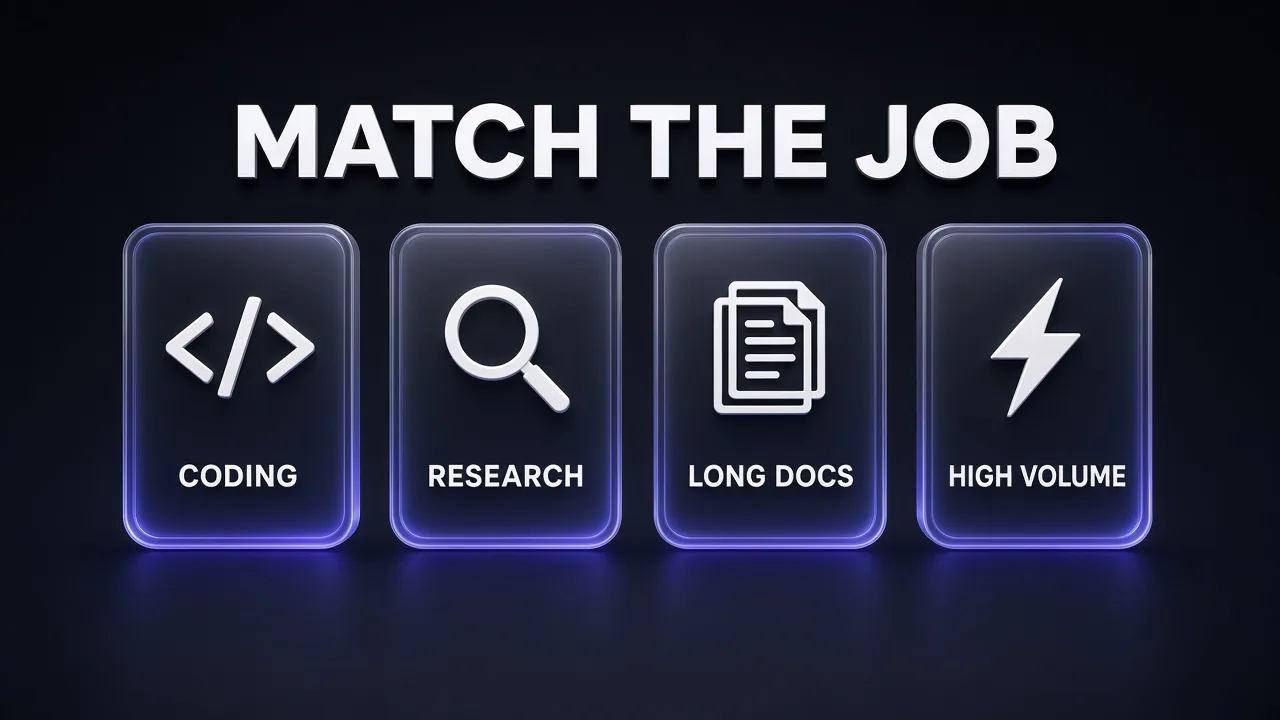
| Job | What we'd pick | Runner-up / budget pick | Why |
|---|---|---|---|
| Coding and agents | Claude Opus 5.5 | GPT-6.1 Sol / GLM-5.3 | Anthropic's own "start here" model for long-running agentic coding; 1M context at standard price |
| Hardest reasoning | Claude Fable 5.1 or GPT-6 Astra | Gemini 4 Argon | Both vendors' top tier at $10 / $50; Argon costs a fifth of that until Nov 30 |
| Long docs and RAG | Gemini 4 Argon | Claude Opus 5.5 / Gemini 3.8 Flash | Text, image, video, audio and PDF input, 1M context, outputs up to 1M tokens with long decode |
| Research and web | Gemini 4 Argon with Search grounding | Genspark Deep Research / Firecrawl | Grounding is built in: 5,000 free searches a month, then $14 per 1,000 |
| Writing and editing | GPT-6.1 Terra | Claude Sonnet 5.5 | OpenAI positions Terra for "clear, natural writing" at $1 / $5 |
| High volume and cheap | GPT-6 Luna | Claude Haiku 5.5 / GLM-5.3-Flash | $0.10 / $0.50 per million tokens, 1.05M context |
| Vision and multimodal | Gemini 3.8 Flash | GPT-6.1 Terra | Video, audio and PDF in at Flash prices; Terra for photos, drawings and screens |
| Image generation | GPT-Image-2.5 Sunburst | Nano Banana 2.1 / GLM-Image | Sunburst for precise edits; Nano Banana 2.1 at $0.0336 per 1K image |
| Video generation | Kling 4.0 | Wan 3 / Gemini Omni Flash | 30-second shots and 10 keyframes vs about $0.10 per second at 720p |
| Self-hosted / private | GLM-5.3 (open weights) | gpt-oss-120b | Weights you can run yourself; gpt-oss-120b fits on one H100 |
Two patterns stand out. First, the top tier of every lab now costs roughly the same, so the real choice sits one level down, where Opus 5.5, GPT-6.1 Sol and Gemini 4 Argon compete. Second, the cheapest tier has collapsed to the same price at two labs: GPT-6 Luna and Claude Haiku 5.5 both list $0.10 in and $0.50 out.
Coding and Agents: Claude Opus 5.5 First
My take: for code that has to compile and agents that run for an hour, start with Claude Opus 5.5. Anthropic's models overview says it plainly: "start with Claude Opus 5.5 for most workloads", and it describes Opus 5.5 as the model "for long-running agentic coding and knowledge work". It lists at $4 input and $20 output per million tokens, with cache hits at $0.20. The full 1M token context window comes at the standard rate, so a 900K-token repo dump costs the same per token as a short prompt. The full plan and token breakdown lives in our Claude Opus 5.5 pricing guide.
The runner-up is GPT-6.1 Sol. OpenAI calls it "near-Astra performance for complex work at a lower cost" and points it at "complex coding, computer use, and professional work". At $2 / $10 it's half the list price of Opus 5.5. The catch is OpenAI's long-context rule: once a prompt passes 272K input tokens, the whole request is billed at 2x input and 1.5x output, so Sol becomes $4 / $15. For big-repo work that gap with Opus 5.5 shrinks fast.
When the task is genuinely hard (multi-day refactors, research-grade reasoning), both labs sell a tier above. Anthropic recommends Claude Fable 5.1 "for demanding reasoning and long-horizon agentic work, or when your evals on Claude Opus 5.5 at higher effort still fall short". OpenAI's GPT-6 Astra is "our most capable model for the most demanding work". Both list at $10 in and $50 out. We compared the two head to head in GPT-6 Astra vs Claude Fable 5.1.
The budget pick is GLM-5.3 from Z.ai. It costs $1.40 in and $4.40 out per million tokens, has a 1M-token context window and 128K max output, and runs through OpenAI- and Anthropic-compatible endpoints, so most coding agents can point at it with a base-URL change. It's text-only and always reasons (effort low, high or max). If you go that way, start with our best GLM-5.3 coding prompts.
Pro tip: before you jump a tier, raise the effort setting on the model you already use. Opus 5.5 defaults to medium effort and GPT-6.1 Sol to medium reasoning. Turning effort up costs tokens, not a migration.
Long Documents and RAG: Gemini 4 Argon
For contracts, codebases, transcripts and research piles, the deciding factors are context size, input types and how the price behaves when the prompt gets huge. On all three, Gemini 4 Argon is the model we'd pick right now.
- Inputs: text, image, video, audio and PDF, according to Google's model page. Claude and OpenAI's current models take text and images only.
- Context: 1,048,576 tokens, unified for input and output.
- Output: 65,536 tokens by default, or up to 1,048,576 with long decode. No other model in this guide lists outputs that long.
- Price: $2 in and $10 out per million tokens through November 30, 2026, then $4 / $20 from December 1. Our Gemini 4 Argon pricing breakdown covers the switch.
Claude Opus 5.5 is the close runner-up. Its 1M window carries no long-context surcharge, which matters because the cheapest Claude model does have one: Haiku 5.5 jumps from $0.10 / $0.50 to $0.50 / $2.50 once a prompt passes 100,000 tokens. On the OpenAI side, the GPT-6 and GPT-6.1 models in this guide have a 1.05M window but a maximum input of 922,000 tokens, and prompts over 272K pay the 2x / 1.5x long-context rate. For cheap long-document passes, Gemini 3.8 Flash takes the same five input types with a 1,048,576-token input limit at $0.75 / $3.75 through December 31.
Honest answer: a giant window is not a retrieval strategy. Models still lose the thread in the middle of very long prompts, which we unpack in what context rot is. For anything you'll query more than once, chunk and retrieve instead, the way we lay out in how to build a RAG pipeline without hallucinating sources.
Research and Web: Grounded Models Plus Agents
Research has two halves: finding fresh sources and reasoning over them. A model alone only does the second half well.
For the first half, Gemini 4 Argon has Grounding with Google Search and URL context built in. Google gives 5,000 free search requests a month, shared across Gemini 3 and newer models, then charges $14 per 1,000. One user request can trigger several searches, and each one counts. On the paid tier Google states your prompts are not used to improve its products.
If you'd rather not wire it yourself, Genspark runs research as an agent. Deep Research is one of its Standard-mode agents, and the Plus plan costs $24.99 a month (or $19.99 a month billed annually) with 10,000 credits. The free plan gives 100 credits a day, which is enough to judge whether its reports suit your work.
When the job is pulling clean text from specific pages rather than searching, a scraper beats any model. Firecrawl turns pages into clean markdown your model can read, and its free plan includes 1,000 credits a month. We walk through that pipeline in Firecrawl + Claude.
Writing and Editing: GPT-6.1 Terra or Claude Sonnet 5.5
Writing doesn't need the smartest model. It needs one that's fast, sounds natural and is cheap enough to run ten drafts. OpenAI positions GPT-6.1 Terra exactly there: "a fast, efficient model for visual reasoning, precise computer use, and clear, natural writing", with use cases that include "draft and revise text". At $1 in and $5 out, ten drafts of a 2,000-word post cost cents. It also supports reasoning effort none, so quick rewrites don't burn thinking tokens.
Claude Sonnet 5.5 is our runner-up. Anthropic calls it "the best combination of speed and intelligence", rates its latency "Fast", and lists it at $2 / $10. It's the natural writing model if the rest of your stack already runs on Claude. For long-form pieces where structure matters more than tone, step up to Opus 5.5 rather than a top-tier model: Fable 5.1 and GPT-6 Astra cost 2.5x as much per token as Opus 5.5, and in our view that's rarely worth it for prose.
Whichever model you pick, the effort setting matters more for writing than people expect. High effort tends to over-plan short copy. Our guide on how to choose thinking level and effort has the settings we'd start with.
High-Volume and Cheap Tasks: GPT-6 Luna or Claude Haiku 5.5
Classification, extraction, routing, tagging, short summaries, subagent chores: jobs where you run thousands of calls and each one is easy. Here, price per token is the whole decision.
- GPT-6 Luna: $0.10 in, $0.50 out, $0.01 cached. OpenAI calls it "our most efficient model for focused, high-volume tasks". 1.05M context, and EU data residency on Standard, Fast, Flex and Batch.
- Claude Haiku 5.5: $0.10 in, $0.50 out for prompts up to 100,000 tokens. Anthropic aims it at "classification, extraction, and routing" and rates it the fastest Claude model.
- GLM-5.3-Flash: $0.15 in, $0.50 out, $0.03 cached, and it also comes as open weights.
- Gemini 3.5 Flash-Lite: $0.30 in, $2.50 out, built for "high-volume agentic tasks, translation, and simple data processing".
Between Luna and Haiku 5.5 the list price is a tie, so let the fine print decide. Haiku's price jumps 5x on prompts over 100K tokens; Luna's input price only doubles (output 1.5x) over 272K. Keep prompts short and either works. Send big documents and Luna stays cheaper.
Batch processing is the other lever. OpenAI, Anthropic and Google all price batch at half the standard rate, so overnight jobs on Luna cost $0.05 / $0.25. Add prompt caching for repeated system prompts, which we explain in Claude prompt caching explained.
Vision and Multimodal Input: Gemini 3.8 Flash
If your inputs include video, audio or scanned PDFs, the Gemini family is the only one of the big three that takes them natively in this lineup. OpenAI's GPT-6.1 Sol model page lists audio and video as unsupported, and Anthropic's overview lists text and image input for all current Claude models.
That makes Gemini 3.8 Flash our default for multimodal work: text, image, video, audio and PDF in, a 1,048,576-token input limit, search grounding and computer use, at $0.75 / $3.75 until the end of 2026 (then $1.50 / $7.50). Google calls it its "most intelligent Flash model". Step up to Argon when the reasoning is hard. Our rundown of what's new in Gemini 3.8 Flash covers the launch in more detail.
For still images and screens, GPT-6.1 Terra is the specialist. OpenAI's examples are concrete: matching product photos to catalogue entries, interpreting technical drawings and acting on application screens.
Image and Video Generation: Pick the Media Model Separately
Chat models don't make the pictures. Each lab sells separate media models, and the pricing works differently.
Images
GPT-Image-2.5 Sunburst is OpenAI's "most capable model for image generation and editing", recommended "for workflows where editing precision matters most". It's billed per token ($30 per million image-output tokens), and OpenAI doesn't publish a flat per-image price. Its sibling, GPT-Image-2.5 Flare, is the faster everyday option at the same token rates. Google's Nano Banana 2.1 is the easiest to budget: $0.0336 per 1K image, $0.0504 per 2K and $0.113 per 4K, with conversational editing and text rendering. Z.ai's GLM-Image lists $0.015 per image.
Video
Kling 4.0 is the pick when the shot itself is the product. Kuaishou launched it on 15 October 2026 with clips of 3 to 30 seconds in one pass, up to 10 keyframes and up to 15 references. The API opened on 28 October at $0.157 per second at 720p and $0.235 at 1080p. Alibaba's Wan 3 (Wan3.0) is the budget pick: 2 to 30 seconds, documents and web links as references, and a list price of $0.10 per second at 720p. Google's Gemini Omni Flash works out to about $0.10 per second of 720p video too. The full breakdown is in Kling 4.0 vs Wan 3, and the rest of the toolchain is in our AI video stack.
Self-Hosted and Private: GLM-5.3 and gpt-oss-120b
Sometimes the data can't leave your servers. Then the question isn't which API, but which weights.
- GLM-5.3: Z.ai published the weights on Hugging Face on 25 August 2026 under its own GLM-5.3 licence, with serving guides for vLLM, SGLang and Transformers. Z.ai calls it the most capable open-weights model for coding. Hugging Face lists it at roughly 753B parameters, so plan for a multi-GPU server, not a laptop.
- gpt-oss-120b: OpenAI's open-weight model under Apache 2.0. It fits on a single H100 (117B parameters, 5.1B active), supports configurable reasoning effort and fine-tuning, and has a 131,072-token context window. Smaller and older (knowledge cutoff June 2024), but far easier to run.
If you only need data controls rather than full self-hosting, the hosted APIs have options. Gemini's paid tier states prompts aren't used to improve Google's products (its free tier says they are). GPT-6 Luna supports EU data residency, and Claude offers US-only inference for a 1.1x price multiplier.
Cost Table: Per-Million-Token List Prices
All prices below are standard (non-batch) API list prices per million tokens, taken from each vendor's pricing page on October 31, 2026. They assume prompts under each model's long-context threshold.
| Model | Input | Output | Context | Long-prompt rule |
|---|---|---|---|---|
| Claude Fable 5.1 | $10.00 | $50.00 | 1M | Standard price across 1M |
| GPT-6 Astra | $10.00 | $50.00 | 1.05M | 2x input, 1.5x output over 272K |
| Claude Opus 5.5 | $4.00 | $20.00 | 1M | Standard price across 1M |
| Gemini 4 Argon (to Nov 30) | $2.00 | $10.00 | 1M | Rises to $4 / $20 on Dec 1 |
| GPT-6.1 Sol | $2.00 | $10.00 | 1.05M | 2x input, 1.5x output over 272K |
| Claude Sonnet 5.5 | $2.00 | $10.00 | 1M | Standard price across 1M |
| GLM-5.3 | $1.40 | $4.40 | 1M | Single list price |
| GPT-6.1 Terra | $1.00 | $5.00 | 1.05M | 2x input, 1.5x output over 272K |
| Gemini 3.8 Flash (to Dec 31) | $0.75 | $3.75 | 1M | Rises to $1.50 / $7.50 on Jan 1, 2027 |
| Gemini 3.5 Flash-Lite | $0.30 | $2.50 | Not checked | Single list price |
| GLM-5.3-Flash | $0.15 | $0.50 | Not checked | Single list price |
| Claude Haiku 5.5 | $0.10 | $0.50 | 1M | $0.50 / $2.50 over 100K |
| GPT-6 Luna | $0.10 | $0.50 | 1.05M | 2x input, 1.5x output over 272K |
Output tokens are where bills grow, because reasoning models think in output tokens. Here's the same list as output price alone.
Output price per million tokens
Standard API list price, short prompts
Source: OpenAI, Anthropic, Google Gemini API and Z.ai pricing pages, checked Oct 31, 2026
To make that concrete, take an illustrative month of 10 million input and 2 million output tokens, all short prompts (our arithmetic from list prices). GPT-6 Luna or Haiku 5.5 costs $2.00. GLM-5.3 costs $22.80. Gemini 4 Argon costs $40 in November and $80 from December. Opus 5.5 costs $80. GPT-6 Astra or Fable 5.1 costs $200. That's a 100x spread for the same token count, which is why routing easy work to a cheap model pays off so quickly.
How to Pick a Model in Three Questions
When a new task lands and you're not sure which model to send it to, ask three questions in this order: quality, cost, speed. Each one narrows the list, and you rarely need more than three.
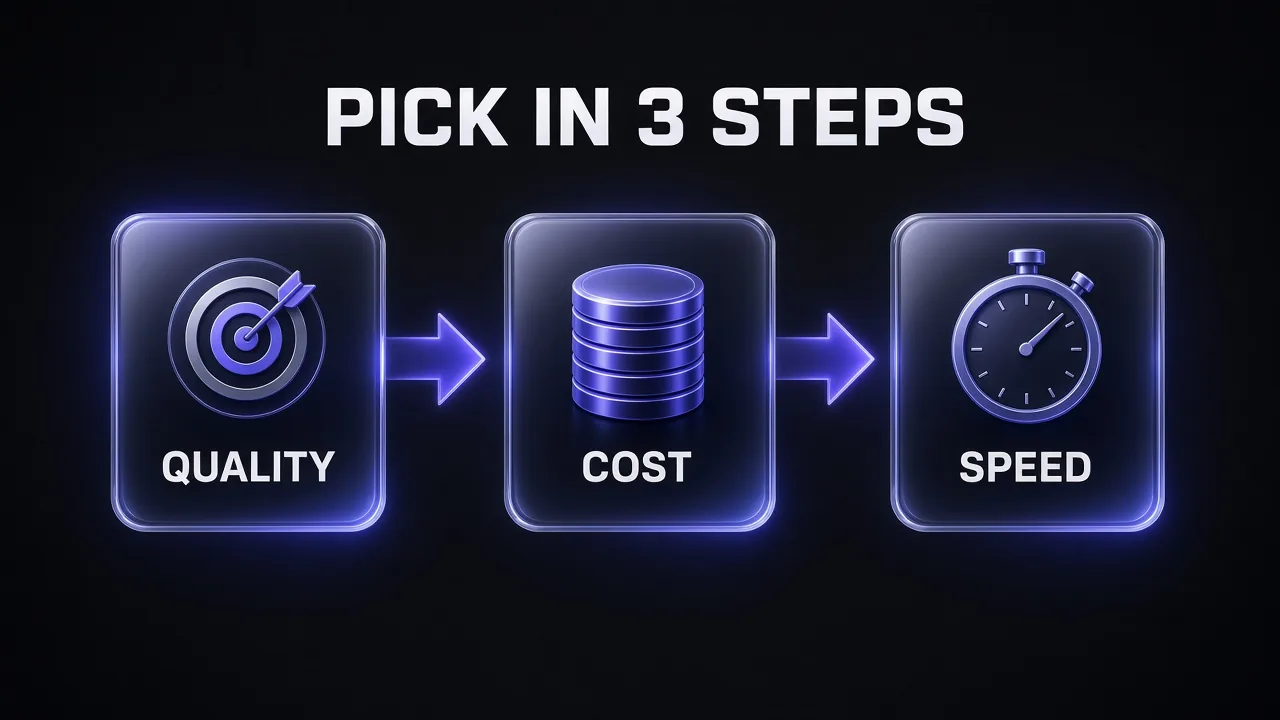
1. Quality: what's the cheapest tier that does the job?
Run your real task on a mid-tier model first (Opus 5.5, GPT-6.1 Sol or Gemini 4 Argon). Only step up to Fable 5.1 or GPT-6 Astra if the mid-tier fails at high effort. Only step down to Luna, Haiku 5.5 or a Flash model if the cheap one passes a handful of real examples.
2. Cost: what does a month of this job cost?
Estimate monthly tokens, then check two traps: long-context surcharges (OpenAI over 272K, Haiku 5.5 over 100K) and scheduled price changes (Argon on December 1, Gemini 3.8 Flash on January 1). Then apply batch (50% off at all three big labs) and caching.
3. Speed: does a human wait on the answer?
If a person is waiting, pick a model the vendor labels fast (Sonnet 5.5, Haiku 5.5, Terra, the Flash models) or a lower effort level. If nobody is waiting, use batch and the cheaper rate. Fast modes cost 2x at both OpenAI and Anthropic, so pay for them only when latency is the product.
Have an AI Pick Your Model
You are an AI cost and quality advisor. I will describe a recurring task. Help me choose a model tier.

Task: [describe the task in 2-3 sentences]
Volume: [calls per day] calls, average [input tokens] input and [output tokens] output tokens
Latency: [a person waits / runs in the background]
Inputs: [text only / images / PDFs / audio / video]
Data rules: [none / must stay in the EU / must be self-hosted]

Step 1: Classify the task as frontier, mid-tier or high-volume, and explain why in two sentences.
Step 2: List what would make a cheaper model fail at this task.
Step 3: Estimate monthly token volume and show the arithmetic.
Step 4: Recommend a primary model and a fallback, and list the 5 test cases I should run on both before deciding.
Do not quote prices from memory. Leave a [PRICE] placeholder for me to fill from the vendor's pricing page.
Common Mistakes When Choosing an AI Model
- Using the flagship for everything. Fable 5.1 and GPT-6 Astra list at 100x the price of Luna or Haiku 5.5. Most classification and extraction calls don't need them.
- Ignoring the long-context fine print. A 300K-token prompt to an OpenAI model is billed at the long-context rate for the whole request, and Haiku 5.5 changes price at 100K.
- Budgeting on promo prices. Gemini 4 Argon doubles on December 1, 2026, and Gemini 3.8 Flash doubles on January 1, 2027. Kling's and Wan's first-month and launch discounts end too.
- Sending video or audio to a text-and-image model. Check the input list first. Today only the Gemini models here take video, audio and PDFs directly.
- Treating vendor benchmarks as your benchmark. Every lab publishes tables where it wins something. Five of your own real tasks tell you more.
- Locking in one vendor. GLM-5.3 already speaks OpenAI- and Anthropic-compatible APIs, and most agent frameworks let you swap models per task. Keep the model a config value.
Verdict: Route by Job, Not by Brand
If you only take one model, take a mid-tier one: Claude Opus 5.5 for coding and agent work, or Gemini 4 Argon if your inputs are long, mixed-media or need live search. Add a cheap worker (GPT-6 Luna or Claude Haiku 5.5) for the high-volume tail, and you've covered most of what a small team does. Keep Fable 5.1 or GPT-6 Astra for the few tasks the mid-tier can't crack, and use GLM-5.3 when the budget is tight or the weights have to live on your own hardware.
For media, treat image and video as separate decisions: GPT-Image-2.5 Sunburst or Nano Banana 2.1 for images, Kling 4.0 or Wan 3 for video. And re-check prices before you commit. Two of the prices in this guide change within the next nine weeks.
FAQ
Keep Reading
- Gemini 4 Argon vs Claude Opus 5.5: the two mid-tier models in this matrix, compared in depth.
- What's new in GPT-6 Astra: a closer look at OpenAI's current flagship.
- Multi-agent workflows in Claude Code: how to route subtasks to cheaper models inside one agent.
Frequently Asked Questions
10 questions answered