The PromptsRush journal
AI ToolsClaude Opus 5.5: What's New, Specs & When to Use It
Claude Opus 5.5 explained from Anthropic's own docs: specs, the $4/$20 pricing and 60% cheaper cache, benchmarks, effort levels, the four breaking API changes from Opus 5, and when to pick it over Fable 5.1 or Sonnet 5.5.

Advertisement
Short version: Claude Opus 5.5 is the new default Claude model for coding and knowledge work, and the headline isn't a benchmark. It's the bill. Anthropic cut the per-token price by 20% ($4/$20 per million input/output tokens, down from $5/$25 on Opus 5), cut cache reads by 60%, and says the model uses fewer tokens per task, which nets out to about 40% lower cost on typical workloads. It also writes more clearly and generates output more than 30% faster than Opus 5.
The catch is for developers. Opus 5.5 ships with four breaking API changes, and the biggest one is that you can no longer turn thinking off. If you have production code on Opus 5, read the migration section before you swap the model ID. Everything here comes from Anthropic's model docs, launch post and pricing pages, checked on 17 October 2026. We haven't run our own benchmarks, so every score below is Anthropic's. If you want the head-to-head with Google's new flagship, read our Gemini 4 Argon vs Claude Opus 5.5 comparison.
Claude Opus 5.5 at a Glance
| Spec | Claude Opus 5.5 |
|---|---|
| Released | 22 September 2026 (first model in the Claude 5.5 family) |
| API model ID | claude-opus-5-5 (Bedrock: anthropic.claude-opus-5-5) |
| Context window | 1M tokens |
| Max output | 128K tokens; 300K on the Batch API (beta header) |
| Input / output | Text and images in, text out |
| Thinking | Adaptive thinking, always on (can't be disabled) |
| Default effort | medium (Opus 5 defaulted to high) |
| Knowledge cutoff | June 2026 |
| API price | $4 input / $20 output per million tokens |
| Where to get it | Claude API, Amazon Bedrock, Google Cloud, Microsoft Foundry, Claude Platform on AWS; Claude Pro, Max, Team and Enterprise |
| Retirement | Not sooner than 22 September 2027 |
Two rows deserve attention. The default effort dropped to medium, so a request that never sets effort now runs one level lower than it did on Opus 5. And the thinking row is new: on Opus 5 you could disable thinking at high effort or below, and on Opus 5.5 that request returns an error. The model still accepts only text and images, so for audio or video you still extract frames and transcripts first.
What's New in Claude Opus 5.5
It costs less per token and uses fewer tokens
Anthropic's pitch is efficiency. Input and output tokens are 20% cheaper than Opus 5, cache reads drop from $0.50 to $0.20 per million, and 5-minute cache writes drop from $6.25 to $5. Anthropic says the model also needs fewer tokens to finish the same task, and that the two together cut costs by about 40% at default settings on typical workloads. In one internal test, Opus 5.5 translated the HAProxy load balancer from C to Rust in 9.5 hours against 12 for Claude Fable 5.1, at 51% lower cost.
Output is more than 30% faster, and fast mode goes further
Standard Opus 5.5 generates output more than 30% faster than Opus 5, per Anthropic. If that isn't enough, fast mode runs the same model weights on a faster inference setup with up to 2.5x the output tokens per second, at $8/$40 per million tokens. On Opus 5.5 it no longer needs a beta header or an access request, and it works in Claude Code and on the Claude API. It speeds up output, not time to first token.
It writes like a colleague, not a report generator
The most common complaint about Opus 5 was long, hard-to-follow answers. Anthropic says Opus 5.5 puts the most important information first, uses less jargon and follows your writing rules more closely. Its launch post shows side-by-side examples where Opus 5.5 leads with the conclusion ("The extra drop is a bug in the billing refactor") before the details. For anyone who reads agent summaries all day, this may matter more than any benchmark.
Sharper vision on charts and screenshots
The docs say Opus 5.5 reads values off dense charts, diagrams and layout-heavy screenshots much more precisely without tools, so the prompt workarounds you built for earlier models (cropping, zooming, asking it to describe first) may no longer be needed. Anthropic reports 89.0% on its Chartography chart test with tools, against 83.4% for Opus 5.
New API features that ship with it
- Per-message effort (beta): change effort mid-conversation without losing the prompt cache.
- Compact on demand (beta): ask for a signed summary of the whole conversation and send it in place of the old turns.
- Tools defined inside a message (beta): add or change a tool mid-conversation without editing
toolsor breaking the cache. - Task budgets, mid-conversation system messages, Files API, PDF support and batch processing, plus prompt caching with a 512-token minimum.
If you design agents around long sessions, these features are the practical side of context engineering: keep the conversation append-only, change instructions through system messages, and compact when it gets long.
Stronger safeguards (and what they block)
Because Opus 5.5 is close to Claude Mythos 5.1 in biology and cybersecurity, Anthropic ships it with safeguards similar to Fable 5.1's. Routine bug fixing in your own code works, but most cybersecurity tasks are re-routed to Opus 4.8, and biology research needs Anthropic's Life Sciences Verification Program. A declined request returns HTTP 200 with stop_reason: "refusal", so production code should handle that case and fall back to another model.
Benchmarks: What Anthropic Reports
| Benchmark | Opus 5.5 | Fable 5.1 | Opus 5 | GPT-6 Astra* |
|---|---|---|---|---|
| Terminal-Bench 4.0 (agentic coding) | 66.4% | 55.8% | 52.3% | 57.9% |
| FrontierCode v1.1, main | 54.4% | 50.3% | 48.0% | 53.3% |
| CursorBench 4.0 | 57.8% | 51.8% | 46.6% | n/a |
| GDPval-AA v2.1 (knowledge work, Elo) | 1846 | 1735 | 1708 | 1542 |
| AutomationBench (business workflows) | 40.0% | 31.4% | 26.9% | 41.4% |
| Humanity's Last Exam, with tools | 67.7% | 65.6% | 63.6% | 57.2% |
| Terminal-Bench-Science 0.1 | 58.7% | 52.6% | 29.0% | 64.6% |
| OSWorld 2.1 (computer use, partial) | 81.8% | 80.7% | 74.0% | n/a |
Source: Anthropic launch post, 22 September 2026. Opus 5.5 at max effort unless noted (Terminal-Bench at xhigh). *GPT-6 Astra figures are as reported by OpenAI.
Honest answer: the table is strong, but read the footnotes. Anthropic itself says benchmark margins have become "a less reliable guide to real-world differences" at this level, and that the real gap to Fable 5.1 is narrower than the scores suggest. AutomationBench was run by Zapier with safeguard interventions counted as failures, which Anthropic says lowers the Opus 5.5 score. The more useful numbers are the default-effort ones: at medium effort, Opus 5.5 scores 54.6% on FrontierCode, above GPT-6 Astra's best (53.3%), at about a fifth of the cost per task. For an independent view, the Artificial Analysis results are in the Argon comparison linked above.
Claude Opus 5.5 Pricing: API and Plans
| Per 1M tokens (USD) | Opus 5.5 | Opus 5 | Change |
|---|---|---|---|
| Input | $4 | $5 | -20% |
| Output | $20 | $25 | -20% |
| Cache write (5 minutes) | $5 | $6.25 | -20% |
| Cache write (1 hour) | $8 | Not in launch table | |
| Cache read | $0.20 | $0.50 | -60% |
| Batch API | $2 / $10 | $2.50 / $12.50 | 50% off list |
| Fast mode | $8 / $40 | $10 / $50 | -20% |
A worked example: an agent step that reads 200,000 tokens and writes 20,000 costs $1.20 on Opus 5.5 ($0.80 input plus $0.40 output), against $1.50 on Opus 5. If 180,000 of those input tokens are cache reads, the Opus 5.5 call drops to about $0.52, against $0.69 on Opus 5. That is why Anthropic leans on the cache price: in long agent loops, cached reads are most of the input. The same call in fast mode costs $2.40, so save it for interactive sessions where speed is worth double. Our Claude Code API pricing guide shows how these rates add up across a real coding session.
On subscriptions, Opus 5.5 is included in Claude Pro ($17 a month billed annually, or $20 monthly), Max (from $100 a month, with 5x or 20x Pro's usage), Team and Enterprise. It is not on the free plan. With the launch, Anthropic also raised five-hour usage limits on Pro, Max, Team and seat-based Enterprise. Our Claude pricing explainer walks through each plan in more detail.
Pro tip: US-only inference costs 1.1x the normal token price on Opus 5.5. Only turn it on if your compliance rules actually require US data residency.
Effort Levels: The Control That Replaces "Thinking Off"
With adaptive thinking always on, the effort parameter is now the only control over how much Opus 5.5 reasons and what each request costs. It applies to every output token, including thinking, text and tool calls. You set it with output_config.effort, and Opus 5.5 supports all five levels:
| Effort | What it does | Use it for |
|---|---|---|
low | Most efficient; some capability loss | Subagents, classification, short tool tasks |
medium (default) | Balanced speed, cost and quality | Most agentic work and everyday coding |
high | Spends what the task needs | Hard bugs, complex reasoning |
xhigh | Extended capability for long-horizon work | Coding and agent runs over 30 minutes |
max | No limit on token spend | The hardest problems, when evals show a gain |
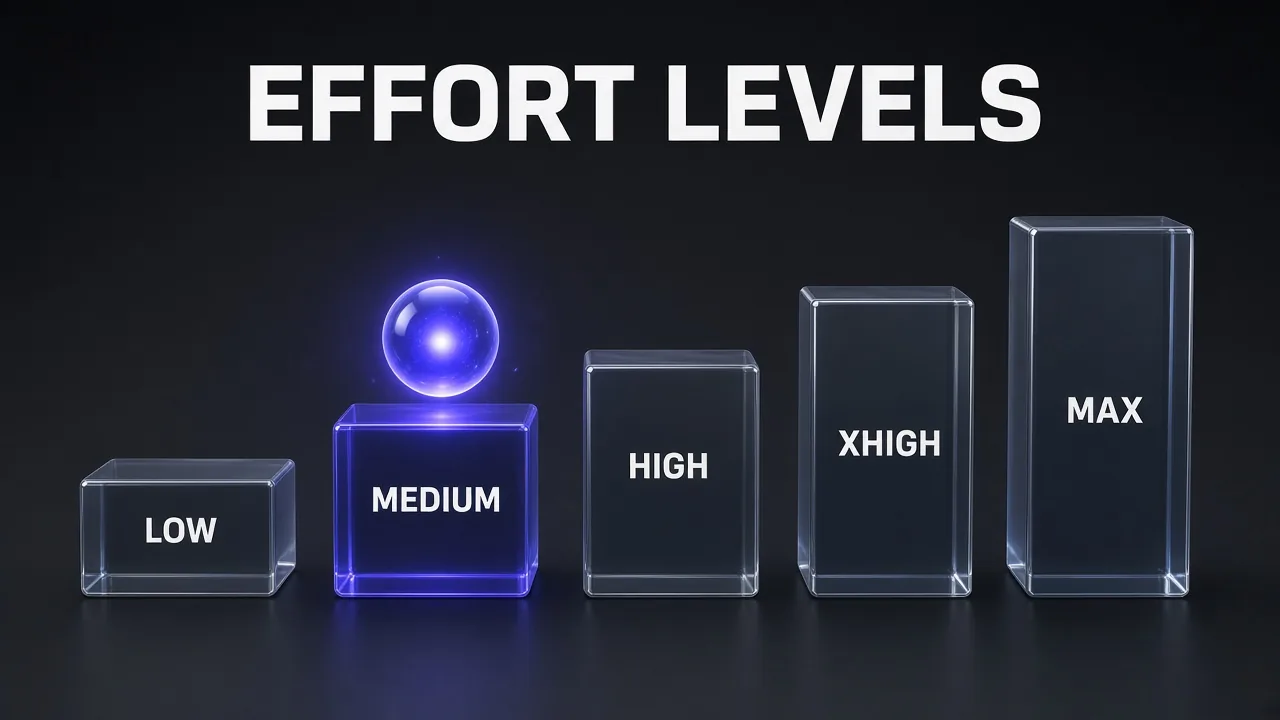
Two points from the docs are easy to miss. First, Opus 5.5 tends to think more per turn than Opus 5 at the same effort level, especially at xhigh and max, so don't copy your old settings. Run a fresh effort sweep on your own tasks. Second, set a large max_tokens at higher levels, because it caps thinking plus the reply. Customer reports in the launch post back up starting low: Deloitte says Opus 5.5 at its lowest effort caught 72% of known bugs in its code reviews, against 56% for Opus 5 at high effort.
Effort Sweep Plan
You are helping me choose an effort level for Claude Opus 5.5 on one workload.

Workload: [DESCRIBE THE TASK, e.g. "review pull requests in a TypeScript monorepo"]
Quality bar: [WHAT A PASS LOOKS LIKE]
Budget: [MAX COST PER TASK OR PER DAY]

Design a small effort sweep across low, medium, high and xhigh:
1. Pick 10 representative test cases from my description and say what each one checks.
2. Define a pass/fail rubric I can apply without judgment calls.
3. List what to log per run: pass/fail, output tokens, latency, cost.
4. Tell me how to pick the cheapest level that meets the quality bar, and when a result justifies trying max.
Keep it to one page.
Breaking Changes If You're Moving From Opus 5
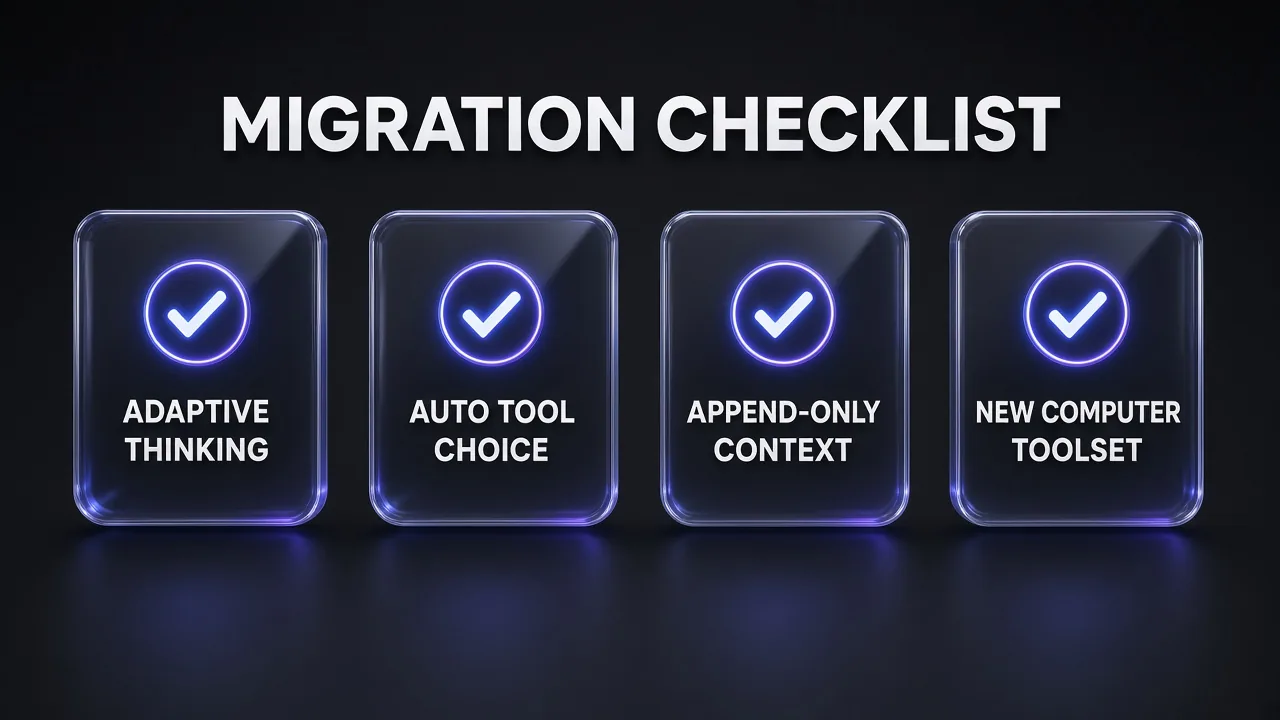
Swapping claude-opus-5 for claude-opus-5-5 is a one-line change, but four request patterns that worked on Opus 5 now fail with a 400 error:
- Thinking can't be disabled.
thinking: {"type": "disabled"}and manualbudget_tokensboth error. Omit the field or send{"type": "adaptive"}, and lower effort wherever you used to switch thinking off. - No forced tool use.
tool_choiceofanyor a named tool errors. Keepauto, use strict tool use or structured outputs for schema-valid JSON, and say in the prompt when a tool applies. - Thinking blocks are tied to the model and conversation. For accounts created on or after 31 August 2026, replaying a thinking block after you've edited the system prompt, tools or an earlier message returns an error. Keep conversations append-only.
- Old computer use tool rejected. On the Claude API and Google Cloud,
computer_20251124errors; move to thecomputer_toolset_20260801toolset. Bedrock still accepts the old tool.
There is also one quiet change that won't throw an error: the short notes Opus 5.5 writes between tool calls now arrive as thinking blocks, which are empty at the default display: "omitted". If your app streams those notes to users as progress updates, it will simply go quiet until you set thinking.display. Select content blocks by type, not by position.
Opus 5.5 Migration Audit
Audit this code for a migration from claude-opus-5 to claude-opus-5-5.

[PASTE THE FILES THAT BUILD OR SEND CLAUDE API REQUESTS]

Check for, and list with file and line:
1. thinking set to "disabled" or "enabled" with budget_tokens (must become adaptive or be removed)
2. tool_choice of "any" or a named tool (must become "auto" plus strict tool use or structured outputs)
3. any edit to the system prompt, tools or earlier messages mid-conversation (must become append-only)
4. the computer_20251124 tool (must move to computer_toolset_20260801 outside Bedrock)
5. code that reads content blocks by position instead of by type
6. requests that omit effort (default is now medium, not high)
For each finding, show the before and after code. End with a short test plan.
Opus 5.5 vs Fable 5.1 vs Sonnet 5.5: Which Claude Model to Pick
| Claude Fable 5.1 | Claude Opus 5.5 | Claude Sonnet 5.5 | |
|---|---|---|---|
| Anthropic's description | Demanding reasoning and long-horizon agentic work | Long-running agentic coding and knowledge work | Best combination of speed and intelligence |
| Price per 1M tokens | $10 / $50 | $4 / $20 | $2 / $10 |
| Latency | Slower | Moderate | Fast |
| Default effort | high | medium | high |
| Context / max output | 1M / 128K | 1M / 128K | 1M / 128K |
Anthropic's own advice is to start with Opus 5.5 for most workloads and move up to Fable 5.1 only when your evals on Opus 5.5 at higher effort still fall short. Given that Opus 5.5 beat Fable 5.1 on every coding row in Anthropic's table at less than half the token price, that's a reasonable default. Sonnet 5.5 at half Opus 5.5's price is the one to test for high-volume work where speed matters more than the last few points. If you are weighing OpenAI's flagship instead, our GPT-6 Astra explainer covers its pricing and its 272K repricing threshold.
When to Use Claude Opus 5.5 (and When Not To)
Use it for
- Long agentic coding: codebase-wide migrations, audits and refactors. Anthropic cites a tester who audited and fixed a 200,000-line codebase in under three hours, where Opus 5 took over 20 hours.
- Research and reports where invented figures are unacceptable: in Anthropic's internal test, 16 of 18 Opus 5.5 reports cleared a bar where any invented figure or quote failed, and neither Fable 5.1 nor Opus 5 cleared it once.
- Professional deliverables: spreadsheets, slides and docs, with shorter, better-structured output.
- Computer use and dense visuals: it posts the top OSWorld 2.1 score in Anthropic's table and reads charts more accurately.
Research agents are only as good as the pages they read. Feeding Opus 5.5 clean markdown instead of raw HTML cuts input tokens and gives it less noise to misread.
Skip it for
- Audio and video input: it only takes text and images. Our guide to editing videos with Claude shows the frame-and-transcript workaround.
- Security research: most cybersecurity tasks get re-routed to Opus 4.8 unless you're in Anthropic's Cyber Verification Program.
- Cheap bulk work: classification, extraction and routing belong on Haiku 5.5 or Sonnet 5.5, or on a budget open-weight model. If price per token is the deciding factor, our GLM-5.3 vs Opus 5 coding comparison shows where a cheaper model holds up.
Pro tip: Opus 5.5's default is already medium effort. Before raising it, try making the task smaller: a tighter brief at medium usually beats a vague brief at xhigh, and costs a fraction as much.
Lead-With-the-Answer Brief
Act as my senior engineer on this task. Work to these writing rules:
- Put the answer or decision in the first sentence.
- Then give at most 5 bullet points of evidence, each with a file, line, command output or source.
- Flag anything you could not verify as "unverified" instead of guessing.
- No preamble, no restating my question, no closing summary.

Task: [DESCRIBE THE BUG, REVIEW, OR RESEARCH QUESTION]
Context: [PASTE CODE, LOGS, OR DOCUMENTS]
Done means: [WHAT A FINISHED ANSWER LOOKS LIKE]
Our Verdict on Claude Opus 5.5
My take: Opus 5.5 is the easiest Claude upgrade to justify in a while. Cheaper tokens, a much cheaper cache, fewer tokens per task and clearer writing all point the same way, and the coding scores in Anthropic's table beat both Opus 5 and Fable 5.1. For chat and Claude Code users on Pro or Max, there's nothing to decide; it's the better model and your limits went up.
For API users, the decision is about migration effort, not quality. Budget an afternoon to remove disabled thinking and forced tool choice, make your conversations append-only, check your progress-update streaming, and run an effort sweep starting at medium. Do that, and Opus 5.5 should cost you less than Opus 5 for the same work. When you're ready to put it to work, our Claude Opus 5 prompt collection carries over well, since the writing-rule and checklist prompts suit Opus 5.5's style.
Frequently Asked Questions
9 questions answered