The PromptsRush journal
AI ToolsKimi K3.1 Pro: Open Weights, 1M Context & How It Compares
Kimi K3.1 Pro is Moonshot AI's new flagship: near-Opus 5.5 scores on agentic coding, a 1M-token context window and $2/$10 API pricing. Here's what changed from Kimi K3, the benchmarks, the open-weights status and when to pick it over Opus, Astra or Terra.

Advertisement
Short version: Kimi K3.1 Pro is the closest an open-weight model has come to Claude Opus 5.5 on agentic coding, and it costs half as much through the API. Moonshot AI's new flagship scores 65.7% on Terminal-Bench 4.0 against Opus 5.5's 66.4%, keeps a one-million-token context window, and lists at $2 per million input tokens and $10 per million output tokens. The catch is the word "open": Moonshot promised the full weights by 4 November 2026, and at the time of writing they still weren't on its Hugging Face page.
K3.1 Pro launched on 23 October 2026 across Kimi.ai, the Kimi apps, Kimi Work, Kimi Code and the Kimi API. Everything below comes from Moonshot's launch post, API docs and pricing page, plus Anthropic's and OpenAI's own pricing pages, all checked on 4 November 2026. We haven't run our own benchmarks, so every score here is Moonshot's. If you're coming from the older model, our Kimi K3 vs Claude Fable 5 comparison covers where the K3 base started.
Kimi K3.1 Pro at a Glance
| Spec | Kimi K3.1 Pro |
|---|---|
| Released | 23 October 2026 (apps and API) |
| Maker | Moonshot AI |
| API model IDs | kimi-k3.1-pro and kimi-k3.1-pro-highspeed |
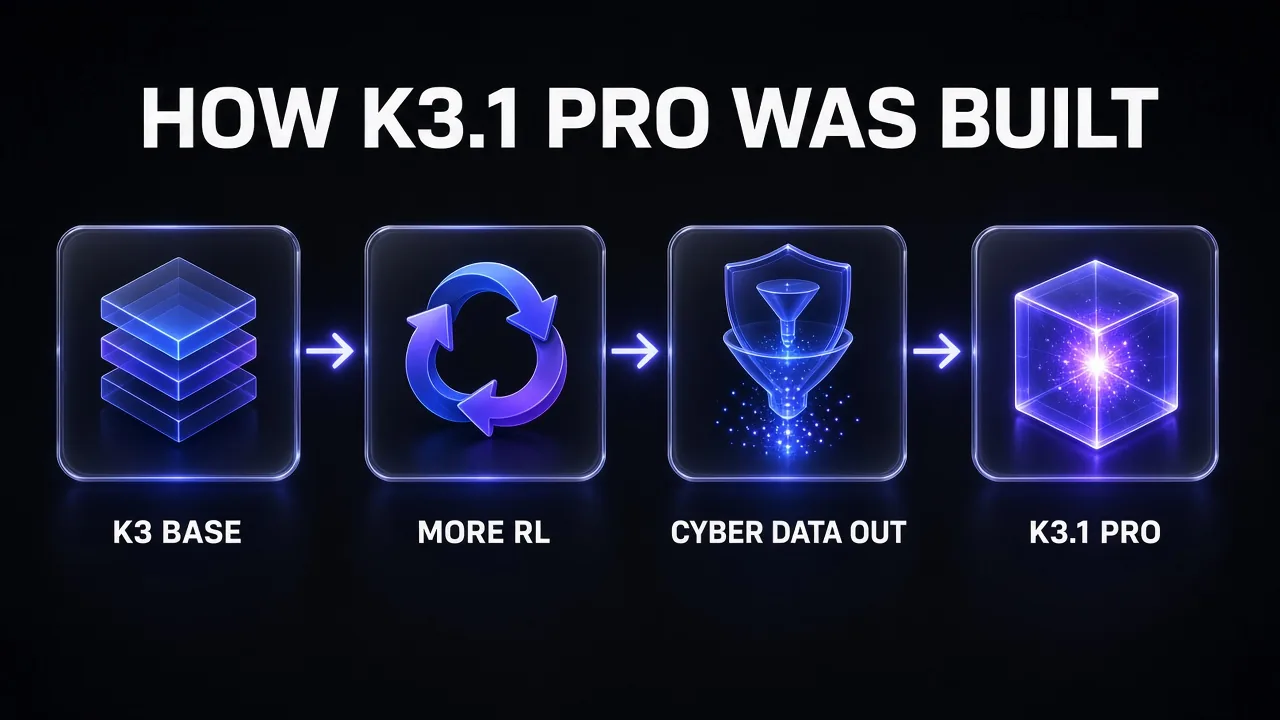
| What it is | A post-trained version of Kimi K3 with much more reinforcement learning compute |
| Base model size | Kimi K3: 2.8T total parameters, 104B active (Mixture-of-Experts, 16 of 896 experts) |
| Context window | 1,048,576 tokens |
| Input | Text, images and video |
| Reasoning effort | Thinking always on; low, high, max (default max) |
| API price | $2 input / $0.20 cached input / $10 output per million tokens |
| Open weights | Promised "by Nov 4, 2026"; licence not yet announced |
Two things in that table deserve a second look. K3.1 Pro is cheaper than the K3 it replaces ($3 in and $15 out), so there's no reason to stay on the old model for cost. And the default reasoning effort is max, which is great for quality and bad for latency, so most production calls will want an explicit setting.
What's New in Kimi K3.1 Pro
Moonshot didn't change the architecture. K3.1 Pro is Kimi K3 with a far bigger post-training run: large-scale reinforcement learning across "hundreds of downstream domains", with the RL framework, long-context inference, sandboxes and rollout scheduling rebuilt so extra compute gave steady gains. The result is improvement everywhere rather than one headline skill.
Long-horizon coding
This is the main pitch. On Moonshot's internal Kimi Code Bench 3.0 Long-horizon, K3.1 Pro scores 61.2% against K3's 55.95%. The launch post also describes an internal run where the model built a human walking simulator over 167 missions and 420 reviews, and found 36 errors in its own shoulder-muscle calculations instead of endlessly tweaking a reward. That's an anecdote, not a benchmark, but it's the behaviour you want from a coding agent that runs for hours.
3D, games and front-end polish
Moonshot leans hard on visual output. K3.1 Pro scores 92.7% on BenchCAD with tools, which rebuilds 3D objects from multi-view renders by writing CAD code. That's behind Opus 5.5 (96.2%) and GPT-6 Astra (95.9%) but close. It writes and runs scripts for Blender and CAD tools directly, and works with Unity, Unreal Engine and Godot. A new 3D Make feature on kimi.ai lets you preview, edit and export those models for 3D printing.
Finance and factual accuracy
K3.1 Pro posts 64.4 on OfficeQA Pro v2, the top score in Moonshot's table, and improves on K3 by 7.2 points in financial modelling and 11.6 points in financial research on internal tests. The bigger number is hallucination: on Moonshot's deliberately hard Kimi Hallu Bench, the claim-level hallucination rate fell from 23.4% for K3 to 8.3%. Moonshot itself warns that this is a stress test and not a daily error rate, so treat it as a direction, not a guarantee. If you're grounding answers in documents, the fixes in our guide to building a RAG pipeline without hallucinated sources still apply.
Deliberately weaker hacking skills
The unusual part. Moonshot says it found cyber content hidden in its general training data and removed it from both mid-training and RL for the open-weight release. On its internal exploit benchmark, the same pipeline without that removal solved 90.5% of tasks; the shipped K3.1 Pro solves 81.0%. Moonshot's stated rule is not to release open weights that push the absolute frontier of offensive cyber capability.
Kimi K3.1 Pro Benchmarks vs Opus 5.5, GPT-6 Astra and Fable 5.1
Moonshot published a 14-benchmark grid. Every model ran at maximum thinking effort, and Moonshot notes that Claude results may include fallbacks and GPT results may include cyber guardrails, so small gaps aren't meaningful. Here are the ones that matter most for builders.
| Benchmark | Kimi K3.1 Pro | Claude Opus 5.5 | GPT-6 Astra | Claude Fable 5.1 |
|---|---|---|---|---|
| Terminal-Bench 4.0 | 65.7 | 66.4 | 58.2 | 57.9 |
| SWE Marathon | 51.7 | 46.3 | 42.5 | 45.6 |
| Kimi Code Bench 3.0 Long-horizon | 61.2 | 58.5 | 66.5 | 58.8 |
| Terminal-Bench Science 0.1 | 38.1 | 63.3 | 68.1 | 40.0 |
| Agents' Last Exam | 43.2 | 42.6 | 32.8 | n/a |
| OSWorld V2.1 | 79.6 | 81.8 | 75.8 | 80.7 |
| Humanity's Last Exam (full, with tools) | 70.0 | 67.7 | 57.2 | 65.6 |
| OfficeQA Pro v2 | 64.4 | 62.2 | 54.4 | 54.5 |
| BenchCAD (with tools) | 92.7 | 96.2 | 95.9 | 92.6 |
Honest answer: K3.1 Pro trades blows with the best closed models on agentic coding and office work, and clearly trails on scientific terminal tasks, where it scores 38.1 against Astra's 68.1. If your agents mostly ship code, browse and fill documents, the gap to Opus 5.5 is small. If they run scientific computing pipelines, it isn't.
Terminal-Bench 4.0 scores
Agentic terminal coding, maximum effort, higher is better
Source: Moonshot AI, Kimi K3.1 Pro launch post (Oct 2026), scores sourced from tbench.ai and vendor posts
The cost side is where K3.1 Pro looks strongest. Moonshot's Terminal-Bench chart, built on tbench.ai data, puts K3.1 Pro at max effort around $5 per task, against roughly $14 for Opus 5.5 at a similar score and about $10 for GPT-6 Astra at max effort with a lower score. Those are vendor-chart readings, not our measurements, but the direction matches the list prices below. For a wider view of where each model fits, see our AI model decision matrix.
Open Weights: What's Actually Released
This is the part to read carefully before you plan a self-hosted deployment. Moonshot's launch post says "Full model weights will be released by Nov 4, 2026." When we checked Moonshot's Hugging Face organisation on the evening of 4 November (IST), the newest repository was still Kimi K3, last updated on 2 September. The deadline didn't specify a time zone, so the weights may land later on the 4th, US time. Moonshot also hasn't named a licence for K3.1 Pro yet.
What we can say is how Kimi K3 itself was released, since K3.1 Pro is a post-trained K3:
- Size: 2.8T total parameters with 104B active per token, so serving needs a multi-GPU cluster, not a workstation.
- Precision: trained with MXFP4 weights and MXFP8 activations from the fine-tuning stage onward, which keeps the download and memory footprint smaller than the parameter count suggests.
- Serving: Moonshot published recipes for vLLM and SGLang.
- Licence: the Kimi K3 License is permissive for most teams. Companies running a model-as-a-service business with more than $20 million in revenue over 12 months need a separate agreement, and products with over 100 million monthly users or $20 million in monthly revenue must display "Kimi K3". Internal use is exempt.
We expect K3.1 Pro to follow the same pattern, but that's our expectation, not Moonshot's announcement. Check the licence file when the repository appears before you build a commercial service on it.
Pro tip: Open weights matter most for data residency and fine-tuning. If you only want low prices, the API already gives you that today, with Zero Data Retention available for API customers.
Kimi K3.1 Pro Pricing and API Access
K3.1 Pro is pay-as-you-go on the Kimi API Platform. It's a flagship model, so it unlocks after your first top-up (minimum $1), and your cumulative top-up sets your rate-limit tier. Our older Kimi AI pricing guide covers the consumer membership side.
| Model | Input | Cached input | Output | 5-min cache write | 1-hour cache write |
|---|---|---|---|---|---|
kimi-k3.1-pro | $2.00 | $0.20 | $10.00 | $2.00 | $4.00 |
kimi-k3.1-pro-highspeed | $4.00 | $0.20 | $20.00 | $4.00 | $8.00 |
kimi-k3 | $3.00 | $0.30 | $15.00 | $3.00 | $6.00 |
All prices are per million tokens. Three billing details are easy to miss:
- Caching is automatic. Repeated prompt prefixes are cached with a five-minute default lifetime, and cached input costs 10% of the base rate. The same prefix tricks from our Claude prompt caching guide work here.
- Batch is 40% off.
kimi-k3.1-proandkimi-k3support batch jobs at 60% of the standard price. - Highspeed doubles the price. It runs two to three times faster than standard K3.1 Pro at exactly twice the input and output cost.
The API is OpenAI-compatible, so the official OpenAI SDK works with base_url set to https://api.moonshot.ai/v1. Moonshot also documents a Responses API route for running K3.1 Pro inside Codex. In Kimi Code, pick it with the /model command.
How Kimi K3.1 Pro's Price Compares
Here's the list-price comparison against the models people actually weigh it against, from each vendor's own pricing page on 4 November.
Standard API price per million tokens
List prices, standard tier, prompts under 272K tokens
- Input
- Output
Source: Moonshot, Anthropic and OpenAI API pricing pages, checked 4 Nov 2026
To make that concrete, take an agent workload of 100 requests, each with 200K input tokens and 10K output tokens, with no caching. That's 20 million input and 1 million output tokens in total:
| Model | Cost for the workload |
|---|---|
| GPT-6.1 Terra | $25 |
| Kimi K3.1 Pro (batch) | $30 |
| Kimi K3.1 Pro | $50 |
| Kimi K3 | $75 |
| Claude Opus 5.5 | $100 |
| Kimi K3.1 Pro Highspeed | $100 |
| GPT-6 Astra | $250 |
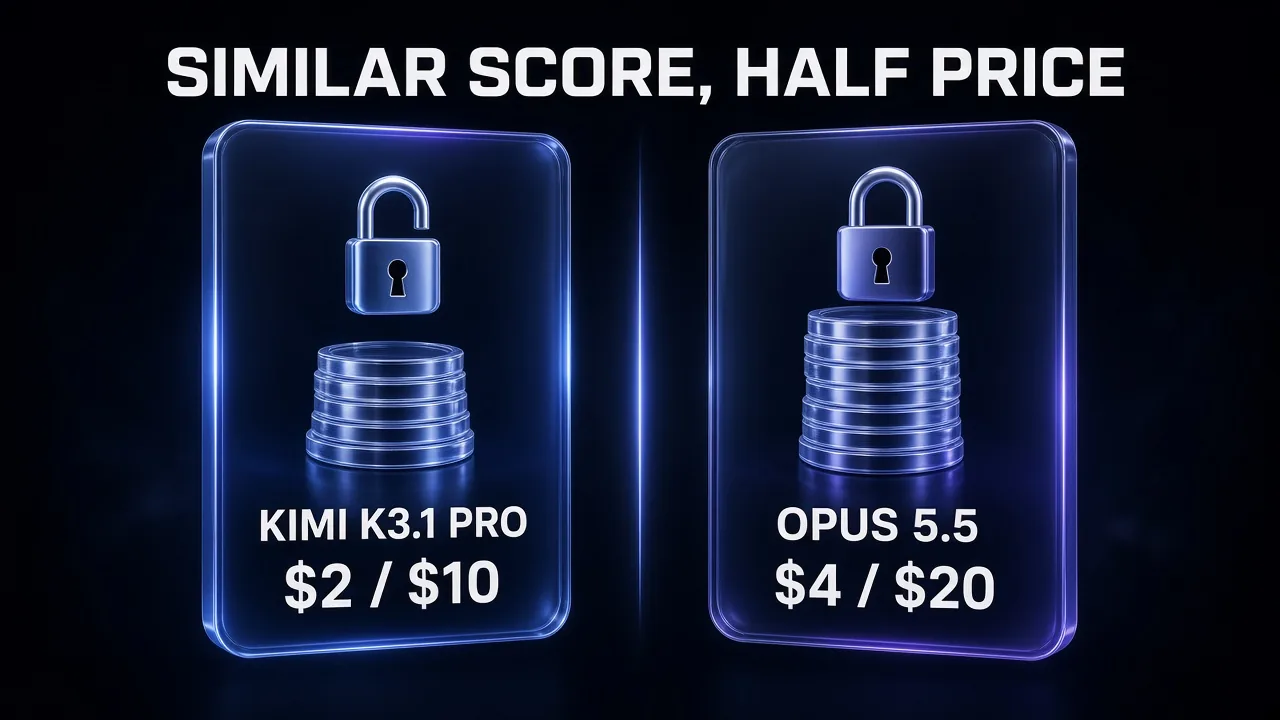
My take: K3.1 Pro sits in a useful middle slot. It costs twice what GPT-6.1 Terra's pricing works out to, but it scores far higher on agentic coding than OpenAI's efficient model is built for. Against Opus 5.5 it's half the price for near-identical Terminal-Bench numbers. Note that Terra's rate doubles on input above 272K tokens, so very long single prompts narrow that gap; our GPT-6.1 Terra explainer covers where that surcharge bites.
How to Use Kimi K3.1 Pro Well
Three settings decide whether K3.1 Pro feels fast and cheap or slow and expensive.
Set reasoning effort explicitly
Thinking is always on, and the default is max. Use low for extraction, classification and quick edits, high for normal coding, and keep max for long agent runs and hard debugging. Moonshot's own chart shows the high setting costing less per task with a clearly lower score, so the trade-off is real. Our guide on choosing thinking levels and effort for real workloads explains how to test this on your own tasks.
Send back the whole assistant message
For multi-turn chats and tool calls, Moonshot's docs say to append the complete assistant message to the next request, not just its content. Streaming returns reasoning_content and the final content separately, so log both while debugging and parse only content.
Don't stuff the full million tokens
A 1M context window is a ceiling, not a target. Long agent sessions still degrade as junk piles up, which we cover in what context rot is and how to fix it. Keep tool outputs trimmed, let caching handle stable prefixes, and start fresh sessions for new tasks.
Open-Weight Model Evaluation Brief
You are evaluating Kimi K3.1 Pro for my team.

Context: we build [PRODUCT TYPE] and our current model is [CURRENT MODEL]. Our main workloads are [WORKLOAD 1], [WORKLOAD 2] and [WORKLOAD 3]. Monthly volume is about [INPUT TOKENS] input and [OUTPUT TOKENS] output tokens.

1. Check Moonshot's official Kimi K3.1 Pro launch post, API pricing page and Hugging Face page today. Report the current API prices, whether the open weights and licence are published, and the release date of each.
2. For each of our workloads, name the most relevant public benchmark Moonshot reports and compare K3.1 Pro with our current model. Flag any score that is vendor-reported only.
3. Estimate our monthly bill on K3.1 Pro standard, K3.1 Pro batch and our current model, showing the arithmetic.
4. List the risks of switching: licence terms, data residency, rate limits and anything still unannounced.
5. Finish with a recommendation: switch, run a pilot, or wait, plus the one test we should run first.

Cite a source URL for every fact. If something can't be verified, say so instead of guessing.
Who Should Use Kimi K3.1 Pro (and Who Shouldn't)
Good fit:
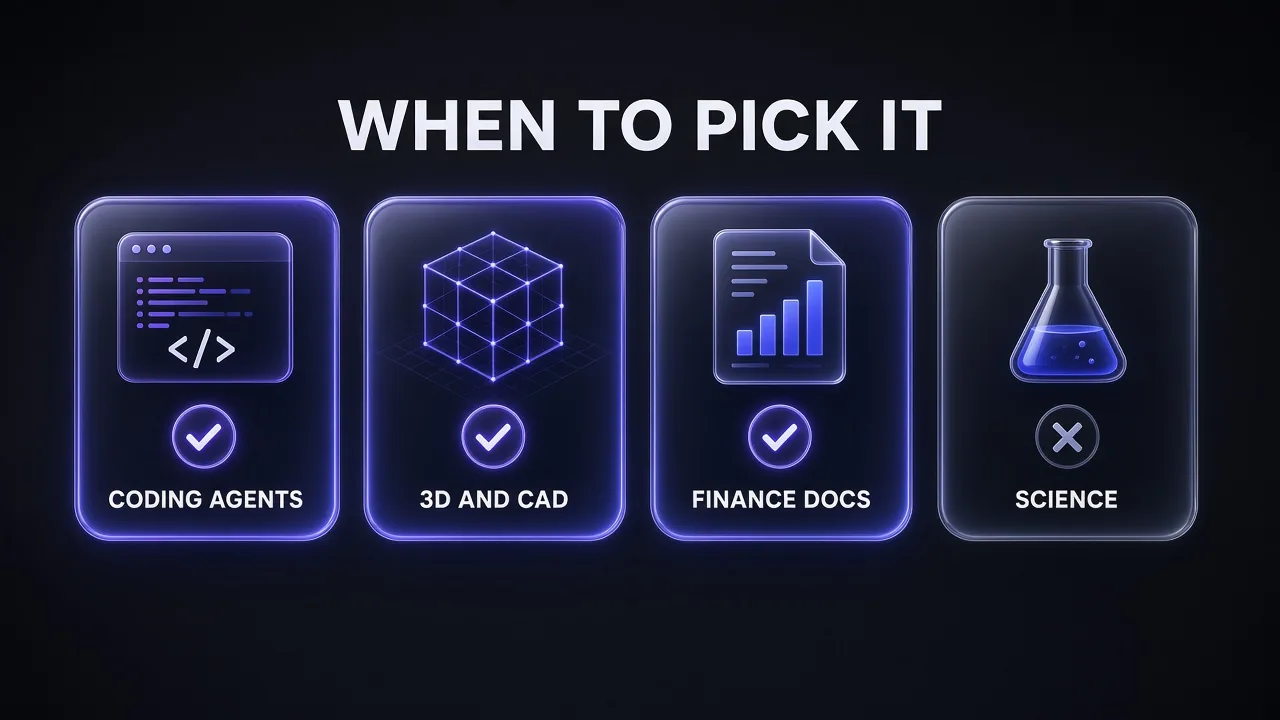
- Teams running long coding agents who want near-Opus results at half the token price.
- Builders doing 3D, CAD, game or front-end work, where Moonshot invested heavily.
- Finance and document-heavy workflows, given the OfficeQA Pro score and the lower hallucination rate.
- Anyone who needs a self-hostable frontier model later, once the weights and licence are out.
Look elsewhere if:
- Your agents do scientific computing; Opus 5.5 and GPT-6 Astra lead that benchmark by more than 25 points. Our Claude Opus 5.5 overview covers the stronger option.
- You need the cheapest model for simple computer-use or writing jobs, where GPT-6.1 Terra costs half as much.
- Your compliance team needs the weights and licence in hand today. Wait for the repository.
- You want a cheaper open alternative for everyday coding; GLM-5.3 is the other open model in Moonshot's own table, and our GLM-5.3 vs Opus 5 coding test shows where it holds up.
Our Verdict on Kimi K3.1 Pro
Kimi K3.1 Pro is the most capable model with a credible open-weights promise right now, and the API alone justifies a test. On Moonshot's numbers it matches Claude Opus 5.5 on Terminal-Bench, beats it on SWE Marathon and costs half as much per token, though it falls well behind on scientific terminal work. The open-weight story is still a promise as of 4 November; check Moonshot's Hugging Face page and the licence before you bet a deployment on it. If you're paying Opus prices for coding agents, run your own eval on K3.1 Pro at high and max effort this week.
Frequently Asked Questions
10 questions answered