The PromptsRush blog
AI ToolsGemini 4 Neon, Carbon, Hydrogen & Argon: Features, Pricing & Which to Use
Google's four Gemini 4 models compared from its own docs and model cards: what Hydrogen, Neon, Carbon and Argon each do, thinking levels, benchmarks, every API price including the 1 December rise, Gemini app and Antigravity access, and which to use.
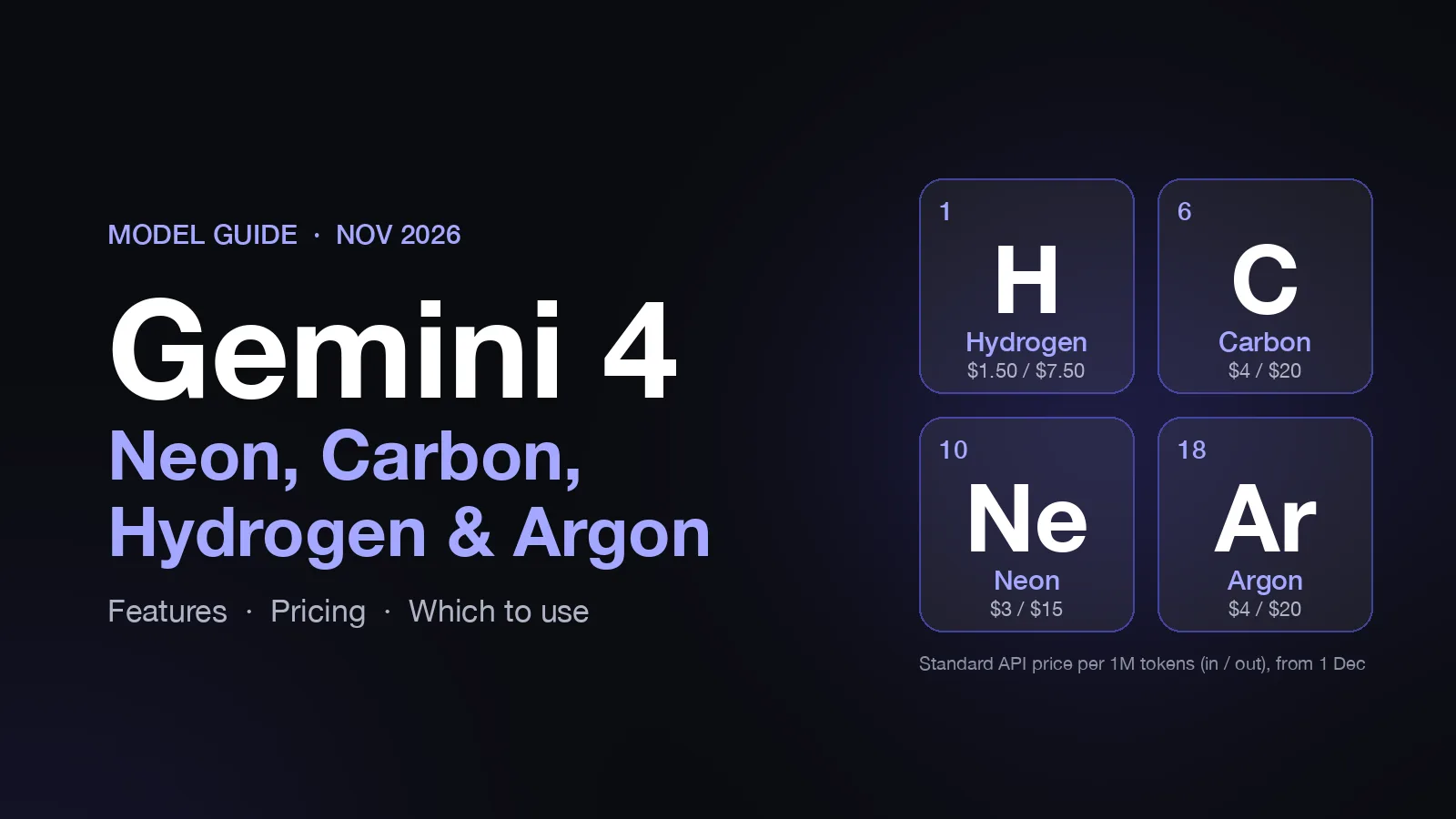
Google shipped four Gemini 4 models in just over five weeks. Argon arrived on 13 October, Carbon reached the API on 10 November, Hydrogen followed on 12 November and Neon on 18 November. All four share one API design, a 1M-token context window and the same tools, so the real differences come down to how hard each one thinks, how fast it answers, what it costs and where you can use it.
Here is where each lands. Hydrogen ($1.50 / $7.50 per million tokens, with a free API tier) is Google's new default for everyday coding and agents. Neon ($3 / $15) is the frontier-level middle model that finishes faster than Carbon. Carbon is the deepest thinker, built for long background runs and security work, and its price doubles to $4 / $20 on 1 December. Argon, the model that started the generation, now costs the same as Carbon and no longer appears in Google's own "Choosing a model" guide.
We went through Google's model pages, launch posts and DeepMind model cards for all four. Below you'll find what each model does, the benchmarks Google publishes (including the rows where its own tables show it losing), every price tier, where you can use each model and which one fits which job. For the long-decode and thinking-level mechanics in more depth, our Gemini 4 Argon explainer still applies to the whole family.
Gemini 4 at a Glance
| Hydrogen | Neon | Carbon | Argon | |
|---|---|---|---|---|
| API release | 12 Nov 2026 | 18 Nov 2026 | 10 Nov 2026 | 13 Oct 2026 |
| Google's pitch | Fast everyday coding and agents | Frontier-level, faster end to end | Strongest reasoning, long-horizon work | Efficient frontier reasoning |
| Speed (Google's label) | Fast | Moderate | Deliberate | Faster than Carbon |
| Thinking levels | low, medium, high, xhigh | low, medium, high, xhigh | low, medium, high | low, medium, high |
| API price (in / out, per 1M) | $1.50 / $7.50 | $3 / $15 | $2 / $10 to 30 Nov, then $4 / $20 | $2 / $10 to 30 Nov, then $4 / $20 |
| Free API tier | Yes | No | No | No |
| Gemini app | Everyone (free users via auto model selection) | Google AI Pro and Ultra | Google AI Ultra | Pro and Ultra at launch |
| Context / output | 1,048,576 tokens shared by input, thinking and output; 64K per response by default, up to 1M with long decode | |||
Bold thinking levels are the defaults. All four take text, images, video, audio and PDFs, return text only, and share a March 2026 knowledge cutoff.
How the Four Gemini 4 Models Fit Together
The lineage explains most of the behaviour. According to DeepMind's model cards, Argon is the base: a new large sparse mixture-of-experts model that is "not a modification or a fine-tune of a prior model". Carbon is built on Argon and trained to spend more thinking tokens per turn, exploring hypotheses and checking its own work before it answers. Hydrogen and Neon are both adapted from Carbon, one tuned for speed and the other for frontier-level quality at lower token spend.
So the family is less a ladder than a set of dials on one model line. Carbon and Argon cost the same per token; the difference is how long they think. Hydrogen and Neon add a fourth thinking level, xhigh, and default to high, while Carbon and Argon default to medium and stop at high.
Don't read anything into the atomic numbers either. Argon (18) is not the strongest model and Hydrogen (1) is not a toy. Price, speed and default thinking depth are the signals that matter.
Features Every Gemini 4 Model Shares
Because Hydrogen, Neon, Carbon and Argon use the same request schema, most of what you learn on one carries over. These are the shared features, taken from Google's model pages:
- A unified 1M-token window. Input, thinking and output tokens share one budget of 1,048,576 tokens, unlike Gemini 3.8 Flash, which kept a 1M input limit and a separate 64K output cap.
- Long decode up to 1M output tokens. A normal response stops at 65,536 tokens. Set
backgroundto true andmax_output_tokensabove 65,536 and Google's servers keep generating in 64K hops until the model finishes or hits your cap. - Multimodal in, text out. Every model reads text, images, video, audio and PDFs, and since 18 November also Word, PowerPoint and Excel files, with slicing by page range, worksheet tab, cell range or time interval so you only pay for the part you need. None of the four generates images or audio, and none supports the Live API.
- The same tool belt. Google Search and Maps grounding, code execution, computer use (generally available since 30 October), file search, function calling, URL context, structured outputs and agentic video understanding. Tool retrieval, added in preview on 19 November, loads function schemas on demand in the Interactions API instead of sending your whole tool library on every call.
- Implicit caching only. Prompts of at least 4,096 tokens are cached automatically and cached input costs 95% less. Explicit caching (
caches.create) is not supported, which is the opposite of how Claude's explicit caching works. - No sampling knobs.
temperature,top_pandtop_kare ignored if sent, and out-of-range values return a 400 error on Neon and Hydrogen. Thinking level is the main control. - Flat pricing across the window. No Gemini 4 model charges more for long prompts. Gemini 3.1 Pro Preview doubled its input price above 200K tokens; the Gemini 4 price lists have a single rate.
Gemini 4 Hydrogen: The Fast Default
Google describes Hydrogen as "cutting-edge intelligence to everyone", and its docs now recommend it as the upgrade for Gemini 3.8 Flash, 3.6 Flash and most Gemini 2.5 users. It is the direct successor to Gemini 3.8 Flash, and the jump is large by Google's numbers: tasks finish 2.5 times faster at the default high setting, Terminal-Bench 4.1 rises from 18.2% to 57%, and fabricated claims fall by more than five times because the model flags missing context instead of guessing.
The practical changes show up in agent loops. Hydrogen batches file reads and searches in parallel instead of opening files one by one, and adapts when a tool call fails or a search comes back empty. Google says early partners running SQL, graph and data-heavy workflows saw runs 2x to 2.8x faster with 12% to 23% fewer tokens than 3.8 Flash.
Hydrogen also introduced the xhigh thinking level. On the Artificial Analysis Intelligence Index, Google reports 51 at the default high level, just ahead of Argon's 50, and 54 at xhigh. Google's own guidance warns that xhigh can overthink simple prompts, so treat it as an escalation, not a default.
At $1.50 / $7.50 per million tokens, priced flat across the whole 1M window, it is half the price of Neon. It is also the only Gemini 4 model with a free API tier, though free-tier prompts can be used to improve Google's products and paid-tier prompts are not.
Hydrogen is also the most widely deployed of the four. It powers Google Search for all users, runs Tasks in Gemini (free since 17 November in the US, India, Canada, Australia, Japan and Korea), and is the default model for the Antigravity agent in Gemini Managed Agents. In the Gemini app, free users get Hydrogen through automatic model selection when it suits the prompt; Google AI Plus and higher plans can pick it directly.
Hydrogen Benchmarks: Google's Numbers
Google compares Hydrogen with Claude Sonnet 5.5 and GPT-6.1 Terra, the models it competes with on price. It leads on reasoning and knowledge work and trails Sonnet 5.5 on computer use and terminal-heavy science tasks.
Gemini 4 Hydrogen vs Claude Sonnet 5.5 vs GPT-6.1 Terra
Google-reported scores, November 2026. Agents' LE = Agents' Last Exam; AutoBench-AA = AutomationBench-AA; TB-Science = Terminal-Bench-Science 0.1; OSWorld-2.1 offline subset.
- Gemini 4 Hydrogen
- Claude Sonnet 5.5
- GPT-6.1 Terra
Source: Google DeepMind, Gemini 4 Hydrogen model card (November 2026). Vendor-reported; competitor scores as measured by Google.
Two results aren't in the chart. On Terminal-Bench 4.1, where Google didn't report a Terra score, Sonnet 5.5 leads Hydrogen 63.9% to 57.0%. On Vending-Bench 2, a long-running business simulation scored in dollars, Hydrogen ends with $14,549 against $11,165 for Sonnet 5.5 and $9,107 for Terra. If your agents live in a desktop or a terminal, Google's own card says Sonnet 5.5 is still ahead.
Gemini 4 Neon: Frontier-Level, Faster
Neon is the model Google added to fill the gap between Hydrogen and Carbon. Its pitch is "frontier-level intelligence with fast end-to-end task completion": deeper reasoning than Hydrogen, but finishing faster and with fewer output tokens than Carbon. Google's guide puts it simply: choose Neon when a developer or a coding agent is waiting on the response.
The launch claims are strong. Google reports Neon at 61 on the Artificial Analysis Intelligence Index at xhigh, third overall at launch and behind only larger, slower models, plus first place on the Artificial Analysis Coding Agent Index (58.6), Zapier's AutomationBench (56.3%) and Andon Labs' Vending-Bench 2 ($16,843). It ranks second on the Vals Index at 70.9%.
The more useful number is cost. At its default high level, Google says Neon costs 32% less per task than Carbon on the Artificial Analysis index while scoring close to it. Neon also cuts redundant file reads, handles context compaction reliably in long sessions, and recorded Google's lowest fabrication rate yet in internal Antigravity testing.
One result shows how much the harness matters. On SWE-sweep, where a model has to find and fix bugs without breaking existing code, Neon scores 12.8% in the neutral mini-SWE harness and 39.0% inside Google Antigravity. Same model, three times the score, because the agent around it does more of the work.
Security is the other headline. Google reports 90.5% on SEC-bench Pro for finding vulnerabilities, 51.3% on WebExploitBench v1.2 for penetration testing, 70.7% on CWE-bench v2 for patching (3.4% better than Carbon) and 76% on the hard tier of AutoBaxBench for writing secure code. A "Neon for cyber" variant is rolling out to vetted defenders through Google's Fairwind Program.
Neon costs $3 / $15 per million tokens with no introductory discount, and it is paid-tier only in the API. Consumers on Google AI Pro or Ultra can pick it from the Gemini app's model menu, and Tasks in Gemini can now run on it.
Neon Benchmarks vs Claude Opus 5.5 and GPT-6.2 Sol
Gemini 4 Neon vs Claude Opus 5.5 vs GPT-6.2 Sol
Google-reported scores, November 2026. Vals Index v2.2; Terminal-Bench 4.1 (cheating-adjusted); FrontierCode 2.0; GraphWalks 1M = GraphWalks 256K to 1M tokens (BFS, F1).
- Gemini 4 Neon
- Claude Opus 5.5
- GPT-6.2 Sol
Source: Google DeepMind, Gemini 4 Neon model card (November 2026). Vendor-reported; competitor scores as measured by Google.
Neon posts the top score in 16 of the 19 rows of its model card. The three it loses are all in the chart: Terminal-Bench 4.1 and FrontierCode 2.0, where Opus 5.5 is ahead by 0.6 and 1.1 points, and Chartography, where GPT-6.2 Sol reads dense charts slightly better (75.1% vs 73.5%). The biggest wins are on AutomationBench and on long context, where GraphWalks at 256K to 1M tokens puts Neon at 95.2% against 66.8% for Opus 5.5.
Keep the framing in mind: Google picked the benchmarks and the rivals. It compared Neon with Opus 5.5 rather than Anthropic's newer Claude Fable 5.2, and with GPT-6.2 Sol rather than the pricier GPT-6.2 Astra.
Gemini 4 Carbon: The Deepest Thinker
Carbon is Google's "strongest reasoning model". It spends more thinking tokens per turn than any other Gemini 4 model to test hypotheses, isolate root causes and check fixes against tests, which makes it slower and more expensive per answer by design. Google says internal teams have run it for days on multi-step engineering problems, persisting through dead ends on tasks like root-causing and patching subtle bugs across large codebases.
Its rollout was cautious. Google announced Carbon on 28 October for a subset of cyber defenders in the Fairwind Program, only two weeks after Argon, and opened it to developers in the API on 10 November.
When Google announced it, Carbon ranked first on version 5.0 of the Artificial Analysis Intelligence Index with 59. Its model card adds 65.2% on Terminal-Bench 4.0, 77.4% on Agents' Last Exam v1.1, 96.2% on GraphWalks at 256K to 1M tokens and $16,484 on Vending-Bench 2. The cybersecurity results are the standouts: 88.2% on SEC-bench Pro, 54.8% on ExploitGym and 71.0% on CWE-bench, though Google notes these reflect the Fairwind version without cyber guardrails.
Its own table also shows where it trails. On OSWorld-2.1, the computer-use test, Carbon scores 81.5% against 87.2% for Claude Opus 5.5. On FrontierSWE 2 it scores 61.2% against 65.5% for GPT-6 Astra and 62.3% for Opus 5.5.
Google also reports better behaviour on long tasks: roughly half as many unsupported claims as Argon, 26% less overreach, 29% less under-delivery, zero successful cheating on Terminal-Bench 4.0 and a 0.0% attack success rate on Gray Swan's indirect prompt-injection benchmark.
A few practical limits come with the depth:
- Thinking stops at
high. Carbon defaults tomediumand has noxhighlevel. - Bigger output caps. Google recommends
max_output_tokensof at least 32,768, because Carbon can spend most of a small cap on thinking and cut the answer short. - Long timeouts. Hard prompts can take several minutes, so Google suggests background execution or HTTP timeouts of at least 15 minutes.
- Smaller non-streaming hops. Non-streaming REST calls return up to 32,768 tokens per hop on Carbon and Argon, half the 65,536 that Neon and Hydrogen allow.
Carbon is $2 / $10 per million tokens until 30 November, then $4 / $20 from 1 December. In AI Studio it needs a Google AI Ultra plan or a paid API key, and in the Gemini app, AI Mode and Antigravity it is an Ultra feature.
Gemini 4 Argon: Where the Original Fits Now
Argon opened the Gemini 4 generation on 13 October. It is the model that raised Gemini's output limit from 64K to 1M tokens, and it launched at the top of the Vals Index (68.9%) with 77.9% on DeepSWE v1.1, 91.7% on LVBench for long-video understanding and 19.6% on Harvey's Legal Agent Benchmark, where the rivals Google tested scored 6.7% or less. Google's examples were concrete: Argon helped the Chrome team untangle a legacy folder of around 6 million lines, made Gemma inference 2.85 times faster and found memory optimisations that freed more than 300 TiB across Google's data centres.
Its position changed fast. Carbon is built on Argon and costs the same per token, and Neon now covers the "faster than Carbon" role at a lower price. Google's "Choosing a model" guide compares Carbon, Neon, Hydrogen and Gemini 3.5 Flash-Lite and leaves Argon out, and the Google AI plans page lists Hydrogen, Neon and Carbon but not Argon. It remains a stable model with no shutdown date on Google's deprecations page.
If you run Argon today, test Neon. From 1 December Argon costs $4 / $20 against Neon's $3 / $15, and Neon defaults to more reasoning (high) with xhigh in reserve. Google says the switch needs no request schema changes: update the model ID and check your thinking-level settings, since Argon defaults to medium. Our Argon vs Claude Opus 5.5 comparison shows how it stacked up when it was the flagship.
Gemini 4 Benchmarks Side by Side
Each model card compares against a different set of rivals, so only a few benchmarks appear with the same name and settings across the family. These are the rows that line up:
| Benchmark (Google-reported) | Hydrogen | Argon | Carbon | Neon |
|---|---|---|---|---|
| Agents' Last Exam v1.1 | 71.6% | 69.0% | 77.4% | 75.8% |
| Chartography | 66.6% | 71.6% | 72.5% | 73.5% |
| GraphWalks, 256K to 1M tokens | Not reported | 84.2% | 96.2% | 95.2% |
| Vals Index v2.2 | Not reported | 69.2% | 70.4% | 70.9% |
| Artificial Analysis Intelligence Index | 51 (high), 54 (xhigh) | 50 | 59 | 61 (xhigh, v5.0.1) |
Neon and Carbon trade wins within about two points on every shared row. That is the surprise of the family: the middle model matches the flagship on these tests while costing 25% less per token from December. Carbon's case rests on behaviour these benchmarks capture poorly, such as persistence on multi-hour runs, deeper verification and its security results.
Treat every number here with care. They come from model cards published weeks apart, Google chose the benchmarks, and the Argon figures in this table come from Carbon's card rather than Argon's own.
Thinking Levels by Model
Thinking level is the main dial on every Gemini 4 model, and Google's advice is to tune it before you switch models. Here is what each supports:
| Level | Hydrogen | Neon | Carbon | Argon | Best for |
|---|---|---|---|---|---|
minimal | Not supported | Not supported | Not supported | Not supported | Only on Gemini 3.5 Flash-Lite |
low | Yes | Yes | Yes | Yes | Fast chat, summaries, simple tool calls |
medium | Yes | Yes | Default | Default | Interactive coding and live UI prototyping |
high | Default | Default | Maximum | Maximum | Complex coding, agents, multimodal work |
xhigh | Yes | Yes | No | No | Hard multi-step problems where high falls short |
Google's recommended method is to run your evaluations at every supported level with max_output_tokens of at least 65,536, then keep the lowest level that passes your quality bar. Thinking tokens are billed at the output rate, so a level you don't need is a direct cost. If you are used to Anthropic's controls, our guide to Gemini thinking levels vs Claude effort maps one onto the other.
Gemini 4 Pricing Compared
All prices are per million tokens on the paid tier. Batch and Flex cost half the Standard rate, and Priority costs 1.8 times Standard for traffic that must not be throttled at peak.
| Model | Standard (in / out) | Cached input | Batch or Flex | Priority | Free tier |
|---|---|---|---|---|---|
| Hydrogen | $1.50 / $7.50 | $0.075 | $0.75 / $3.75 | $2.70 / $13.50 | Yes |
| Neon | $3 / $15 | $0.15 | $1.50 / $7.50 | $5.40 / $27 | No |
| Carbon (from 1 Dec) | $4 / $20 | $0.20 | $2 / $10 | $7.20 / $36 | No |
| Argon (from 1 Dec) | $4 / $20 | $0.20 | $2 / $10 | $7.20 / $36 | No |
Until 30 November, Carbon and Argon cost half the figures above: $2 / $10 Standard, $0.10 cached, $1 / $5 on Batch or Flex and $3.60 / $18 on Priority.
Gemini 4 standard API prices from 1 December 2026
USD per 1M tokens, paid tier. Carbon and Argon are $2 input / $10 output until 30 November.
- Input
- Output
Source: Google Gemini API pricing page, checked 25 November 2026.
The December change reorders the family. From 1 December, Neon is 25% cheaper per token than Carbon and Argon, and Google says it also uses fewer tokens per task. Hydrogen stays at half Neon's price. Our Gemini 4 Argon pricing breakdown walks through how thinking tokens, caching and long-decode hops add up on a real bill, and the same rules apply to all four.
A few costs sit outside the token table. Search grounding includes 5,000 free requests a month, shared across Gemini 3 and newer models, then costs $14 per 1,000. Every token the model processes is billed, including thinking and the hidden instructions that grounding adds. Google AI Pro and Ultra subscribers can claim monthly Google Cloud credits for the API: $10 on Pro, and $40 or $100 depending on the Ultra tier.
Where You Can Use Each Model
Access differs more than the specs do. This is the current split, from Google's launch posts, plan pages and model cards:
| Surface | Hydrogen | Neon | Carbon | Argon |
|---|---|---|---|---|
| Gemini API | Free and paid tiers | Paid tier | Paid tier | Paid tier |
| Google AI Studio | All plans, including free | AI Pro and Ultra, or a paid key | AI Ultra, or a paid key | Paid key |
| Gemini app | Free via auto selection; Plus and above can choose it | AI Pro and Ultra | AI Ultra | AI Pro and Ultra at launch |
| Google Antigravity | AI Pro and Ultra | AI Pro and Ultra | AI Ultra | AI Ultra at launch |
| Google Search | Powers Search for all users | Not listed | AI Mode on Ultra | AI Mode at launch |
| Gemini for business | Yes | Yes | Yes | Yes |
| Also in | Gemini in Sheets, Tasks in Gemini | Tasks in Gemini, Fairwind (cyber variant) | Fairwind Program | Fairwind Program |
For developers building agents, the Antigravity agent in Gemini Managed Agents runs on Hydrogen by default, and you can switch it to Neon, Carbon or Argon in agent_config. If you are choosing between Google's coding agent and Anthropic's, our Claude Code vs Google Antigravity comparison covers the tools around the models.
Pairing Models: Plan With Neon or Carbon, Execute With Hydrogen
Google's own recommendation is not to pick one model for everything. Because the four share a schema, context window and tools, you can send each turn to a different model and keep the conversation with previous_interaction_id. The pattern Google documents is a strong planner (Neon or Carbon) that designs the change or isolates the bug, followed by Hydrogen writing the code, running subagent tasks and iterating on tests.
Antigravity automates this with Orchestrator. Pairing Carbon with Hydrogen, Google reports near-Carbon success on Terminal-Bench 4.0 while using 24% less quota and finishing 19% faster. Since 18 November, Orchestrator also pairs Neon as planner with Hydrogen as executor, handing control back to Neon when Hydrogen gets stuck. If you manage history yourself with generateContent, return earlier model turns and thought signatures unchanged when you switch models mid-conversation.
These two prompts follow the same split. Use the first on Neon or Carbon and the second on Hydrogen in the next turn.
Planner Turn for Gemini 4 Neon or Carbon
You are the planning model in a two-model workflow. A faster model will implement your plan, so be precise.
Task: [DESCRIBE THE CHANGE OR BUG]
Context: [REPO SUMMARY, RELEVANT FILES, CONSTRAINTS]
1. Restate the goal. List any missing context you need. If something critical is missing, stop and ask.
2. Identify the root cause or the key design decisions, with the evidence for each.
3. Write a numbered plan: one file or function per step, the exact change, and how to verify it (test name or command).
4. List the risks and the checks that would catch them.
Do not write the implementation.
Executor Turn for Gemini 4 Hydrogen
You are the executor. Implement step [N] of the plan above, and only that step.
Rules:
- Make the smallest change that satisfies the step. Do not touch unrelated files.
- Batch the file reads and searches you need before you edit.
- After editing, run [TEST COMMAND] and report the output verbatim.
- If the plan is wrong, or a test fails for a reason the plan did not expect, stop and explain what you found instead of improvising a new design.
Return the diff, the test output, and one line saying whether step [N] is done.
For a fuller setup with several agents running at once, see our guide to multi-agent workflows with Gemini Managed Agents.
How Gemini 4 Compares With Claude and GPT-6.2
On price, Gemini 4 slots neatly between its rivals. These are standard API rates per million tokens, with the Claude and OpenAI figures as listed in our GPT-6.2 Astra and Sol breakdown:
| Model | Input | Output | Long-prompt surcharge |
|---|---|---|---|
| Gemini 4 Hydrogen | $1.50 | $7.50 | None |
| GPT-6.2 Sol | $2 | $10 | Above 272K tokens |
| Claude Sonnet 5.5 | $2 | $10 | None |
| Gemini 4 Neon | $3 | $15 | None |
| Claude Opus 5.5 | $4 | $20 | None |
| Gemini 4 Carbon and Argon (from 1 Dec) | $4 | $20 | None |
| GPT-6.2 Astra | $8 | $40 | Above 272K tokens |
| Claude Fable 5.2 | $8 | $40 | None |
On quality, Google's cards tell a consistent story. Neon beats or ties Opus 5.5 on most of Google's chosen tests at 75% of Opus's price. Hydrogen beats Sonnet 5.5 on reasoning and knowledge work at a lower price. Carbon matches Opus 5.5 on price from December and leads it on long context and cybersecurity, but Claude still leads computer use on Google's own tables: Opus 5.5 beats Carbon on OSWorld-2.1, and Sonnet 5.5 beats Hydrogen.
Two gaps deserve attention. Google never compared any Gemini 4 model with Claude Fable 5.2 or GPT-6.2 Astra, the top models from Anthropic and OpenAI. And Anthropic's own Fable 5.2 launch table shows Gemini 4 Carbon ahead of Fable 5.2 on Zapier's AutomationBench, 53.9% to 51.4%, which is a useful cross-check from a rival with no reason to flatter Google.
Which Gemini 4 Model Should You Use?
| If you need… | Use | Why |
|---|---|---|
| A cheap default for coding, chat and agents | Hydrogen | $1.50 / $7.50, free tier, fastest Gemini 4 model, parallel tool calls |
| Complex coding or analysis while someone waits | Neon | Frontier-level scores, 32% lower cost per task than Carbon by Google's numbers |
| Multi-hour background runs, proofs or security audits | Carbon | Deepest verification, best long-context and cyber results |
| You already run Argon | Test Neon | 25% cheaper per token from 1 December, same schema, xhigh headroom |
| A planner plus a fast executor | Neon or Carbon, then Hydrogen | Google's documented pairing pattern, automated in Antigravity's Orchestrator |
| High-volume extraction, translation or sub-second latency | Gemini 3.5 Flash-Lite | $0.30 / $2.50 with a minimal thinking level |
| Yes/no labels, routing or scoring | gemini-decision-1 | Returns calibrated decisions with zero output tokens |
Google's own escalation rule is a good default: start on Hydrogen or Neon at high, try xhigh when a task is hard, and move to Carbon only when Neon at high or xhigh still gets stuck. If you are choosing across vendors rather than within Gemini, our AI model decision matrix lines up the main models job by job.
Migrating to Gemini 4: What Changes
Moving within Gemini 4 is a model ID change. Moving from Gemini 3 or 2.5 is not, and 1 December matters here too: from that date, requests to gemini-2.5-pro route automatically to Gemini 3.8 Flash and gemini-2.5-flash to Gemini 3.5 Flash-Lite. Google recommends Hydrogen for Gemini 2.5 and 3.x Flash users (with Carbon as the step up for the hardest 2.5 Pro workloads), and Neon, or Carbon for the hardest problems, for Gemini 3.1 Pro Preview users. Its migration guides list these changes:
- Raise output caps. Remove hardcoded limits such as 8,192 and use 65,536, or at least 32,768 on Carbon and Argon, because thinking shares the cap with the answer.
- Switch to
thinking_level. It replacesthinking_budget, andminimalreturns an error on Gemini 4. - Drop explicit caching. Remove
cached_contentfields and structure prompts so shared instructions and documents come first for implicit cache hits. - Remove sampling parameters.
temperature,top_pandtop_kno longer do anything. - Declare tools natively. Asking the model to write raw JSON tool calls through the system prompt can return
MALFORMED_FUNCTION_CALL; use function calling or structured outputs. - Keep state and thought signatures. Use
previous_interaction_id, or return model turns and thought signatures unchanged, and never copy one signature across parallel function calls. - Use background execution for long outputs. Anything past 64K tokens needs
backgroundset to true and a highermax_output_tokens. - Lengthen timeouts. Google suggests at least 15 minutes for hard prompts on synchronous calls.
The Verdict
Hydrogen is the model most people should start with. It is cheap, fast, free to try in the API and good enough that Google put it behind Search, Tasks in Gemini and its own managed coding agent.
Neon is the most interesting launch of the four. On Google's numbers it trades blows with Carbon at a lower price and lower token spend, and it is the right default for complex work where someone is waiting on the answer. Carbon earns its price on long, unattended runs, deep debugging and security work, where its extra thinking is the point rather than overhead. Argon is the one to skip for new projects; if you are already on it, benchmark Neon before the December price rise lands.
One deadline applies to everyone: Carbon's and Argon's introductory prices end on 30 November. If you are comparing Carbon with Neon, run the numbers at December rates, not today's.
Frequently Asked Questions
10 questions answered
Written by
PromptsRush
November 24, 2026 · 24 min read
Keep reading
Keep your curiosity going.
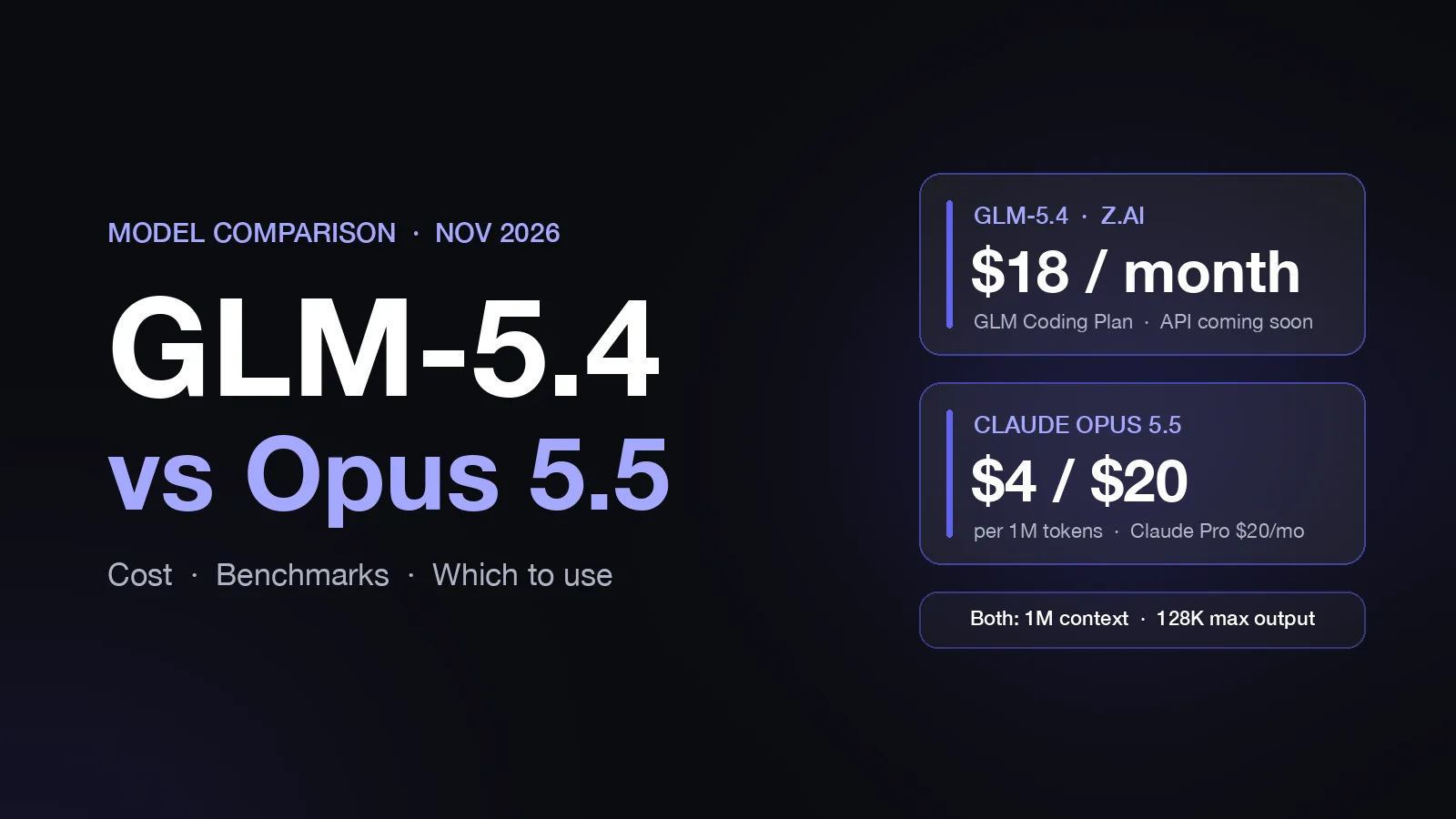
GLM-5.4 vs Opus 5.5: Cost Comparison & Benchmarks
GLM-5.4 launched on 23 November inside Z.ai's GLM Coding Plan, with no API yet. We compare its plan prices, token allowances and published benchmarks with Claude Opus 5.5's $4/$20 pricing, and show why cost per task tells a different story.
Lorka AI vs Genspark vs Perplexity for Research (2026)
Perplexity cites, Lorka AI cross-checks many models on one bill, and Genspark turns research into decks and docs. Plans, prices, citations and a research workflow compared from each vendor's own pages, checked November 2026.

Onepage Review (2026): AI Landing Pages in Minutes, Worth It?
Onepage is now an AI-native website builder: a chat agent that builds pages, a CMS, and an MCP server for Claude, Cursor and Codex. We cover features, November 2026 pricing, AI credit costs, the Forms & Funnels add-on, and Onepage vs Framer and Carrd.