The PromptsRush blog
AI ToolsGLM-5.4 vs Opus 5.5: Cost Comparison & Benchmarks
GLM-5.4 launched on 23 November inside Z.ai's GLM Coding Plan, with no API yet. We compare its plan prices, token allowances and published benchmarks with Claude Opus 5.5's $4/$20 pricing, and show why cost per task tells a different story.
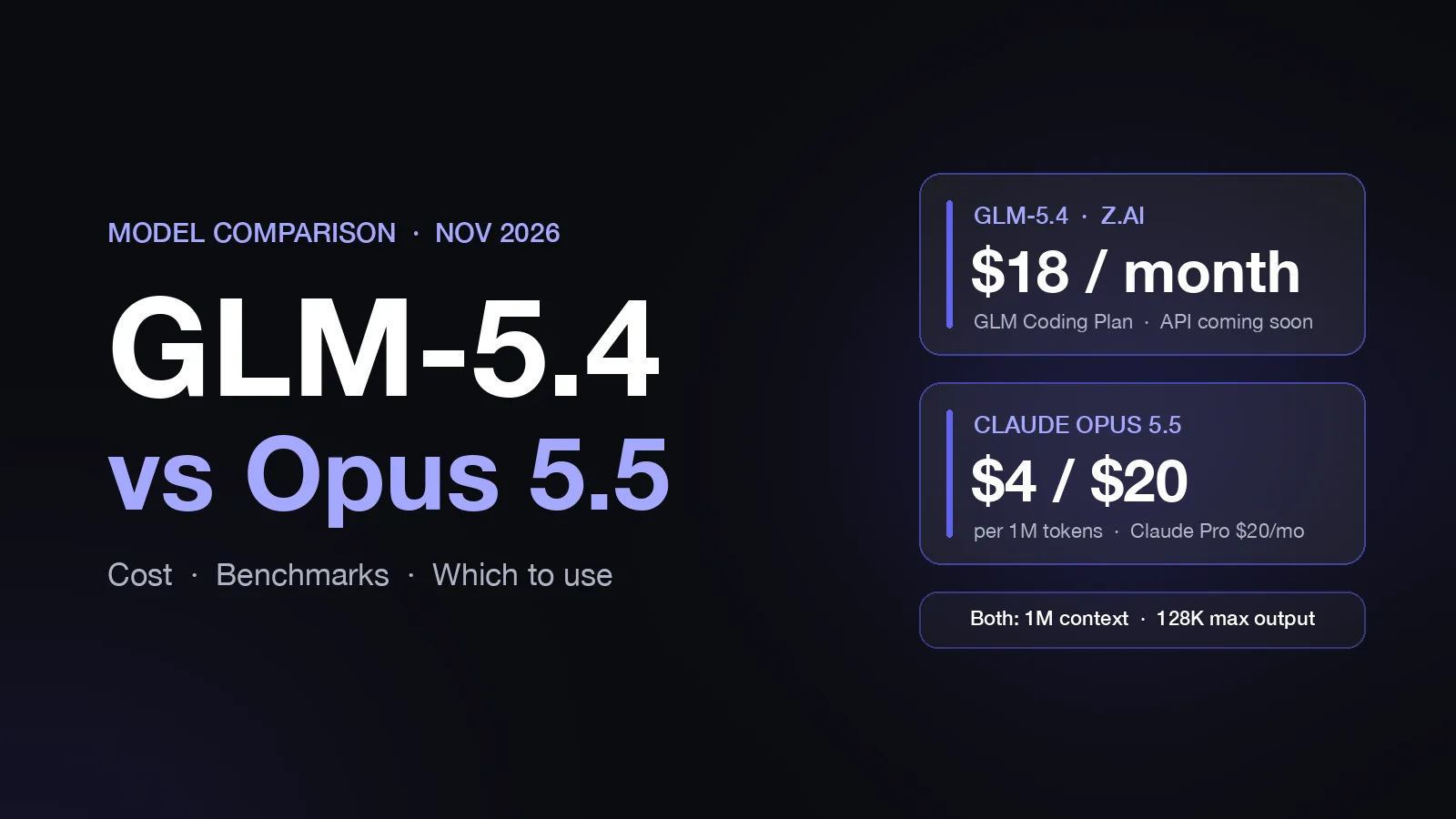
Z.ai released GLM-5.4 on 23 November 2026, and the first thing to know is where you can use it: only in Z.ai's own chat app and its GLM Coding Plan, a subscription for coding tools that starts at $18 a month. The pay-per-token API is listed as "coming soon", pending a security assessment, and open weights will follow "after completing necessary safety hardening". Claude Opus 5.5, Anthropic's recommended default since 22 September, costs $4 per million input tokens and $20 per million output tokens on the API, or comes with Claude Pro from $20 a month.
That makes this comparison unusual. There is no GLM-5.4 API price to set against Opus 5.5's, and nobody has published a head-to-head benchmark: Z.ai compared GLM-5.4 only with its own GLM-5.3, Kimi K3.1 Pro and DeepSeek V4.1 Flash. What we can compare is what each subscription buys, what each company's numbers say, and how the last independently measured GLM model, GLM-5.3, fared against Opus 5.5. It scored lower and cost more per task.
Here is where that leaves you. GLM-5.4 is the cheaper way to buy a very large volume of coding-agent tokens, especially if you work outside Asian business hours. Opus 5.5 is the better-proven model, faster per task, and much less expensive on agent workloads than its sticker price suggests. Since our GLM-5.3 vs Opus 5 coding comparison, the price gap has narrowed further; the evidence gap has not.
GLM-5.4 vs Opus 5.5 at a Glance
| GLM-5.4 | Claude Opus 5.5 | |
|---|---|---|
| Released | 23 Nov 2026 | 22 Sep 2026 |
| Made by | Z.ai (Zhipu AI) | Anthropic |
| Where to use it | Z.ai Chat and the GLM Coding Plan (ZCode, Claude Code, Codex, Cursor and 20+ tools); API coming soon | Claude API, Claude apps, Claude Code, Amazon Bedrock, Google Cloud, Microsoft Foundry |
| Architecture | Loop Transformer on a ~750B base; 28 layers run twice | Not disclosed |
| Context window | 1M tokens | 1M tokens |
| Max output | 128K tokens | 128K tokens (300K on Batch with a beta header) |
| Input types | Text, images, video, files | Text, images |
| Reasoning control | Thinking mode; low, high or max in Claude Code (default max) | Adaptive thinking, always on; effort from low to max (default medium) |
| API price per 1M tokens | Not announced (GLM-5.3: $1.40 / $4.40) | $4 input, $20 output, $0.20 cache reads |
| Cheapest subscription | GLM Coding Plan Lite: $18/month, $12.60 billed yearly | Claude Pro: $20/month, $17 billed yearly |
| Open weights | Planned after safety hardening | No |
What's New in GLM-5.4: The Loop Transformer
GLM-5.4 is the first flagship model built on what Z.ai calls a Loop Transformer. In a normal transformer, each layer runs once per pass. GLM-5.4 takes 28 layers of its GLM-5 base model and runs them twice with shared weights, so the network gets deeper without gaining parameters. Z.ai claims the result reaches "intelligence levels comparable to 2T-3T parameter models" from a base of about 750B.
Looped models trained from scratch usually lose to ordinary models on the same compute budget, so Z.ai converted an already-trained base through continued training instead. Three engineering changes keep the second pass affordable:
- Gated updates. Per-token gates decide how much each pass writes back. The first pass writes cautiously to keep activations stable; the second pass refines, and harder tokens get bigger updates.
- A hybrid KV cache. The second pass reuses the first pass's cache plus its own small sliding window, so the extra loop costs one window of memory rather than a full copy. Z.ai says this keeps the added serving cost over GLM-5.3 "well under control" at 1M tokens.
- Reused attention indices. The second pass reuses the first pass's sparse-attention indices, adding no indexing work.
Z.ai's evidence for the approach comes from a 30B test model with the same design, not from GLM-5.4 itself. With identical parameters and about 10% more training compute, the looped version rose from 19.17 to 30.42 on AIME 2025, from 47.58 to 56.26 on GPQA-Diamond and from 40.33 to 47.67 on the AA-LCR long-context test. Its answers also got 10% to 14% shorter on most benchmarks, because part of the reasoning moves from visible thinking tokens into the extra pass.
Two other changes matter in practice. GLM-5.4 accepts images, video and files, where GLM-5.3 was text-only. And Z.ai pitches it for "generalized coding": writing code to edit video, model a six-axis robot arm in FreeCAD, or build a 3D scene in GLSL shaders. Z.ai is also candid about the main weakness: the model "tends to get caught in overly long 'marathon thinking' loops", which costs time even when it improves accuracy.
Claude Opus 5.5 in Brief
Anthropic launched Opus 5.5 on 22 September as the first Claude 5.5 model. Anthropic says it performs at the level of Claude Fable 5.1 on most work, generates output more than 30% faster than Opus 5, and costs 40% less to run at default settings, because it is cheaper per token and uses fewer tokens per task. Anthropic's model guide now tells developers to start with Opus 5.5 for most workloads.
The specs line up closely with GLM-5.4: a 1M-token context window at standard pricing with no long-context surcharge, 128K output tokens, and always-on adaptive thinking with effort levels from low to max. Opus 5.5 reads text and images but not video. Our guide to what's new in Claude Opus 5.5 covers the launch in full.
Benchmarks: What Z.ai Published for GLM-5.4
Z.ai published one comparison chart for GLM-5.4: head-to-head win rates against three models. It doesn't describe the tasks or the judge, so treat these as Z.ai's internal results rather than a public benchmark.
GLM-5.4 head-to-head results, as published by Z.ai
Share of comparisons GLM-5.4 won, tied or lost against each model. DeepSeek V4.1 = DeepSeek-V4.1-Flash-1017.
- Win
- Tie
- Lose
Source: Z.ai GLM-5.4 documentation and launch blog (23 November 2026). Task set and judging method not disclosed.
Against its predecessor, GLM-5.4 wins about twice as often as it loses (51.1% vs 23.1%). Against Kimi K3.1 Pro it wins 41.8% and loses 31.3%. Against DeepSeek's V4.1 Flash it is close to even, which is a modest result for a flagship. What the chart leaves out says as much as what it shows: there is no Anthropic, OpenAI or Google model in it, and no public benchmark scores for GLM-5.4 at all.
Benchmarks: What Anthropic Published for Opus 5.5
Anthropic's launch table compares Opus 5.5 with its own previous models and OpenAI's. GLM models don't appear.
| Benchmark (Anthropic-reported) | Opus 5.5 | Fable 5.1 | Opus 5 | GPT-6 Astra |
|---|---|---|---|---|
| Terminal-Bench 4.0 | 66.4% | 55.8% | 52.3% | 57.9% |
| FrontierCode v1.1 (main) | 54.4% | 50.3% | 48.0% | 53.3% |
| CursorBench 4.0 | 57.8% | 51.8% | 46.6% | Not reported |
| GDPval-AA v2.1 (Elo) | 1846 | 1735 | 1708 | 1542 |
| AutomationBench | 40.0% | 31.4% | 26.9% | 41.4% |
| Humanity's Last Exam (with tools) | 67.7% | 65.6% | 63.6% | 57.2% |
| OSWorld 2.1 (partial credit) | 81.8% | 80.7% | 74.0% | Not reported |
These are maximum-effort scores, except Terminal-Bench, which Anthropic ran at xhigh. Anthropic also reports that at its default medium effort Opus 5.5 scores 54.6% on FrontierCode and 52.5% on CursorBench, still ahead of OpenAI's best published results at a fraction of the cost per task. Anthropic itself cautions that "benchmark margins have become a less reliable guide to real-world differences" at this level.
The Independent Numbers: Opus 5.5 vs GLM-5.3
GLM-5.4 can't be tested independently until its API opens, so the closest neutral comparison is with GLM-5.3. On the Artificial Analysis Intelligence Index (version 5.0.2, nine evaluations spanning agentic work, coding, knowledge and science), the gap is wide:
Artificial Analysis Intelligence Index, by effort setting
Higher is better. GLM-5.4 is not yet listed because it has no public API.
Source: Artificial Analysis Intelligence Index v5.0.2, checked 25 November 2026.
Opus 5.5 at its lowest effort (35) outscores GLM-5.3 at its highest (32). The same evaluation also measures time and cost per task:
| Model and effort | Index score | Cost per task | Time per task |
|---|---|---|---|
| Opus 5.5 (max) | 59 | $10.04 | 24.7 min |
| Opus 5.5 (xhigh) | 58 | $6.05 | 15.8 min |
| Opus 5.5 (high) | 52 | $3.46 | 9.2 min |
| Opus 5.5 (medium) | 48 | $2.45 | 6.9 min |
| Opus 5.5 (low) | 35 | $0.98 | 3.1 min |
| GLM-5.3 (max) | 32 | $5.01 | 28.1 min |
| GLM-5.3 (low) | 23 | $1.57 | 13.2 min |
Two caveats keep this from settling the question. GLM-5.4 is a new architecture, and Z.ai's own chart has it beating GLM-5.3 in most head-to-head tasks. But a 27-point gap at maximum effort is a lot to close in one release, and Z.ai hasn't claimed it has. Until GLM-5.4 appears on independent leaderboards, Opus 5.5 is the only one of the two with verified frontier-level results.
API Pricing: Opus 5.5 vs GLM, Per Token
Z.ai hasn't priced the GLM-5.4 API, so the last published GLM rate is GLM-5.3's. Here is how it compares with Opus 5.5:
| Per 1M tokens | GLM-5.4 | GLM-5.3 | Claude Opus 5.5 |
|---|---|---|---|
| Input | Not announced | $1.40 | $4 |
| Cached input (reads) | Not announced | $0.26 (cache storage free for now) | $0.20 |
| Cache writes | Not announced | No separate charge listed | $5 (5-minute) or $8 (1-hour) |
| Output | Not announced | $4.40 | $20 |
| Batch | Not announced | Not listed | $2 / $10 |
| Fast mode | Not listed | Not listed | $8 / $40 (up to 2.5x faster) |
On paper, Opus 5.5 costs 2.9 times as much for input and 4.5 times as much for output. How much that matters depends on the shape of the work:
- Chat-style requests barely use caching. A 20K-token prompt with a 2K-token answer costs $0.12 on Opus 5.5 and about $0.037 on GLM-5.3, a 3.3x gap.
- Coding agents re-read the same context on every turn, so cache reads dominate. Using the mix Z.ai's own allowance tables imply (95% of input cached, about 0.7% of all tokens output), a million tokens costs about $0.58 on Opus 5.5 and $0.35 on GLM-5.3. That is a 1.7x gap, not 4.5x.
The reason is that Opus 5.5's cache reads cost $0.20 per million, less than GLM-5.3's $0.26. Our full Claude Opus 5.5 pricing breakdown covers cache writes, Batch and fast mode in detail.
Subscription Costs: GLM Coding Plan vs Claude Pro, Max and Ultra
For most people choosing between these two models, the real decision is between subscriptions. Both companies sell three tiers:
| Plan | Monthly | Billed yearly | Usage | Extras |
|---|---|---|---|---|
| GLM Lite | $18 | $12.60/mo | 10,000 credits/week (2,000 per 5 hours): about 72M to 146M GLM-5.4 tokens a week | 20+ agent tools, vision, web search and reader tools |
| GLM Pro | $80 | $56/mo | 6x Lite: about 440M to 870M tokens a week | Faster generation, priority access to new models |
| GLM Max | $168 | $117.60/mo | 14x Lite: about 1.0B to 2.0B tokens a week | Dedicated resources at peak times |
| Claude Pro | $20 | $17/mo | More than Free; token limits not published | Opus 5.5, Claude Code, Claude apps |
| Claude Max | $100 | Monthly only | 5x Pro, per 5 hours and per week | $100/month in API credits; Fable for up to half the weekly limit |
| Claude Ultra | $200 | Monthly only | 10x Pro per week; no 5-hour limit for verified accounts | $200/month in API credits |
GLM plans also come with 20% off billed quarterly ($14.40, $64 and $134.40 a month). The GLM token ranges are Z.ai's own estimates at a 95% cache hit rate: the low end assumes all usage at peak hours, the high end all off-peak.
Three differences stand out. First, Z.ai publishes the exact formula: credits equal input, cached-input and output tokens multiplied by per-model rates, divided by 10,000. GLM-5.4's rates (4.6, 1.1 and 16) are a third lower than GLM-5.3's (6.9, 1.7 and 24), which is how Z.ai gives GLM-5.4 users 1.5 times GLM-5.3's quota. Anthropic publishes no token allowances at all, only multiples of Pro.
Second, GLM's bigger tiers are better value per dollar. Pro gives six times Lite's usage for 4.4 times the price, and Max gives 14 times for 9.3 times the price, while Claude's tiers scale linearly. Third, Claude bundles more: the Claude apps, access to Fable on Max and Ultra, and monthly API credits worth the full subscription price on those two tiers. Our Claude Pro vs Max vs Ultra guide covers those plans in detail.
What a GLM Plan's Tokens Would Cost on Opus 5.5
Because Z.ai publishes token allowances, you can price the same volume at Opus 5.5's API rates. We used Z.ai's own assumptions (95% of input cached, about 0.7% of tokens as output, which its allowance tables imply), billed Opus 5.5's uncached input as 5-minute cache writes, and assumed the full weekly allowance is used every week:
| GLM plan | Monthly price | GLM-5.4 tokens per week | Same tokens on the Opus 5.5 API, per month |
|---|---|---|---|
| Lite | $18 | 72M to 146M | About $180 to $370 |
| Pro | $80 | 440M to 870M | About $1,100 to $2,200 |
| Max | $168 | 1.0B to 2.0B | About $2,550 to $5,100 |
Token for token, a fully used GLM plan buys roughly 10 to 30 times its price in Opus 5.5 API usage. But that is token for token, not task for task. If one model needs more tokens to finish the same job, the comparison shifts, which is exactly what the independent data shows.
Cost per Task: Why Cheaper Tokens Don't Always Win
Cost per Intelligence Index task, in US dollars
Lower is better. Measured at each model's API prices; GLM-5.4 not yet tested.
Source: Artificial Analysis Intelligence Index v5.0.2, checked 25 November 2026.
On Artificial Analysis's tasks, GLM-5.3 at maximum effort cost $5.01 per task at its own API rates, twice what Opus 5.5 cost at medium ($2.45), while scoring 16 points lower. Even GLM-5.3 at low ($1.57) cost more than Opus 5.5 at low ($0.98). Cheaper tokens lose when a model spends far more of them, and Opus 5.5's efficiency is the main selling point of its launch.
On a flat subscription the maths changes. Extra tokens cost quota and time rather than money, and a GLM plan has a lot of quota. GLM-5.4 should also be leaner than GLM-5.3: Z.ai's architecture tests showed 10% to 14% shorter outputs, and its credit rates are a third lower. Z.ai's "marathon thinking" warning cuts the other way. Expect GLM-5.4 to cost you less money and possibly more waiting.
Speed and Peak Hours
Z.ai quotes GLM-5.4 at up to 200 tokens a second off-peak and 70 to 80 tokens a second at peak load. Peak hours are Monday to Friday, 14:00 to 18:00 Singapore time, and off-peak usage costs half the credits. In late November that peak window falls at:
- 06:00 to 10:00 in the UK, so UK mornings are the expensive slot.
- 11:30 to 15:30 in India, which covers much of the working day.
- 01:00 to 05:00 US Eastern and 22:00 to 02:00 Pacific, so almost the entire US working day is off-peak.
For US developers, that means the high end of Z.ai's token estimates is the realistic one. Opus 5.5 has no peak pricing on Claude plans, though usage limits still apply. For latency-sensitive work, fast mode runs up to 2.5 times faster for double the token price, and Artificial Analysis timed Opus 5.5 at 3.1 minutes per task on low against 13.2 minutes for GLM-5.3 on low.
How to Run GLM-5.4 in Claude Code
You don't have to give up Claude Code to use GLM-5.4. Z.ai runs an Anthropic-compatible endpoint, so Claude Code can send its requests to GLM instead. With an active GLM Coding Plan and a Z.ai API key, add these keys to the env block of ~/.claude/settings.json, replacing your_zai_api_key with your key:
{
  "env": {
    "ANTHROPIC_AUTH_TOKEN": "your_zai_api_key",
    "ANTHROPIC_BASE_URL": "https://api.z.ai/api/anthropic",
    "ANTHROPIC_DEFAULT_OPUS_MODEL": "glm-5.4[1m]",
    "ANTHROPIC_DEFAULT_SONNET_MODEL": "glm-5.4[1m]",
    "ANTHROPIC_DEFAULT_HAIKU_MODEL": "glm-5.3-flash[1m]",
    "CLAUDE_CODE_AUTO_COMPACT_WINDOW": "1000000",
    "API_TIMEOUT_MS": "3000000"
  }
}
The [1m] suffix is part of the model name, not a placeholder: it turns on GLM's 1M-token context. If Claude Code says the model doesn't exist, update Claude Code first. Keep the rest of your settings file; only add or change these keys.
GLM-5.4 defaults to max effort through this endpoint. The /effort command maps Claude Code's levels onto GLM's three: low stays low, medium and high become high, and xhigh or max become max. Given the marathon-thinking warning, dropping routine work to high is the easiest way to save time and quota; the same trade-offs apply as with effort settings for Claude models.
These settings route every model slot in that Claude Code install to Z.ai, so remove them to switch back to Opus 5.5. Remember too that Z.ai's plan only covers use inside supported coding tools. Prompts written for the previous model carry over, and our 25 GLM-5.3 coding prompts make a good starting set.
Which Should You Use?
| If you… | Choose | Why |
|---|---|---|
| Need the strongest proven model for long agent runs | Opus 5.5 | Verified frontier scores and the lowest cost per task in independent testing |
| Code all day and hit Claude limits | GLM-5.4 on GLM Pro ($80) | Hundreds of millions of tokens a week with a published allowance |
| Work mostly in US or European afternoons | GLM-5.4 | Off-peak credits cost half and generation runs faster |
| Need an API in production today | Opus 5.5, or GLM-5.3 at $1.40 / $4.40 | GLM-5.4 has no API yet |
| Want video input in a coding agent | GLM-5.4 | Opus 5.5 reads images but not video |
| Want the best of both for under $40 a month | Claude Pro plus GLM Lite ($38) | Send bulk work to GLM, hard problems to Opus 5.5 |
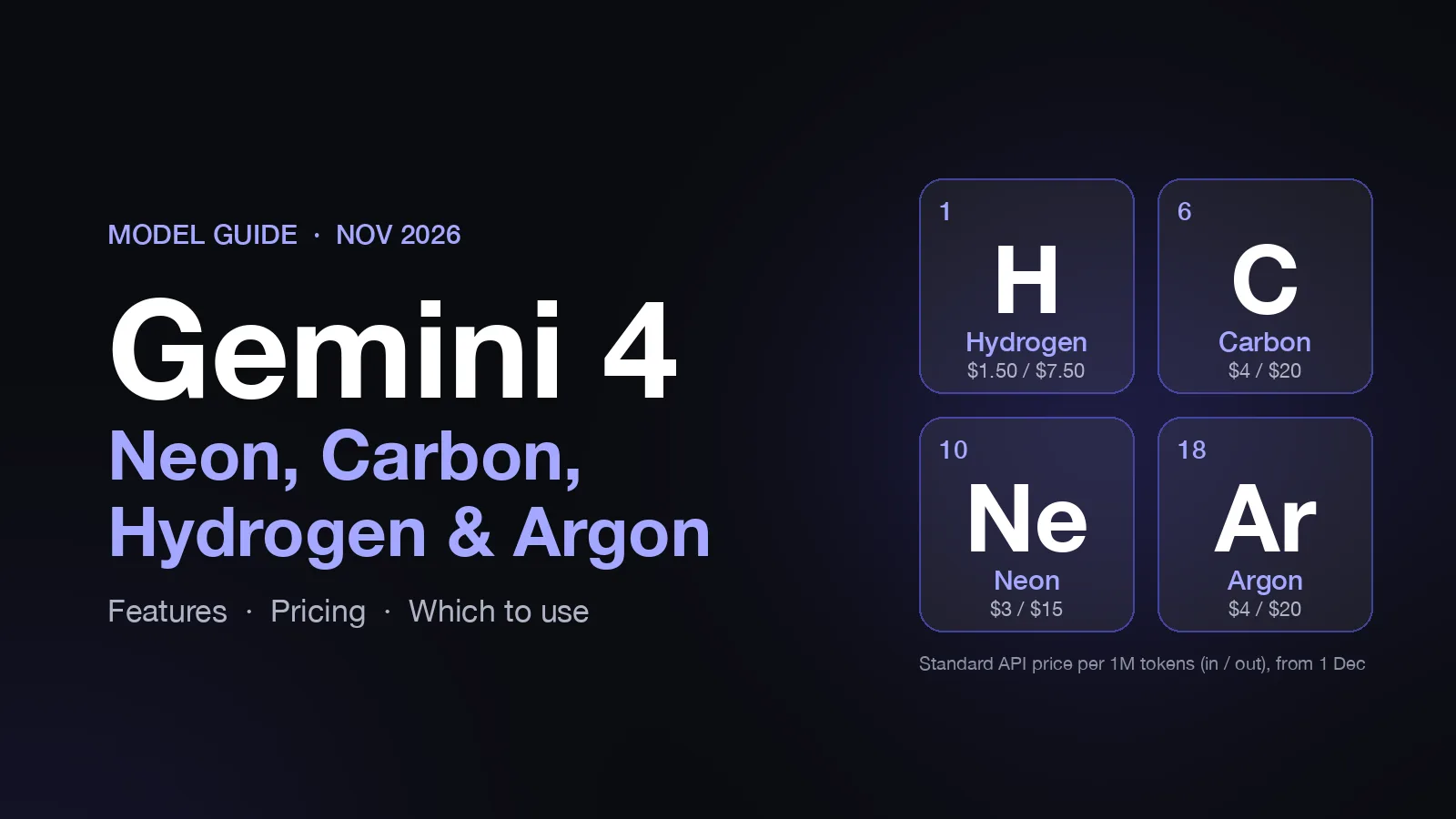
If neither fits, Google's Gemini 4 line is the other value option: Gemini 4 Hydrogen and Neon cost $1.50 / $7.50 and $3 / $15 per million tokens with a working API today. For a wider view by job, see our AI model decision matrix.
Risks and Fine Print
Each option comes with conditions worth reading before you pay:
- No refunds on GLM plans. Z.ai doesn't refund subscriptions, even unused ones, and you must cancel at least three days before renewal. Annual billing saves 30% but locks in the money.
- GLM usage rules. Plans are for one person and only inside supported tools; account sharing or other use can lead to limits or bans. Concurrency is not fixed and rises with tier.
- Plan terms move. Z.ai switched the Coding Plan to credits on 30 July 2026, and its multipliers and promotional offers have changed since. Check the live plan page before committing for a year.
- Data handling. Z.ai's team plans state that data is never used for training; individual plans promise "default data privacy". If you work under data-residency rules, confirm where your code is processed before routing it to either provider.
- Opus 5.5 limits are opaque. Claude plans don't publish token allowances, and Anthropic's safeguards can block or reroute some security and biology requests.
The Verdict
GLM-5.4 is the more interesting release and the cheaper way to buy volume. Its architecture is a genuine new idea, its plan maths is transparent, and $80 a month buys a token allowance that would cost well over $1,000 on Opus 5.5's API. If your bottleneck is Claude usage limits rather than model quality, it is worth a month on the Lite plan to find out how it handles your codebase.
Opus 5.5 remains the stronger and better-proven model. It has published frontier scores, the lowest cost per task in the only independent comparison available, faster answers, an API you can use today and month-to-month billing on every plan. Until GLM-5.4 reaches the public leaderboards, Opus 5.5 is the safer choice for work where quality matters more than volume.
Frequently Asked Questions
10 questions answered
Written by
PromptsRush
November 25, 2026 · 17 min read
Keep reading
Keep your curiosity going.
Gemini 4 Neon, Carbon, Hydrogen & Argon: Features, Pricing & Which to Use
Google's four Gemini 4 models compared from its own docs and model cards: what Hydrogen, Neon, Carbon and Argon each do, thinking levels, benchmarks, every API price including the 1 December rise, Gemini app and Antigravity access, and which to use.
Lorka AI vs Genspark vs Perplexity for Research (2026)
Perplexity cites, Lorka AI cross-checks many models on one bill, and Genspark turns research into decks and docs. Plans, prices, citations and a research workflow compared from each vendor's own pages, checked November 2026.

Onepage Review (2026): AI Landing Pages in Minutes, Worth It?
Onepage is now an AI-native website builder: a chat agent that builds pages, a CMS, and an MCP server for Claude, Cursor and Codex. We cover features, November 2026 pricing, AI credit costs, the Forms & Funnels add-on, and Onepage vs Framer and Carrd.