The PromptsRush journal
AI ToolsGemini 4 Argon Pricing Explained: Intro Rates, Plans & API Costs
Gemini 4 Argon costs $2/$10 per million tokens until November 30, then $4/$20. Here's every API tier, how thinking, caching and long decode change the bill, which Google AI plans include Argon, and how it compares with Claude Opus 5.5.

Advertisement
Short version: Gemini 4 Argon costs $2 per million input tokens and $10 per million output tokens until November 30, 2026, then doubles to $4 and $20 on December 1. Cached input is 95% off, Batch and Flex halve the bill, Priority adds 80%, and there is no free API tier. If you just want to use Argon in a chat window, the cheapest Google plan that includes it is Google AI Pro at $19.99 a month in the US.
That headline rate hides most of what actually decides your bill: thinking tokens billed as output, a caching system you can't control directly, long-decode hops that re-count your context, and grounding fees once you pass 5,000 searches. If you're new to the model itself, start with our Gemini 4 Argon explainer on long decode, thinking levels and specs, then come back here for the money side.
Sources: Google's Gemini API pricing page (last updated 22 October 2026), the Argon "What's new" guide, the long decode, caching, Flex, Priority and rate-limit docs, the Google Cloud Agent Platform pricing page, Google's launch post and the Gemini subscriptions page, all checked on 26 October 2026. We haven't run billed Argon workloads ourselves, so every cost example below is our own arithmetic from Google's published rates, and it's labelled that way.
Gemini 4 Argon Pricing at a Glance
Here is every paid API rate Google lists for gemini-4-argon, per million tokens in US dollars. Each cell shows the introductory rate (through November 30, 2026) and the regular rate (from December 1, 2026).
| Tier | Input | Output (incl. thinking) | Cached input | Best for |
|---|---|---|---|---|
| Standard | $2.00 → $4.00 | $10.00 → $20.00 | $0.10 → $0.20 | Normal interactive use |
| Batch | $1.00 → $2.00 | $5.00 → $10.00 | $0.05 → $0.10 | Bulk jobs that can wait up to 24 hours |
| Flex | $1.00 → $2.00 | $5.00 → $10.00 | $0.05 → $0.10 | Synchronous work that tolerates delays and retries |
| Priority | $3.60 → $7.20 | $18.00 → $36.00 | $0.18 → $0.36 | User-facing apps that need low, steady latency |
| Free tier | Not available for Argon | Use Gemini 3.8 Flash for free testing | ||
A few things in that table matter more than they look:
- Every regular rate is exactly double the intro rate. If you budget on today's numbers, your December bill for the same traffic will be twice as large.
- The output column includes thinking tokens. Google's pricing table labels it "Output price (including thinking tokens)", so reasoning you never see is billed at the output rate.
- Caching is implicit only. Google notes "explicit caching is not supported" for Argon, and unlike Gemini 3.8 Flash, the Argon row lists no hourly cache storage fee.
- Paid-tier data isn't used for training. Standard, Batch, Flex and Priority all show "Used to improve our products: No".
There is also a fifth, invite-only tier on the pricing page, which we cover in the tiers section below.
What You're Actually Billed For: Input, Thinking, Output and Cache Hits
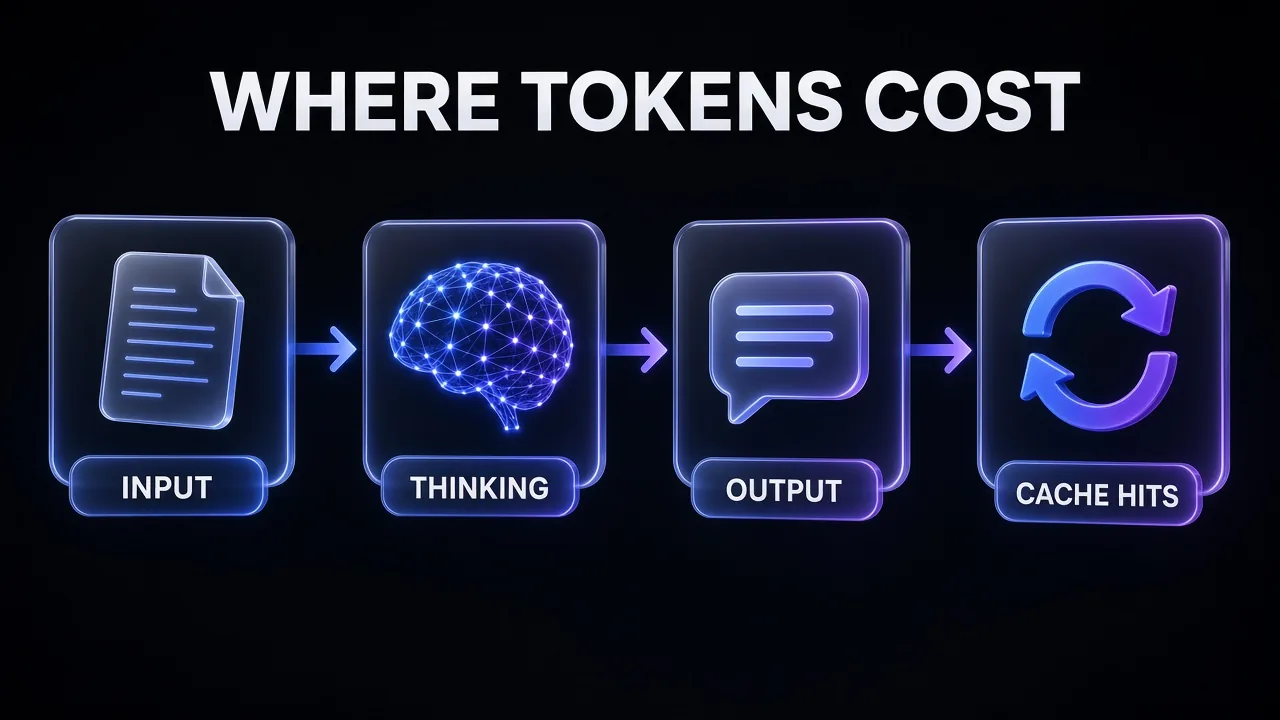
An Argon request is billed in four buckets. Input is everything you send: system prompt, conversation history, files, images, tool results. Thinking is the reasoning the model does before answering, reported in the total_thought_tokens usage field and charged at the output rate. Output is the visible answer. Cache hits are input tokens Google recognised from a recent request with the same prefix, charged at 5% of the input rate.
Thinking is the line item people underestimate. Google's thinking guide says that when thinking is on, "response pricing is the sum of output tokens and thinking tokens", and you pay for the full thought tokens, not the shorter thought summary you can optionally request. Argon thinks at medium by default, and Google warns it "can spend more of the limit on thinking than earlier models", which is why it recommends raising max_output_tokens to at least 32,768 for apps that set it lower.
The thinking_level setting is therefore your main cost dial. Google's own table describes low as "fewest tokens, lowest latency", medium as "balanced" and high as "most tokens, slowest first token", and its advice is to "run your evaluations at all three levels, then pick the lowest level that meets your quality bar." We walk through that process step by step in how to choose thinking_level and effort for real workloads.
Pro tip: Don't try to save money with a tinymax_output_tokens. It's a hard cutoff, not a budget the model plans around. If thinking eats the whole allowance, the response ends asincompletewith little or no text, and the thinking tokens are still billed. Lower the thinking level instead.
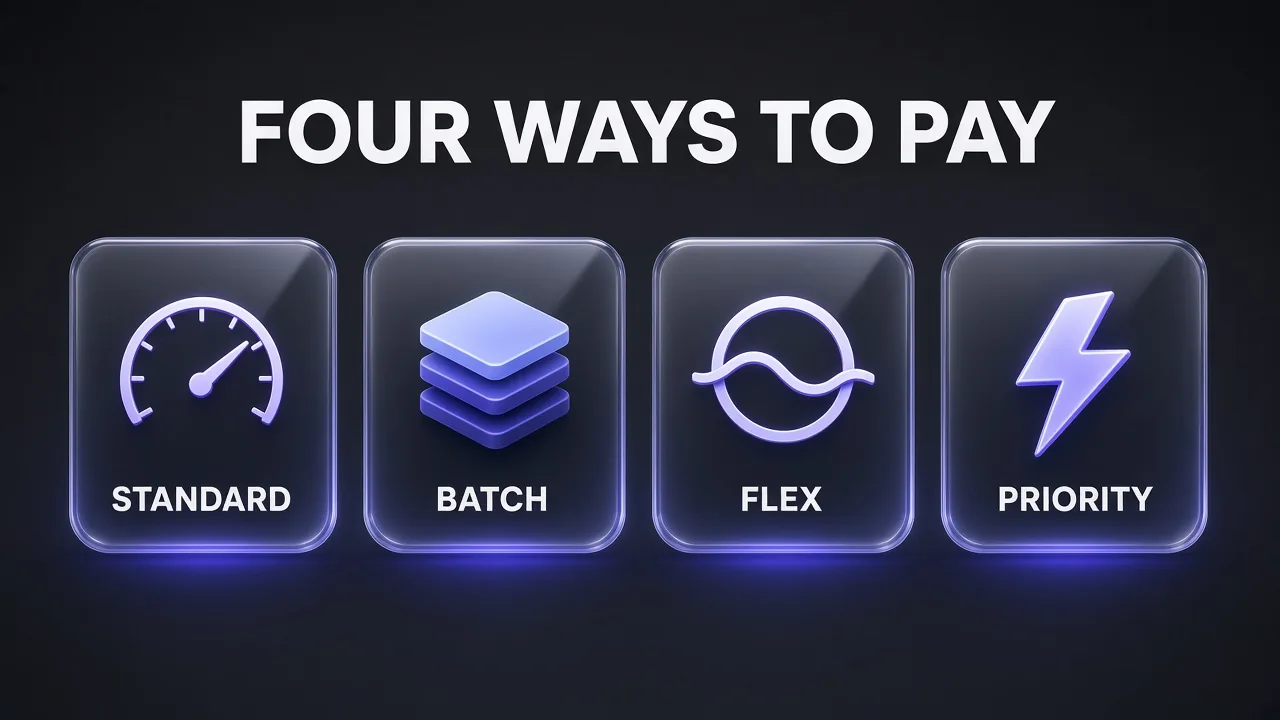
Standard, Batch, Flex and Priority: Four Ways to Pay
The same model, at the same quality, is sold at four price points depending on how fast and how reliably you need the answer. You pick the tier per request with the service_tier field (Flex and Priority) or by submitting a batch job.
Standard: the default
Omit service_tier and you get Standard: $2 input and $10 output per million tokens during the intro period. This is what every example in Google's docs assumes.
Batch: half price, up to 24 hours
The Batch API runs requests asynchronously "at 50% of the standard cost", with a target turnaround of 24 hours (Google says most jobs finish much faster). Batch has its own rate limits, separate from your interactive traffic, which makes it the natural home for evaluations, document backfills and dataset labelling.
Flex: half price, still synchronous
Flex charges the same 50%-off rates as Batch but keeps the normal request-response flow, so it suits agent chains where each step needs the previous answer. The trade-off is reliability. Google calls Flex traffic "sheddable": it can be pre-empted during spikes and returns 503 or 429 errors when capacity is short. There is deliberately no automatic fallback to Standard, "to prevent unexpected charges", so you write your own retries, and Google recommends client timeouts of 10 minutes or more. Flex also counts toward your normal rate limits.
Priority: 80% more for lower latency
Priority routes requests to high-criticality queues for user-facing apps. Google's Priority doc describes it as "priced at 75-100% more than the standard API"; for Argon the table shows $3.60 against $2.00, which is 80% more. Two details are easy to miss: default Priority rate limits are 0.3x your standard limits, and overflow requests are quietly downgraded to Standard and billed at the standard rate. Check the x-gemini-service-tier response header to see what you actually got.
Contributor: the invite-only fifth tier
The pricing page also lists a Contributor tier, "offered as a private preview on an invite-only basis", with Standard-level speed at Batch-level prices ($1 input, $5 output during the intro). The catch is in the last row: unlike every other paid tier, Contributor traffic is marked "Used to improve our products: Yes". If you're invited, treat it as a data-sharing decision, not just a discount.
Intro vs Regular Rates: What Changes on December 1
The introductory pricing runs "through November 30, 2026", and every tier doubles the next day. Google hasn't said anything about extending it, so plan as if it ends on schedule. To make the jump concrete, here is one illustrative request priced across tiers: 20,000 input tokens and 5,000 tokens of thinking plus output, with no cache hits. This is our arithmetic from Google's published rates, not a measured bill.
| Tier | One request (intro) | One request (from Dec 1) | 1,000 requests (intro) | 1,000 requests (from Dec 1) |
|---|---|---|---|---|
| Standard | $0.09 | $0.18 | $90 | $180 |
| Batch / Flex | $0.045 | $0.09 | $45 | $90 |
| Priority | $0.162 | $0.324 | $162 | $324 |
Read that table two ways. First, Batch or Flex after December 1 costs exactly what Standard costs today, so moving latency-tolerant work off Standard before the deadline keeps that part of your bill flat. Second, output dominates: in this example the 5,000 output-side tokens cost more than the 20,000 input tokens. Trimming thinking with a lower thinking_level moves the number more than trimming your prompt.
If you buy Argon through Google Cloud's Agent Platform (the Vertex AI side) rather than the Gemini API, two extra details apply. The intro price there is "provided through 50% credits back on net spend", and non-global regional endpoints cost 10% more ($2.20 input and $11 output during the intro, $4.40 and $22 afterwards). Google also lists a Gemini 4 Argon Cyber Permissive variant on that page at the regular $4/$20 rate, and says promotional pricing doesn't apply to it.
Implicit Caching: The 95% Discount and Its Rules
Caching is the biggest lever on an Argon bill, and you can't switch it on or off. Google's caching guide says explicit caching (creating and managing cache objects with caches.create) "is not supported in the Interactions API, or for Gemini 4 Argon and onward". Instead, implicit caching runs automatically: when a new request starts with the same content as a recent one, the repeated part is billed at the cached rate, $0.10 per million tokens instead of $2.00 during the intro.
To show the size of the effect: a 50,000-token system prompt plus reference docs costs $0.10 per request at the full intro input rate and $0.005 when it's a cache hit. From December 1 those become $0.20 and $0.01. Again, that's our arithmetic, and it assumes the prefix actually hits the cache, which Google doesn't guarantee.
The rules that decide whether you get the discount, all from Google's docs:
- Minimum size: implicit caching applies to prompts of at least 4,096 tokens on Argon.
- Prefix order matters: put large, stable content (instructions, docs, tool definitions) at the start and the changing part at the end, and send similar requests close together in time.
- The 2,050-token rule for agent loops: on Gemini 4 models, Google caches the full previous request only if the new request adds at least 2,050 tokens. For smaller additions, it "re-processes the last 2,050 tokens of the previous request at the standard input rate." Google says most agent turns exceed this threshold.
- Check, don't assume: cache hits show up in
usage.total_cached_tokens. Log it per request.
If you're coming from Claude, the mental model is different: Anthropic lets you mark cache breakpoints and pay a write premium, while Gemini decides for you. We compare the two approaches in detail in Gemini implicit caching vs Claude explicit caching.
Restructure a Prompt for Gemini Implicit Caching
I'm moving an app to Gemini 4 Argon, which only supports implicit caching (automatic prefix caching, minimum 4,096 tokens, 95% off cached input). Below is my current request layout: system prompt, tool definitions, reference documents, conversation history and the user's new message.

[PASTE YOUR REQUEST STRUCTURE OR AN EXAMPLE REQUEST]

1. Reorder it so the largest stable content comes first and anything that changes per request comes last.
2. Flag anything inside the stable part that changes between requests (timestamps, user names, random IDs) and suggest where to move it.
3. Estimate how many tokens of each request should be cacheable after the change.
4. List what I should log (for example usage.total_cached_tokens) to confirm cache hits in production.
Long Decode Costs: You Pay for Every Hop
Argon can write past the usual 64K output limit, up to the 1,048,576-token window minus your input, using what Google calls long decode. It works in hops: the server generates up to 64K tokens, then starts a new hop that sends your prompt plus everything generated so far back in as input, and repeats. That has two billing consequences spelled out in the long decode guide: "You pay for every token in every hop, including hops that contain only thinking," and repeated hop input is discounted 95% by implicit caching.
Google's own example is a 1,000-token prompt that produces 200,000 tokens of thinking and output. It takes four hops, and total_input_tokens reports about 397,000 tokens even though the real context is only about 201,000. Pricing that at intro rates (our arithmetic): the 200,000 output-side tokens cost $2.00, and the ~397,000 input tokens cost somewhere between about $0.04 (if nearly all of it is billed at the cached rate) and about $0.79 (if none were), so roughly $2.04 to $2.79 per run, and double that from December 1.
Push it to the limit and the numbers get serious: a response that uses close to the full million tokens costs about $10 in output alone at the intro rate, or about $20 after December 1, before any input.
- Failures still cost money. The long decode guide says cancelled and failed interactions are billed for "all work completed before the interaction ends." On Google Cloud's Agent Platform, a separate note says that from November 13, 2026, completions over 32K tokens will be "charged for retrievable token usage even if the request ultimately fails due to client or server timeouts."
- Incomplete isn't free. If the model uses all of
max_output_tokens, the status isincompleteand the text "can be empty if the model was still thinking". You still pay. - Use it rarely. Google lists chat, Q&A, summarisation, classification and extraction as tasks that "finish well under 32K tokens" and don't need long decode.
Pro tip: Never feed total_input_tokens into context-compaction logic for long-decode jobs. Google warns it's the sum of every hop's input, not your context size. Add your prompt size to the output and thought token counts instead. Long contexts degrade in other ways too, which we cover in what context rot is and how to fix it.
Hidden Costs Beyond Tokens: Grounding, Spend Limits and Prepay
Token rates aren't the whole bill. Three other line items and limits are worth knowing before you ship.
Grounding with Google Search and Maps
Search grounding and Maps grounding each include 5,000 free requests per month, "shared across all Gemini 3 and newer models", then cost $14 per 1,000. Google adds that a single request "may result in one or more queries to Google Search," and each query is charged. As an example of our arithmetic: an app that triggers 20,000 grounded searches a month pays for 15,000 of them, which is $210 on top of tokens. If you only need the contents of specific pages, fetching them yourself and passing them in as input can be cheaper; tools like Firecrawl turn web pages into clean, model-ready text.
Spend-based rate limits
On top of request and token limits, the Gemini API enforces spend-based limits on a rolling 10-minute window: $10 for Tier 1, $50 for Tier 2 and $200 for Tier 3. Google says whether they apply "depends on your billing history and account standing". Tier 2 needs $100 of paid spend plus 3 days since your first payment; Tier 3 needs $1,000 plus 30 days. A new Tier 1 project running several near-1M-token long-decode jobs in parallel could plausibly hit that $10 ceiling, so test limits before a launch.
Prepay and a $5 minimum
Because Argon isn't on the free tier, you need a paid project. Google's billing doc says upgrading means linking a billing account and prepaying a minimum of $5, and new users default to the Prepay plan. When the prepaid balance hits $0, all API keys in every project linked to that billing account stop working, with HTTP 402 errors until you add credits; auto-reload is available to avoid that. Google also warns of overages during the roughly 10-minute billing pipeline delay, especially for long-running batch and agent jobs.
Using Argon Without the API: Google AI Pro and Ultra Plans
If you want Argon in the Gemini app, AI Mode in Search or Google Antigravity rather than in your own code, you pay a flat subscription instead of per token. At launch, Google said Argon was available to "Google AI Ultra and Pro subscribers in the Gemini app and AI Mode in Search", and to Ultra subscribers in Antigravity. US prices from Google's Gemini subscriptions page on 26 October 2026:
| Plan | US price | Argon access | Usage vs lower plan | Antigravity |
|---|---|---|---|---|
| Free | $0 | No | Baseline | Not listed |
| Google AI Plus | $4.99/month | No (Flash model) | 2x Free | Not listed |
| Google AI Pro | $19.99/month | Yes | 4x Free | Entry rate limits |
| Google AI Ultra (5x) | $99.99/month | Yes, highest access | 5x AI Pro | Higher rate limits |
| Google AI Ultra (20x) | $199.99/month | Yes, highest access | 20x AI Pro | Highest rate limits |
Two caveats. Prices and availability vary by country, and Google says Argon in AI Mode is limited to select countries. And the subscription limits are "compute-based": they factor in prompt complexity, features and chat length, refresh every 5 hours up to a weekly cap, and can be extended by buying AI credits. Google doesn't publish how many Argon messages that equals, so treat "4x" and "20x" as relative, not as message counts.
For coding, the Google One plans page now lists "expanded access to Gemini 4 Argon in Google Antigravity and Google AI Studio" under AI Pro, and "higher access" under Ultra, even though the launch post framed Antigravity access as an Ultra perk. If Antigravity is why you're subscribing, our guide on how to use Google Antigravity with Gemini 4 Argon covers the setup. Google is also offering 10,000 scientists the highest Antigravity usage tier free for six months through an application, and cyber defenders can apply to the Fairwind Program for access without cyber guardrails.
Honest answer: a subscription and API credits are not interchangeable. AI Pro or Ultra gives you Argon inside Google's apps; it does not pay for gemini-4-argon API calls, which always need a paid API project.
Argon vs Claude Opus 5.5, Sonnet 5.5 and Gemini 3.8 Flash on Price
Per-token rates only tell part of the story, because models use different numbers of tokens for the same job. Still, the list prices set the ceiling. All figures are per million tokens, from each vendor's pricing page on 26 October 2026, and the last column applies our same 20,000-in, 5,000-out example request.
| Model | Input | Output | Cache hit | Example request (our math) |
|---|---|---|---|---|
| Gemini 4 Argon (intro, to Nov 30) | $2.00 | $10.00 | $0.10 | $0.09 |
| Gemini 4 Argon (from Dec 1) | $4.00 | $20.00 | $0.20 | $0.18 |
| Claude Opus 5.5 | $4.00 | $20.00 | $0.20 | $0.18 |
| Claude Sonnet 5.5 | $2.00 | $10.00 | $0.10 | $0.09 |
| Gemini 3.8 Flash (intro, to Dec 31) | $0.75 | $3.75 | $0.075 | about $0.034 |
My take: during the intro window, Argon is priced like a mid-tier model while competing on benchmarks with flagships. From December 1 its list price matches Claude Opus 5.5 exactly, so the decision shifts from price to fit: which model finishes your tasks in fewer tokens and fewer retries. The structures differ too. Anthropic charges a premium to write to its cache and lets you choose what to cache; Gemini caches implicitly with no write fee. Anthropic's Batch API is also 50% off, and Opus 5.5 offers a faster mode at $8/$40 where Argon offers Priority at $3.60/$18 (intro). For benchmarks and real-task differences, see our Gemini 4 Argon vs Claude Opus 5.5 comparison, and for how each vendor's reasoning dial affects token spend, Gemini thinking levels vs Claude effort.
If price is the main constraint and the tasks are routine, Gemini 3.8 Flash is about 2.7x cheaper per token than Argon's intro rate, and has a free tier for testing. Open-weight and budget coding models are another route for high-volume agent work.
Verdict: Cheap Until November 30, Opus-Priced After
Gemini 4 Argon's intro pricing is genuinely aggressive: $2 and $10 per million tokens for Google's flagship reasoning model, with 95% off cached input and half price on Batch and Flex. But it's a five-week window. From December 1, Argon costs the same per token as Claude Opus 5.5, and because thinking is billed as output, real bills depend more on your thinking_level, cache hit rate and long-decode habits than on the headline rate.
Short version: use the intro period to measure, not just to save. Log thinking and cache tokens, move patient work to Batch or Flex, and set thinking levels per task. If the numbers still work at $4 and $20, Argon earns its place; if they don't, Gemini 3.8 Flash covers a lot of ground for far less.
Who should pay for Argon, and how
- Developers prototyping: use the Standard tier during the intro window, but log
total_thought_tokensandtotal_cached_tokensfrom day one so you can forecast December costs at double the rate. - Teams running evals or backfills: move them to Batch (or Flex if each step depends on the last). After December 1, that keeps those jobs at today's Standard price.
- Customer-facing products: Priority is worth testing if latency spikes cost you users, but watch for silent downgrades and the 0.3x rate limit.
- Researchers with very long outputs: budget long decode per run, not per request, and set
max_output_tokensdeliberately; a near-1M response is roughly a $10 output bill at intro rates. - Non-developers: skip the API. Google AI Pro at $19.99 a month is the cheapest plan that includes Argon in the Gemini app.
- Cost-sensitive high-volume apps: route easy requests to Gemini 3.8 Flash and keep Argon for the hard ones. Prompts written for Argon's strengths help here; our 25 best Gemini 4 Argon prompts for developers are a good starting set.
Before committing, get a rough monthly estimate with your own numbers. This prompt does the arithmetic for you from Google's published rates:
Estimate My Monthly Gemini 4 Argon API Bill
Act as an AI cost analyst. Estimate my monthly Gemini 4 Argon API bill using these published per-1M-token rates.
Standard: input $2.00 (from Dec 1, 2026: $4.00), output including thinking $10.00 ($20.00), cached input $0.10 ($0.20).
Batch and Flex: half of Standard. Priority: input $3.60 ($7.20), output $18.00 ($36.00).
Grounding: 5,000 free searches per month, then $14 per 1,000.

My workload:
- Requests per month: [NUMBER]
- Average input tokens per request: [NUMBER]
- Share of input that repeats as a stable prefix (likely cache hits): [PERCENT]
- Average thinking + output tokens per request: [NUMBER]
- Share of requests that could run on Batch or Flex: [PERCENT]
- Grounded searches per month: [NUMBER]

Give me: (1) the monthly cost at intro rates and at the December 1 rates, (2) the same with the Batch/Flex share moved, (3) the three changes that would cut the bill most, and (4) which assumptions I should verify against my real usage logs.
Frequently Asked Questions
10 questions answered