The PromptsRush journal
AI ToolsGPT-6.1 Terra vs Claude Opus 5.5 vs Gemini 4 Argon
GPT-6.1 Terra, Claude Opus 5.5 and Gemini 4 Argon compared on independent benchmarks, API pricing, cost per task, speed, coding and multimodal inputs, with a clear pick for each job and what changes when Argon's price doubles on 1 December.
Advertisement
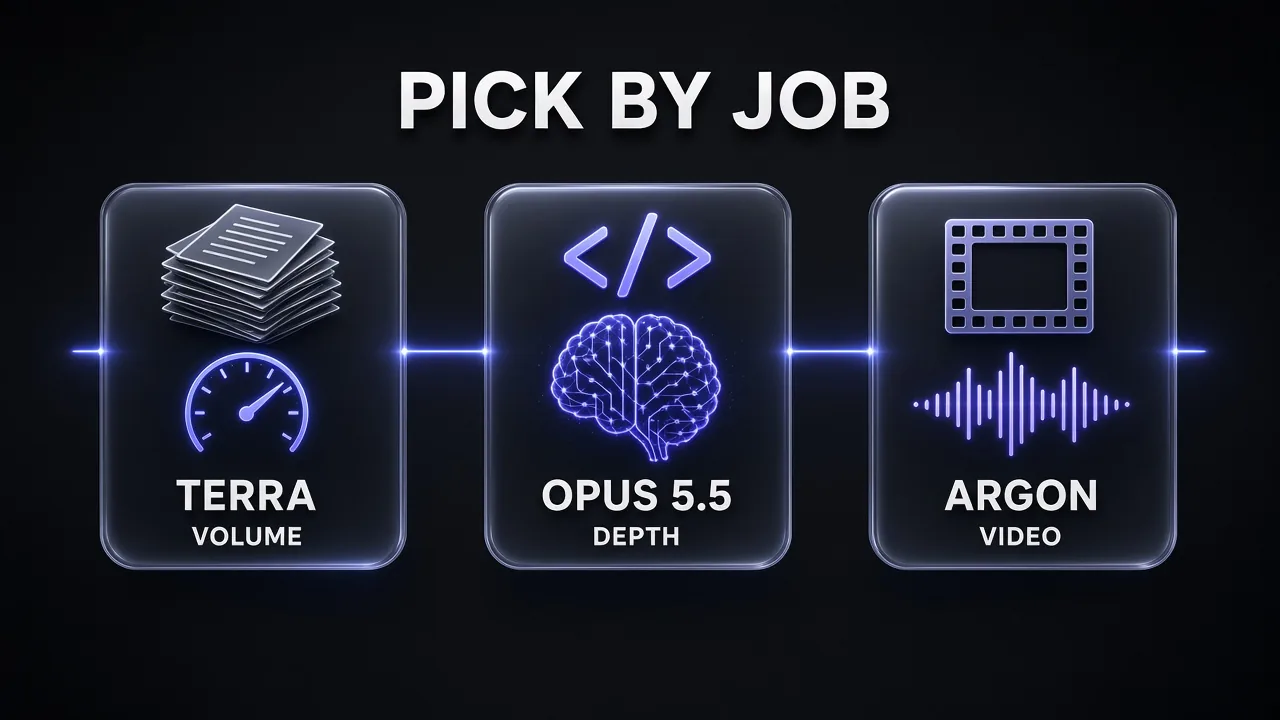
Short version: Claude Opus 5.5 is the strongest of the three, GPT-6.1 Terra is by far the cheapest to run, and Gemini 4 Argon sits in between with the best long-input and multimodal story, at least until its price doubles on 1 December. If you're choosing one model for hard agentic coding and deep reasoning, pick Opus 5.5. If you're running thousands of screen-reading, form-filling or writing tasks a day, pick Terra. If your inputs are video, audio or huge document piles, or you live in Google's stack, pick Argon.
That's the answer. The rest of this post shows why, with numbers from the three vendors' own pricing pages and docs (all re-checked on 5 November 2026) and independent scores from Artificial Analysis. We haven't run our own benchmark suite on these models, so every score below is labelled with who measured it. If you want the background on each model first, we've covered what's new in GPT-6.1 Terra, Claude Opus 5.5's specs and changes and Gemini 4 Argon's long decode and thinking levels separately.
GPT-6.1 Terra vs Claude Opus 5.5 vs Gemini 4 Argon at a Glance
| Spec | GPT-6.1 Terra | Claude Opus 5.5 | Gemini 4 Argon |
|---|---|---|---|
| Maker / API ID | OpenAI, gpt-6.1-terra | Anthropic, claude-opus-5-5 | Google, gemini-4-argon |
| Released | 26 Oct 2026 | 22 Sep 2026 | 13 Oct 2026 (GA) |
| Position | Fast, efficient tier of GPT-6 | Anthropic's mainstream flagship | Google's flagship reasoning model |
| Context window | 1,050,000 tokens | 1M tokens | 1,048,576 tokens (input + output) |
| Max output | 128K | 128K (300K on Batch, beta) | 65,536 by default, up to ~1M with long decode |
| Inputs | Text, images | Text, images | Text, images, video, audio, PDF |
| Reasoning control | Effort none to max (default medium) | Adaptive thinking, always on; effort default medium | Thinking level low / medium / high (default medium) |
| Knowledge cutoff | 1 Jun 2026 | Jun 2026 | Mar 2026 |
| API price (in / out per 1M) | $1 / $5 | $4 / $20 | $2 / $10 until 30 Nov, then $4 / $20 |
Three things jump out. All three now sit in the same million-token context class, so context size alone no longer decides anything. Only Terra can switch reasoning off entirely with none, which makes it usable as a plain fast model for extraction. And only Argon takes video and audio natively, which matters more than any benchmark if your inputs are recordings.
Benchmarks: What Independent Tests Say
Vendor launch tables are built to flatter their own model, and the three companies don't even test the same benchmarks. So the fairest single source here is Artificial Analysis, which runs one suite on all three. Its settings: Terra at max effort, Opus 5.5 at max effort, Argon at high (Argon's highest thinking level).
| Artificial Analysis metric | GPT-6.1 Terra (max) | Claude Opus 5.5 (max) | Gemini 4 Argon (high) |
|---|---|---|---|
| Intelligence Index v5 | 51 | 59 | 50 |
| AA-Briefcase (agentic knowledge work, Elo) | 1401 | 1800 | 1484 |
| AutomationBench-AA (SaaS workflows) | 60% | 70% | 78% |
| Terminal-Bench 4.0 (command-line coding) | 56% | 60% | 57% |
| FrontierCode 2.0 (mergeable repo changes) | 42% | 46% | 26% |
| HLE-Diamond (hard reasoning) | 47% | 68% | 57% |
| AA-Omniscience (knowledge minus hallucination) | 30 | 48 | 46 |
| CritPt v2 hard subset (physics research) | 68% | 68% | 53% |
| Terminal-Bench-Science 0.1 | 58% | 59% | 53% |
| GDP.pdf (document tasks) | 29% | 26% | 22% |
Selected Artificial Analysis scores
Terra and Opus 5.5 at max effort, Argon at high thinking. Higher is better
- GPT-6.1 Terra
- Claude Opus 5.5
- Gemini 4 Argon
Source: Artificial Analysis model comparison pages, fetched 5 Nov 2026
Honest reading: Opus 5.5 wins most rows, often by a wide margin on hard reasoning and knowledge reliability. Argon's standout is AutomationBench, where it leads every model Artificial Analysis has measured, but it falls well behind on FrontierCode. Terra is never far behind on coding and science, and it ties Opus on CritPt, which is remarkable for a model at a quarter of the token price.
Pro tip: These are max-effort scores. Opus 5.5 and Terra both default to medium effort in the API, so your out-of-the-box results will be lower than this table and your bill will be lower too. Our guide to choosing thinking level and effort for real workloads covers how to test that trade-off.
What the vendors claim (and how to read it)
OpenAI's launch post claims that on its Agents' Last Exam benchmark, Terra at max effort is over three times as token-efficient as Opus 5.5 at a quarter of the price per token, for roughly 9x lower cost per task. That's OpenAI's own test and its own framing, but the independent data points the same direction (see the cost section below). OpenAI is also candid that for the most complex coding tasks, its bigger GPT-6.1 Sol and GPT-6 Astra remain the better choice, which tells you where Terra stops.
Google's model card for Argon is the only vendor table that tests Opus 5.5 head to head, and it shows Argon ahead on long-context retrieval and video understanding but behind Opus on Terminal-Bench 4.0. We broke those numbers down in our Gemini 4 Argon vs Claude Opus 5.5 comparison, including where Google's and Anthropic's figures for the same model disagree.
API Pricing Compared
This is where the three models split hardest. All rates below are per million tokens, standard tier, from each vendor's pricing page on 5 November 2026.
| Rate | GPT-6.1 Terra | Claude Opus 5.5 | Gemini 4 Argon (to 30 Nov) | Gemini 4 Argon (from 1 Dec) |
|---|---|---|---|---|
| Input | $1.00 | $4.00 | $2.00 | $4.00 |
| Cached input | $0.05 | $0.20 | $0.10 (implicit only) | $0.20 (implicit only) |
| Output (incl. reasoning) | $5.00 | $20.00 | $10.00 | $20.00 |
| Batch | 50% off ($0.50 / $2.50) | 50% off ($2 / $10) | $1 / $5 | $2 / $10 |
| Fast mode | 2x standard | $8 / $40 | Priority tier available | Priority tier available |
| Long prompts | Over 272K input: 2x input, 1.5x output for the whole request | No surcharge across the full 1M | Flat rate | Flat rate |
Two catches people miss. Terra's cheap rate has a long-context cliff: once a prompt passes 272K input tokens, the entire request is billed at double input and 1.5x output. And Argon's attractive rate is an introductory price that ends on 30 November, after which it matches Opus 5.5 exactly. The full detail for each lives in our GPT-6.1 Terra pricing breakdown, Claude Opus 5.5 pricing guide and Gemini 4 Argon pricing explainer.
What a real task costs
Here's our arithmetic from the list prices above. These are not billed tests, and they assume each model uses the same number of tokens, which, as the next chart shows, they don't.
| Example request | GPT-6.1 Terra | Claude Opus 5.5 | Argon now | Argon from 1 Dec |
|---|---|---|---|---|
| 50K input + 10K output (typical agent step) | $0.10 | $0.40 | $0.20 | $0.40 |
| Same step, 10,000 times a month | $1,000 | $4,000 | $2,000 | $4,000 |
| 400K input + 20K output (long document) | $0.95 | $2.00 | $1.00 | $2.00 |
Notice the last row. Past 272K tokens, Terra's surcharge almost erases its lead over Argon's intro price. If your workload is dominated by giant prompts, Terra stops being the obvious budget pick.
Cost per task once token use is counted
The bigger difference is how many tokens each model burns to finish a job. Artificial Analysis measured output tokens per task at 59.9K for Terra, 116K for Argon and 173K for Opus 5.5. Multiply that by the price gap and the spread gets dramatic.
Average cost per Intelligence Index task
Artificial Analysis prices Argon at its $4/$20 list rate, the rate that applies from 1 Dec 2026
Source: Artificial Analysis model comparison pages, fetched 5 Nov 2026
Roughly a tenth of the cost per task for Terra, with Argon and Opus nearly tied at the post-promo price. That's the single strongest argument for Terra, and it's measured by a third party, not OpenAI.
Speed and Latency
Speed depends on what you measure. On Artificial Analysis's numbers:
- Time per task: Terra finishes an average task in 13.0 minutes, roughly half of Argon (25.8) and Opus 5.5 (26.2). Fewer tokens means less waiting.
- Raw output speed: Opus 5.5 streams fastest at 110 tokens per second, against 77 for Terra and 75 for Argon. It just produces far more tokens per task.
- Time to first answer token: Argon starts answering in about 40 seconds at high thinking, versus about 157 seconds for Terra and 336 seconds for Opus 5.5 at max effort.
So if a person is waiting on the reply, Argon feels the quickest. If you care about jobs finished per hour, Terra wins. Both OpenAI and Anthropic also sell a fast mode for extra money: 2x standard for Terra, $8/$40 for Opus 5.5, which Anthropic says runs up to 2.5x faster.
Coding and Agentic Work
For serious software engineering, Opus 5.5 is the pick. It leads FrontierCode 2.0 (whether a maintainer would merge the change) and Terminal-Bench 4.0 on Artificial Analysis, and Anthropic's own launch table shows the same strengths. Our 25 best Claude Opus 5.5 coding prompts are a good starting set if you go that way.
Terra is closer than its price suggests. It's only four points behind Opus on both coding benchmarks above, and OpenAI reports it more than doubled GPT-5.6 Terra on Terminal-Bench 4.0 (50.3% vs 21.5% in OpenAI's own run). For routine fixes, tests and refactors at volume, that's a lot of capability per dollar.
Argon is the odd one out: near Opus on Terminal-Bench but far behind on FrontierCode. Google's own numbers show strong results inside its Antigravity coding agent, which we compared in Claude Code vs Google Antigravity. If your team already lives there, Argon is the natural default; otherwise it's not our first coding pick.
Computer Use, Vision and Long Inputs
OpenAI built Terra specifically for computer use and visual reasoning: reading screens, interpreting technical drawings, filling forms and typing invoice data into accounting software. It's the cheapest way to run a screen-driving agent all day. Anthropic's Opus 5.5 also supports computer use and scores well on OSWorld in Anthropic's own testing; if you want to try that route, our Claude computer use setup guide walks through it safely.
Argon's edge is input type and output length. It's the only one of the three that accepts video and audio directly, and its long decode mode can produce up to roughly a million output tokens in background runs, far past the 128K cap on the other two. For transcripts, meeting recordings, lecture video or book-length generation, that's decisive.
On knowledge reliability, Opus 5.5 (48) and Argon (46) are well ahead of Terra (30) on Artificial Analysis's Omniscience score, which penalises confident wrong answers. If you run Terra on fact-heavy work, ground it in sources you fetch yourself rather than trusting its memory.
Which Model Should You Use?
| Your job | Best pick | Why |
|---|---|---|
| High-volume extraction, forms, screen-driving agents | GPT-6.1 Terra | About a tenth of the cost per task, fastest time to finish |
| Hard agentic coding, mergeable PRs | Claude Opus 5.5 | Leads FrontierCode and Terminal-Bench on independent tests |
| Deep reasoning, research, knowledge-heavy answers | Claude Opus 5.5 | Large lead on HLE-Diamond and Omniscience |
| SaaS workflow automation | Gemini 4 Argon | Top AutomationBench-AA score of any model measured |
| Video, audio or very long generation | Gemini 4 Argon | Native video and audio input, long decode output |
| Prompts over 272K tokens on a budget | Gemini 4 Argon (until 30 Nov) | Flat rate beats Terra's long-context surcharge |
| Writing, drafts, email at scale | GPT-6.1 Terra | OpenAI tuned it for clear writing at the lowest price |
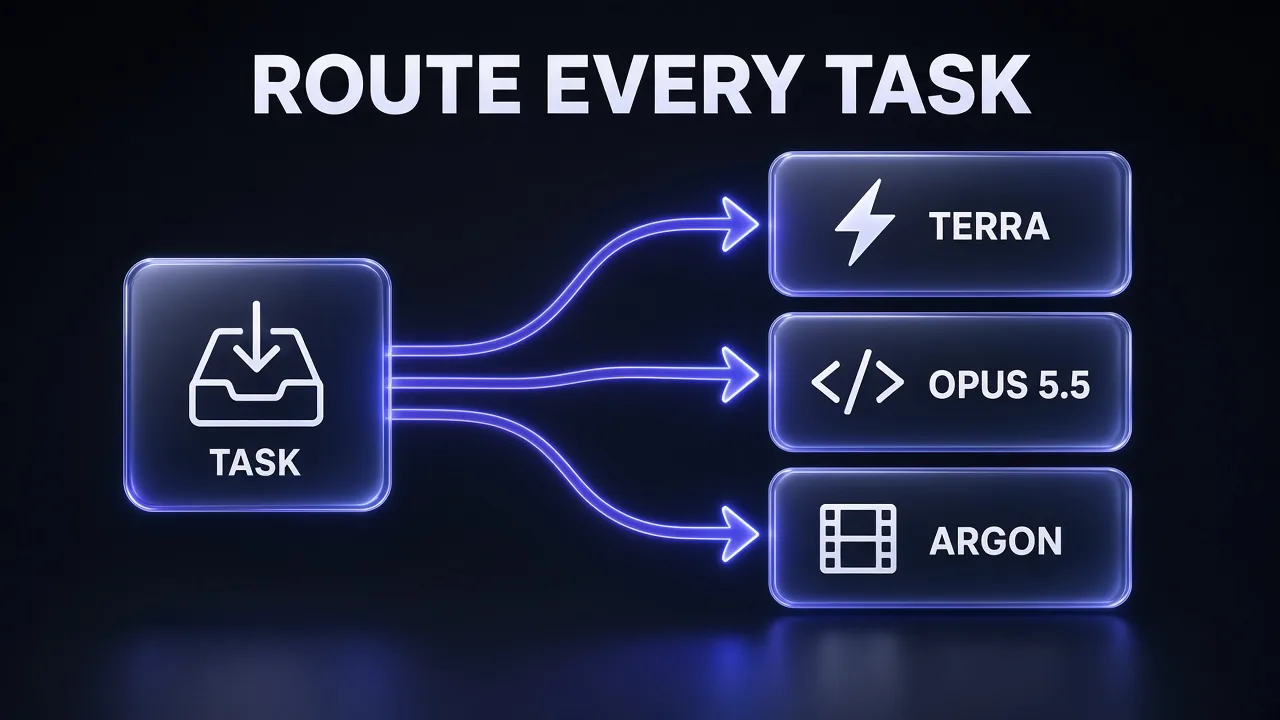
My take: most teams shouldn't pick one. Route the bulk of routine calls to Terra, escalate the hard 10% to Opus 5.5, and send video or giant document jobs to Argon. That's the same routing logic as our AI model decision matrix, and with Terra's prices it's never been cheaper to run.
Three-Model Routing Brief
I run an AI workload with these tasks: [LIST YOUR TASKS, VOLUMES PER MONTH AND AVERAGE PROMPT SIZE].
Available models: GPT-6.1 Terra ($1/$5 per 1M tokens, 2x input and 1.5x output above 272K input), Claude Opus 5.5 ($4/$20, flat to 1M), Gemini 4 Argon ($2/$10 until 30 Nov 2026, then $4/$20; accepts video and audio).
For each task: recommend one model, give the reason in one sentence, estimate monthly cost from my volumes, and flag any task where a cheaper model is likely good enough if I add a verification step.
End with a routing table and the total monthly cost before and after 1 December 2026.
Where You Can Use Each Model
- GPT-6.1 Terra: OpenAI API (Responses, Chat Completions and Batch; tool calling needs the Responses API), plus ChatGPT Work and Codex on Plus, Pro, Enterprise and Edu plans.
- Claude Opus 5.5: Claude API, Amazon Bedrock, Google Cloud and Microsoft Foundry, plus the Claude apps and Claude Code on paid plans.
- Gemini 4 Argon: Gemini API on the paid tier only (not the free tier), Google AI Studio, the Gemini app on paid Google AI plans and the Antigravity coding agent.
If you're watching costs on Claude specifically, prompt caching changes the maths a lot: Opus 5.5 cache hits cost 5% of the input rate. Our Claude prompt caching guide shows how to set it up.
The Verdict
Claude Opus 5.5 is the best model of the three on quality, and it's not especially close on hard reasoning and repo-level coding. GPT-6.1 Terra is the best value by a mile, finishing tasks for roughly a tenth of the cost and twice as fast, while staying within a few points of Opus on coding. Gemini 4 Argon is the specialist: unbeatable for video, audio and very long outputs, strong on workflow automation, and a bargain until 30 November, after which its price matches Opus.
If you only take one action this week, move your cheap, repetitive calls to Terra and measure the quality drop on your own data before moving anything harder. Then revisit Argon before 1 December, when its price doubles.
Keep Reading
Frequently Asked Questions
10 questions answered