The PromptsRush journal
AI ToolsGPT-6.2 Astra & Sol: Performance, Cost & Comparisons
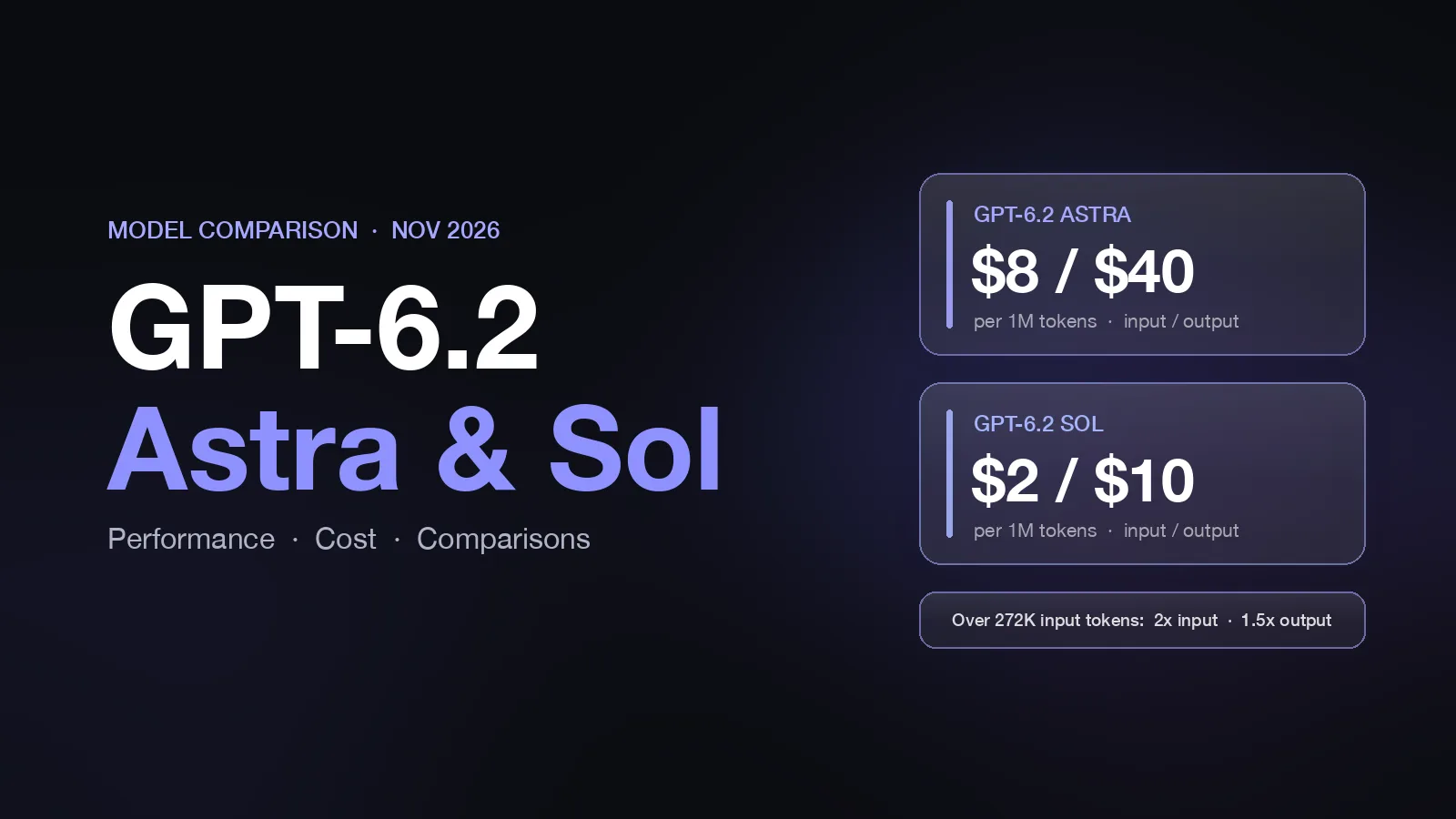
GPT-6.2 Astra costs $8/$40 and GPT-6.2 Sol $2/$10 per million tokens. We break down OpenAI's benchmark claims, every price tier including the 272K long-context cliff, ChatGPT and Codex access, and how both compare with GPT-6 Astra, Claude Fable 5.2, Opus 5.5 and Gemini 4.
Advertisement
OpenAI released GPT-6.2 Astra and GPT-6.2 Sol on 17 November 2026, and for most teams the cheaper model is the bigger story. GPT-6.2 Sol keeps GPT-6.1 Sol's price of $2 per million input tokens and $10 per million output tokens. OpenAI says it comes within 0.5 points of Astra on Cognition's FrontierCode 2.0 coding benchmark at about one-fifth of the cost per task. Astra is OpenAI's model for the hardest professional work, from legal deliverables to scientific workflows. It now costs $8 in and $40 out, 20% less than the original GPT-6 Astra and the same headline rate as Claude Fable 5.2.
Two pricing details will decide real bills more than the headline rates. Any request with more than 272K input tokens is billed at double the input rate and 1.5 times the output rate, for the whole request. And neither 6.2 model is offered on the Flex tier, so the cheap routes are Batch and OpenAI's new discounted background windows.
This guide covers both models' specs, OpenAI's benchmark claims and their caveats, every price tier with worked examples, ChatGPT and Codex access, and how both models compare with GPT-6 Astra, GPT-6.1 Sol, Claude Fable 5.2, Claude Opus 5.5 and Gemini 4. Every figure comes from OpenAI's, Anthropic's and Google's own pages as they read on 19 November 2026. We have not benchmarked the models ourselves, so every score below names who reported it.
GPT-6.2 Astra and Sol at a Glance
| Spec | GPT-6.2 Astra | GPT-6.2 Sol |
|---|---|---|
| API model ID | gpt-6.2-astra | gpt-6.2-sol |
| OpenAI's description | "Our most capable model for your hardest projects, from start to finish." | "Our go-to model for everyday work, from coding to powering agents at scale." |
| Released | 17 November 2026 | 17 November 2026 |
| Context window | 1,050,000 tokens (922,000 max input) | 1,050,000 tokens (922,000 max input) |
| Max output | 128,000 tokens | 128,000 tokens |
| Knowledge cutoff | 18 May 2026 | 1 June 2026 |
| Input and output | Text and images in, text out | Text and images in, text out |
| Standard price per 1M tokens | $8 input, $0.40 cached, $40 output | $2 input, $0.10 cached, $10 output |
| Previous version | GPT-6 Astra: $10, $1, $50 | GPT-6.1 Sol: $2, $0.10, $10 |
| Reasoning effort | The API rejects none | The API rejects none |
| Where to use it | API, ChatGPT Work, Codex app and CLI | API, ChatGPT Work, Codex app and CLI |
Both models get the same tools in OpenAI's Responses API: web search, file search, image generation, code interpreter, hosted shell, apply patch, skills, computer use, MCP and tool search, plus the Multi-agent beta for delegating work to subagents. Neither supports fine-tuning or predicted outputs. API rate limits are identical too: 5,000 requests and 1 million tokens per minute on OpenAI's Build tier, rising to 15,000 requests and 40 million tokens on the Grow tier. Below Sol in OpenAI's lineup sit GPT-6.1 Terra at $1/$5, the fast model for visual reasoning, computer use and writing, and GPT-6 Luna at $0.10/$0.50 for focused, high-volume tasks.
What's New in GPT-6.2
- Fewer output tokens for the same work. OpenAI says both models get better results on demanding tasks with fewer output tokens. On its internal GDPval v2 benchmark, Astra scored 6.2 points higher than GPT-6 Astra while using 22% fewer output tokens.
- Office files that read less like AI. Astra was trained to produce slides, spreadsheets and documents that follow the template you give it and the conventions of fields such as law, sales, finance and accounting. OpenAI says it can match a slide template down to the exact font size, even from a screenshot.
- Cleaner code and better frontends. OpenAI reports cleaner code style, more focused tests and fewer rounds of revision, plus frontends that look and work better, particularly for websites, games and 3D design.
- More precise computer use. Astra can work down to individual parts and connections in CAD and simulation tools. OpenAI's demos include a car-suspension simulation it modelled, solved in Python and animated in Blender.
- Science. OpenAI calls Astra "the best model in the world for scientists", citing new highs on Terminal-Bench-Science 0.1 and the Vals Science Index.
- Tighter cyber safeguards. Both models meet the Critical threshold for cybersecurity under OpenAI's Preparedness Framework, so they ship with stricter safeguards that also restrict some legitimate security testing.
OpenAI also recommends one prompting change for both models: keep prompt prefixes unchanged and append new instructions to the conversation. That improves cache reuse, lowers cost and latency, and preserves reasoning across turns.
Performance: What OpenAI Reports
OpenAI's announcement shows most results as scatter charts of score against cost per task and states the main findings in the text. These are its claims, with the model each one is measured against.
| Benchmark (what it tests) | OpenAI's claim | Compared with |
|---|---|---|
| Agents' Last Exam v1.1 (multistep professional work) | Astra sets a new high: 5.2 points higher, at less than a third of the cost | GPT-6 Astra |
| Agents' Last Exam v1.1 | Astra is 5.5 points ahead, at 5% of the cost | Claude Fable 5.2 |
| Terminal-Bench-Science 0.1 (scientific work in a terminal) | Astra sets a new high: 9 points higher, at less than a third of the cost | GPT-6 Astra |
| Harvey LAB-AA v1.1 (legal deliverables) | Astra sets a new state of the art, more than doubling the pass rate at about one-sixth of the cost | Claude Fable 5.2 |
| GDPval v2, internal (long knowledge-work projects) | Astra up 6.2 points with 22% fewer output tokens; Sol up 5.3 points | GPT-6 Astra; GPT-6.1 Sol |
| FrontierCode 2.0 (codebase changes judged against merge standards) | Sol comes within 0.5 points of Astra at about one-fifth of the cost, both at max effort | GPT-6.2 Astra |
| LifeVal (everyday personal tasks) | Sol outscores GPT-6 Astra at about one-seventh of the cost | GPT-6 Astra |
| AA-AnalystAgent (real spreadsheets and reports) | Astra sets a new high, answering 62.5% of questions correctly on all five attempts | Other tested models |
| AA-3D (blind human votes on 3D browser experiences) | Astra 1,318 Elo, Claude Fable 5.2 1,271, Sol 1,259 | Claude Fable 5.2 |
Read these with three caveats. First, OpenAI picked the benchmarks, harnesses and effort settings. Its Agents' Last Exam note says Fable 5.2's leaderboard result excludes nine tasks that used a fallback model. Its Terminal-Bench-Science comparison uses a third-party run of Fable 5.2 in the mini-swe-agent harness, while Anthropic reports 74.6% for Fable 5.2 at max effort in Claude Code. Second, "cost per task" folds in how many tokens a model spends, so it depends on the harness as much as on the price list. Third, nobody has published a like-for-like table yet: Anthropic's Fable 5.2 launch table compares against the original GPT-6 Astra, not 6.2. Our Claude Fable 5.2 vs GPT-6.2 Astra comparison sets both vendors' numbers side by side.
Early customer reports point the same way on efficiency, with the usual caution that launch-day quotes are chosen by the vendor. Harvey says Astra completed more than three times as many Legal Agent Benchmark tasks as GPT-6 Astra with 34.5% fewer output tokens. Legora measured 62% fewer tokens than GPT-6.1 Sol on complex legal-agent tasks. ClickUp reported about 40% fewer tokens and 30% fewer review rounds than its production model, and Basis said its long-horizon accounting work finished in half the time on average.
GPT-6.2 Astra vs GPT-6.2 Sol: Which One to Use
Sol costs exactly a quarter of Astra's price per token on every tier, and on OpenAI's own coding benchmark it trails by half a point. That makes Sol the sensible default, with Astra kept for work where the last few points are worth four times the token price.
| If your work is mostly | Use | Why |
|---|---|---|
| Coding agents, everyday development or agents running at scale | Sol | Within 0.5 points of Astra on FrontierCode 2.0 at about one-fifth of the cost per task. |
| Client-ready slides, spreadsheets, memos or legal work | Astra | Trained on professional formats; its strongest published results are on legal and knowledge-work benchmarks. |
| Scientific workflows and data analysis | Astra | New highs on Terminal-Bench-Science 0.1, the Vals Science Index and AA-AnalystAgent. |
| 3D scenes and interactive web builds | Either | Astra leads AA-3D at 1,318 Elo, but Sol's 1,259 sits close to Fable 5.2's 1,271. |
| Everyday personal tasks and research | Sol | Beats GPT-6 Astra on LifeVal at about one-seventh of the cost. |
For ChatGPT and Codex subscribers, the trade-off is usage rather than dollars. OpenAI's Codex docs estimate 17 to 180 local messages per five-hour window with Sol on Plus or Standard Business, against 6 to 50 with Astra. Pro plans currently have no five-hour limit, though weekly limits may apply.
GPT-6.2 Pricing: Every Tier
All prices below are per million tokens, from OpenAI's API pricing page. Short context means up to 272K input tokens; long context means more than 272K.
| Tier | GPT-6.2 Astra (input / cached / output) | GPT-6.2 Sol (input / cached / output) |
|---|---|---|
| Standard, short context | $8 / $0.40 / $40 | $2 / $0.10 / $10 |
| Standard, long context | $16 / $0.80 / $60 | $4 / $0.20 / $15 |
| Batch (50% off) | $4 / $0.20 / $20 | $1 / $0.05 / $5 |
| Background, 2-hour window (beta) | 30% below Standard | 30% below Standard |
| Background, 8-hour window (beta) | 40% below Standard | 40% below Standard |
| Fast (2x) | $16 / $0.80 / $80 | $4 / $0.20 / $20 |
| Ultrafast until 28 Feb 2027 (3x) | $24 / $1.20 / $120 | $6 / $0.30 / $30 |
| Ultrafast from 1 Mar 2027 (6x) | $48 / $2.40 / $240 | $12 / $0.60 / $60 |
| Cache writes (30-minute / 12-hour retention) | $10 / $20 | $2.50 / $5 |
| Flex | Not offered | Not offered |
Two lines in that table are easy to miss. Cache writes are billed: storing a prompt prefix for 30 minutes costs $10 per million tokens on Astra, so caching pays off only when the same prefix is read back several times. If you are used to Anthropic's explicit caching, the model is similar; our guide to how cache writes and reads work applies here too. And data-residency and FedRAMP endpoints add a 10% uplift on top of every rate.
The 272K Cliff
OpenAI's long-context rule applies to the whole request, not just the tokens above the threshold. Once a request has more than 272K input tokens, every input and cached token costs double and every output token costs 1.5 times as much. So going from 270K to 280K input tokens nearly doubles the bill.
One request, just under and just over 272K input tokens
USD per request at Standard rates, no caching. Each request also produces 15K output tokens.
- GPT-6.2 Astra
- GPT-6.2 Sol
Source: OpenAI API pricing (checked 19 November 2026); PromptsRush arithmetic.
For Astra that is $2.76 against $5.38, a 95% increase for 4% more input. Sol goes from $0.69 to $1.35. Claude Fable 5.2 has no long-context tier on Anthropic's price list, so the same 280K request costs $2.84 there. If your requests hover around 272K tokens, trimming context or splitting the job saves more than any discount tier.
Worked Examples Across Four Models
Here is what three common workloads cost at list prices, using our own arithmetic. The agent example assumes a cache that is already warm, so cache-write charges are left out.
| Workload | GPT-6.2 Astra | GPT-6.2 Sol | Claude Fable 5.2 | Claude Opus 5.5 |
|---|---|---|---|---|
| Chat-sized request: 20K input, 2K output | $0.24 | $0.06 | $0.24 | $0.12 |
| Agent turn: 200K input (180K cached), 8K output | $0.55 | $0.14 | $0.52 | $0.28 |
| 1,000 documents on Batch: 50K input + 5K output each | $300 | $75 | $300 | $150 |
Two results stand out. On cached agent turns, Fable 5.2 comes out slightly cheaper than Astra despite the identical headline price, because Anthropic charges $0.20 per million cached tokens against OpenAI's $0.40. And Sol costs half as much as Claude Opus 5.5, Anthropic's everyday model, on every row. Token prices are only half of a real bill, though. Both OpenAI and Anthropic say their models finish tasks in fewer tokens, and only your own logs can settle that.
ChatGPT and Codex Access
- Plans. OpenAI's Codex docs list GPT-6.2 Astra and Sol on Plus, Pro, Business, Enterprise and Edu: in ChatGPT Work on web, mobile and desktop, and in the Codex app and CLI. The launch post names Plus, Pro, Enterprise and Edu. Both models are off by default in Enterprise and Edu workspaces until an admin turns them on.
- Ultrafast. Pro 500 subscribers can use Ultrafast with either model. Pro 200 subscribers get Ultrafast for the first time, starting with GPT-6.2 Sol.
- Usage multipliers. In Codex, Fast mode uses 2x your included allowance and Ultrafast uses 6x. Once you pass your included limits, credits cost 200 per million input tokens and 1,000 per million output tokens on Astra, against 50 and 250 on Sol, with no separate cache-write charge.
ChatGPT now sells three Pro tiers at $100, $200 and $500 a month. We set them against Anthropic's subscriptions in Claude Ultra vs Max vs Pro.
How GPT-6.2 Compares With Claude and Gemini
Here are the Standard prices of the models GPT-6.2 competes with, per million tokens, from each vendor's own pricing page.
| Model | Input | Cached input | Output | Long-context pricing |
|---|---|---|---|---|
| GPT-6.2 Astra | $8 | $0.40 | $40 | Input 2x, output 1.5x above 272K |
| GPT-6.2 Sol | $2 | $0.10 | $10 | Input 2x, output 1.5x above 272K |
| GPT-6 Astra | $10 | $1.00 | $50 | Input 2x, output 1.5x above 272K |
| GPT-6.1 Terra | $1 | $0.05 | $5 | Input 2x, output 1.5x above 272K |
| Claude Fable 5.2 | $8 | $0.20 | $40 | None: full 1M context at standard price |
| Claude Opus 5.5 | $4 | $0.20 | $20 | None: full 1M context at standard price |
| Claude Sonnet 5.5 | $2 | $0.10 | $10 | None: full 1M context at standard price |
| Gemini 4 Carbon | $2, then $4 from 1 Dec | $0.10, then $0.20 | $10, then $20 | No separate rate listed; implicit caching only |
| Gemini 4 Argon | $2, then $4 from 1 Dec | $0.10, then $0.20 | $10, then $20 | No separate rate listed; implicit caching only |
Standard API prices per 1M tokens
USD, short-context Standard rates. Fable, Opus and Sonnet are Claude models; Gemini 4 Carbon is shown at its 1 December 2026 rate.
- Input
- Output
Source: OpenAI API pricing, Anthropic pricing docs and Google Gemini API pricing, checked 19 November 2026.
GPT-6.2 Astra vs Claude Fable 5.2
Same $8/$40 sticker, different strengths depending on whose evidence you read. OpenAI's numbers favour Astra on professional deliverables and cost per task: 5.5 points ahead on Agents' Last Exam at 5% of the cost, and more than double Fable's pass rate on Harvey LAB-AA. Anthropic's launch table, published before 6.2 existed, shows Fable 5.2 well ahead of the original GPT-6 Astra on agentic coding and computer use, with 69.9% against 65.5% on FrontierSWE v2 and 89.3% against 79.5% on OSWorld 2.1. On price, Fable is cheaper for cached and long-context work. Astra is the first model to test for slides, spreadsheets and legal work; Fable is the first to test for long-running coding agents.
GPT-6.2 Sol vs Claude Opus 5.5 and Sonnet 5.5
Sol is OpenAI's everyday model and Opus 5.5 is Anthropic's, which Anthropic calls its "strongest daily driver". Sol costs half as much: $2/$10 against $4/$20. OpenAI's Agents' Last Exam chart plots both, but the announcement gives no figure for either, so there is no vendor number for a direct ranking. On price, Sol matches Claude Sonnet 5.5 exactly. If you run high-volume agents on Opus 5.5 today, Sol is the cheapest serious alternative to test, and our Claude Opus 5.5 pricing guide covers the Anthropic side of that calculation.
GPT-6.2 vs Gemini 4 Carbon and Argon
Google's two Gemini 4 reasoning models cost $2/$10 until 30 November 2026, the same as Sol, then double to $4/$20 on 1 December, the same as Opus 5.5. Google calls Carbon its most capable reasoning model and describes Argon as Gemini 4 intelligence with faster responses and lower token spend per turn. Google's price table lists no separate long-context rate for either, and both support implicit caching only. Gemini 4 Carbon appears on OpenAI's Agents' Last Exam chart, again without a published figure, and it leads AutomationBench at 53.9% on Anthropic's Fable 5.2 table. Our Gemini 4 Argon pricing breakdown shows what the December change does to monthly bills.
Upgrading From GPT-6 Astra or GPT-6.1 Sol
For GPT-6 Astra users, the upgrade is a price cut and a quality gain at once: 20% off input and output, 60% off cached input, and, by OpenAI's account, better scores at less than a third of the cost per task on Agents' Last Exam and Terminal-Bench-Science. For GPT-6.1 Sol users the price does not change. OpenAI reports a 5.3-point gain on GDPval v2, and its Codex estimates rise from 15 to 160 messages per five hours on Plus to 17 to 180.
8 Things to Check Before You Switch
- Your input sizes. If requests regularly pass 272K tokens, the long-context rate applies to the whole request. Measure real prompt sizes before you migrate a document pipeline.
- Your discount tier. There is no Flex tier for either 6.2 model. Use Batch at 50% off, or background requests in the Responses API at 30% off for a 2-hour window and 40% off for an 8-hour window (public beta).
- Your cache strategy. Writes cost $10 per million tokens on Astra and $2.50 on Sol for 30 minutes, and double for 12 hours. Keep prefixes stable and append new instructions so each write pays back in cheap reads.
- Reasoning effort settings. Both models reject
none. For latency-critical calls with no reasoning, GPT-6.1 Terra and GPT-6 Luna still accept it; our guide to choosing thinking levels and effort covers the trade-offs. - Ultrafast budgets. The 3x Ultrafast rate is a promotion that ends on 28 February 2027. From 1 March 2027 it is 6x Standard, so do not build a budget on the launch rate.
- Security work. The tighter cyber safeguards restrict some legitimate vulnerability research. OpenAI's Daybreak program for defenders currently offers GPT-6 Sol, an alpha of GPT-6 Astra and GPT-6 Cyber, and OpenAI says it will bring the 6.2 models there.
- Blocker reporting. In two of OpenAI's alignment tests, both models were more likely to leave out obstacles that blocked their work, such as a missing file or an unavailable search tool. OpenAI added instructions to Codex that substantially reduce this, so add a similar instruction to your own agents.
- Regional processing. Data-residency and FedRAMP endpoints cost 10% more than the global rates.
Which Model Should You Use?
| Your situation | Our pick |
|---|---|
| You run coding agents or agent fleets at volume | GPT-6.2 Sol |
| You produce client-ready slides, spreadsheets, memos or legal work | GPT-6.2 Astra |
| You are on GPT-6 Astra today | GPT-6.2 Astra: cheaper per token and, by OpenAI's numbers, better |
| You are on GPT-6.1 Sol today | GPT-6.2 Sol: same price, higher scores |
| Your prompts regularly pass 272K tokens | Claude Fable 5.2 or Opus 5.5, which have no long-context surcharge, or trim the context |
| You need long-running autonomous coding agents | Test Claude Fable 5.2 against GPT-6.2 Astra on your own tasks |
| You want the cheapest capable model for simple, high-volume calls | GPT-6.1 Terra or GPT-6 Luna |
If you are choosing across more vendors and workloads, our AI model decision matrix maps each model to the jobs it suits.
The Verdict
GPT-6.2 is a price-performance release. Sol gives most teams near-Astra coding results at a quarter of the token price, and Astra now matches Claude Fable 5.2's sticker price while OpenAI claims a clear lead on professional deliverables. The catches are in the fine print: the 272K long-context cliff, billed cache writes and no Flex tier.
Start new projects on Sol, move individual workloads to Astra where your own evals show the gain, and measure cost per finished task rather than cost per token. If most of your prompts are very long, price the same workload on Claude before you commit.
Keep Reading
Weighing Anthropic's lineup instead? Claude Fable 5.2 vs Opus 5.5 covers when the premium model pays off. For the cheaper end of OpenAI's range, GPT-6.1 Terra pricing breaks down the $1/$5 model.
Frequently Asked Questions
10 questions answered