The PromptsRush journal
AI ToolsClaude Fable 5.2 vs Opus 5.5: Specs and Comparison
Claude Fable 5.2 vs Opus 5.5 compared: specs, benchmarks, pricing, API differences and plan access, plus a clear guide to which model fits coding, agents and research.
Advertisement
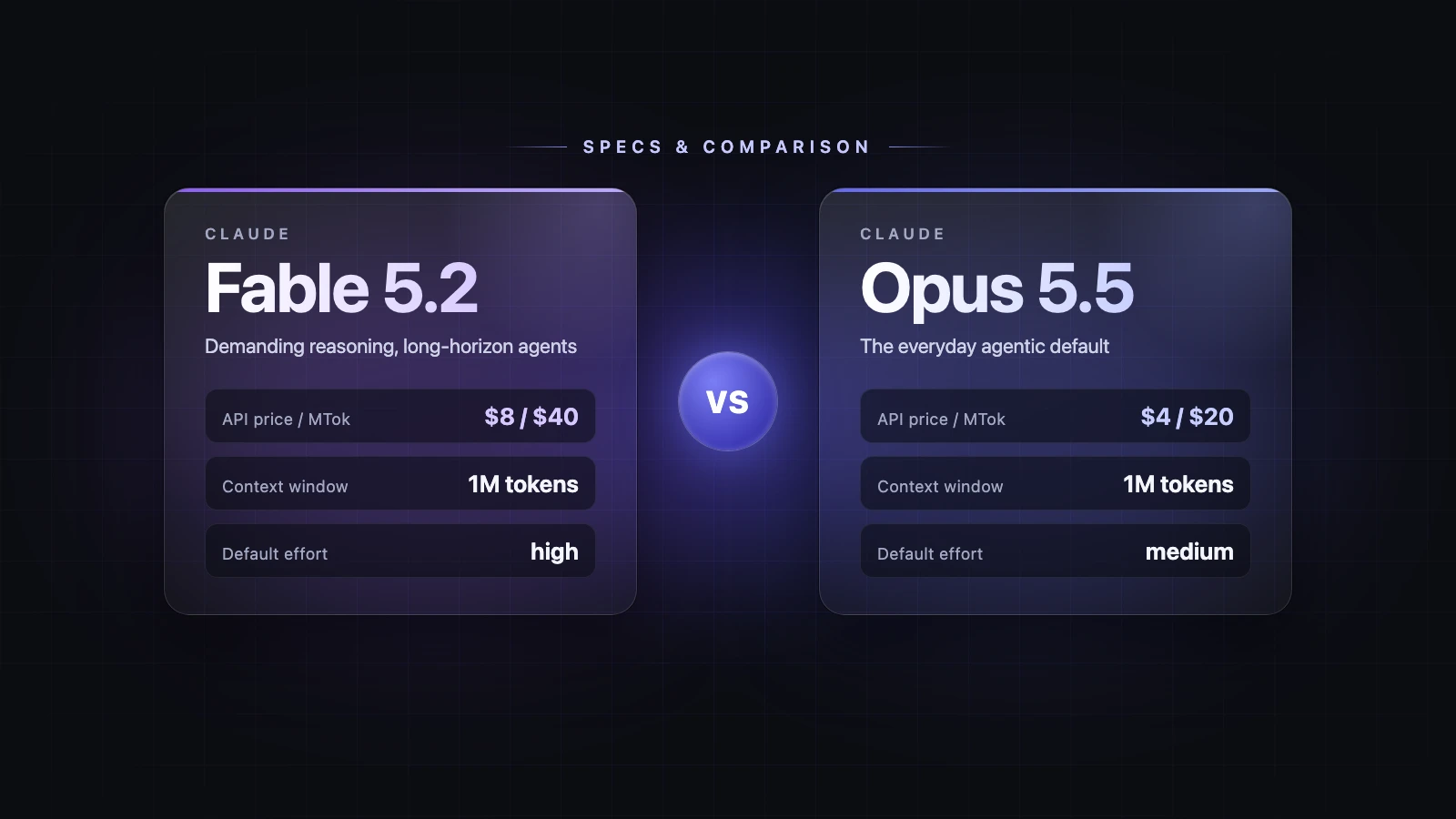
Claude Opus 5.5 is still the model to start with. Claude Fable 5.2, released on November 9, 2026, is the one to move up to when Opus 5.5 at high effort still falls short: agent sessions that run for hours, multistep research, work that has to end in a finished deliverable. That is Anthropic's own guidance, and the specs back it up. Fable 5.2 costs exactly twice as much per token — $8/$40 per million input/output tokens against $4/$20 — and on Anthropic's published benchmarks it beats Opus 5.5 on almost everything.
The 2x price is not the whole story. Cache reads cost the same $0.20 per million tokens on both models, Fable 5.2 can reach Opus-level results at a lower effort setting, and the two models differ in ways that break code: data retention, default effort, thinking-block portability and rate limits. This comparison covers the specs, the benchmarks, what a task actually costs on each, and the API details that decide whether you can switch at all. We took every number from Anthropic's model pages, pricing docs and launch announcement on November 11, 2026.
Fable 5.2 vs Opus 5.5 at a Glance
| Spec | Claude Fable 5.2 | Claude Opus 5.5 |
|---|---|---|
| Released | November 9, 2026 | September 22, 2026 |
| Built for | Demanding reasoning and long-horizon agentic work | Long-running agentic coding and knowledge work |
| API model ID | claude-fable-5-2 | claude-opus-5-5 |
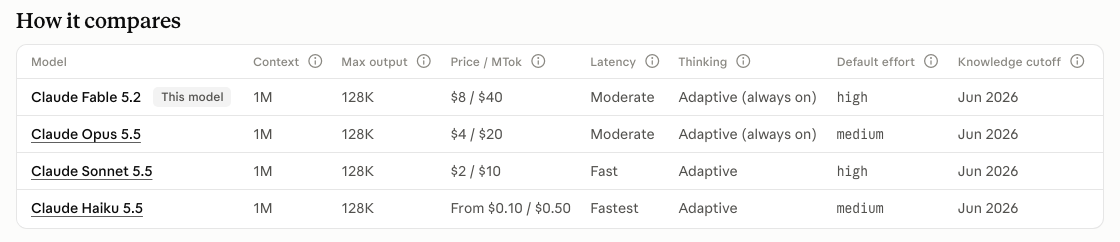
| Input / output (per MTok) | $8 / $40 | $4 / $20 |
| Cache writes (5-minute / 1-hour) | $10 / $16 | $5 / $8 |
| Cache reads | $0.20 | $0.20 |
| Batch API (input / output) | $4 / $20 | $2 / $10 |
| Fast mode (input / output) | $16 / $80 | $8 / $40 |
| Context window | 1M tokens | 1M tokens |
| Max output | 128K tokens | 128K tokens (300K on the Batch API, beta) |
| Thinking | Adaptive, always on | Adaptive, always on |
| Default effort on the API | high | medium |
| Reliable knowledge cutoff | June 2026 | June 2026 |
| Comparative latency | Moderate | Moderate |
| Zero data retention | Only if Anthropic authorizes it (30-day retention required) | Available |
| Rate limits | Separate pool, lower token limits per tier | Separate pool, higher token limits per tier |
| Retirement | Not before November 9, 2027 | Not before September 22, 2027 |
On paper the two models are close to twins: the same 1M-token context window, the same 128K output ceiling, the same June 2026 knowledge cutoff, the same always-on adaptive thinking and the same "moderate" latency rating. Both run on the same six platforms — the Claude API, Amazon Bedrock, Claude Platform on AWS, Microsoft Foundry, and both versions of Claude on Google Cloud. The differences are price, default effort, and a handful of operational rules covered further down.
What's New in Claude Fable 5.2
Fable 5.2 replaces Fable 5.1 as Anthropic's top widely available model. It shares its underlying model with Claude Mythos 5.2, continuing the Fable and Mythos split Anthropic introduced with Fable 5: Mythos 5.2 has the same specs and prices but is reserved for organizations in Anthropic's cyber and life-sciences verification programs. Against Fable 5.1, these are the changes that matter:
- A 20% price cut. Input drops from $10 to $8 per million tokens and output from $50 to $40. Cache reads stay at 2.5% of the input price, which is now $0.20.
- Faster output. Anthropic says Fable 5.2 generates output up to 30% faster than Fable 5.1, and a new fast mode speeds token generation by up to 2.5x at $16/$80 per million tokens.
- Fewer false refusals. In Anthropic's early testing across claude.ai, Claude Code and Cowork, Fable 5.2's safety classifiers blocked about 55% fewer requests than Fable 5.1's — roughly 60% fewer in cybersecurity and 40% fewer in biology.
- Large benchmark gains. FrontierSWE v2 rises from 56.3% to 69.9%, the Remote Labor Index from 17.9% to 41.3%, and the RoboDojo robotics simulation from 27.6% to 64.9%.
- Stricter conversation rules. Preserved thinking — the check that rejects a request whose earlier history was edited — now applies to every account, and only Fable 5.2 and Mythos 5.2 can read Fable 5.2's thinking blocks.
Fable 5.2 is also deliberately held back in one area. During training, Anthropic limited the research skills that most directly speed up AI development, such as accelerator kernel optimization and LLM architecture work, so on those tasks it performs at about Opus 5.5's level, with transparent fallbacks to Opus 5 on a small set of topics. Anthropic says agentic coding, hardware work and general machine-learning research were not affected.
Claude Opus 5.5 in Brief
Opus 5.5 launched on September 22, 2026, and Anthropic still calls it its "strongest daily driver" — the model to start with for most coding and knowledge work. It costs $4/$20 per million tokens, below Opus 5's $5/$25, and its cache reads cost 5% of the input price, the same $0.20 as Fable 5.2. Like Fable, it always thinks adaptively, but its default effort is medium, one level lower. Anthropic lists multihour autonomous coding agents, large-scale refactoring, systems engineering, vision-heavy workflows and computer use as its typical jobs.
Opus 5.5 also keeps a few things Fable 5.2 doesn't have: up to 300K output tokens on the Message Batches API with a beta header, structured outputs in organizations that use customer-managed encryption keys, and zero data retention. Our Opus 5.5 pricing guide works through its fast mode, caching and batch costs in detail.
Benchmarks: Where Fable 5.2 Leads
Anthropic's launch table puts Fable 5.2 ahead of Opus 5.5 on 11 of the 12 general benchmark rows where both have a score. Every number is Anthropic's own, run at each model's highest available effort with safeguards on unless noted, so read them as the vendor's best case rather than an independent ranking.
Agentic work: Fable 5.2 vs Opus 5.5
Score in %, highest available effort, safeguards on. T-Bench Sci = Terminal-Bench-Science 0.1, WANDR = agentic search, OSWorld = computer use, RoboDojo = robotics sim.
- Fable 5.2
- Opus 5.5
Source: Anthropic, Claude Fable 5.2 and Mythos 5.2 announcement (Nov 9, 2026). Fable 5.2 FrontierCode 2.0 score at xhigh effort.
The gaps are not uniform. Fable 5.2's biggest leads come on the longest, most open-ended work: RoboDojo robotics climbs from 39.4% to 64.9%, and Terminal-Bench-Science, which tests agentic scientific research, rises 15.9 points. On contained tasks the gap shrinks to 2.1 points on OSWorld 2.1 computer use and 3.6 points on FrontierCode 2.0, which measures whether a model's code changes would be merged by open-source maintainers.
Knowledge work and reasoning: Fable 5.2 vs Opus 5.5
Score in %, highest available effort, safeguards on. Remote Labor = Remote Labor Index, AA-Briefcase = v1.1 rubric score, HLE = Humanity's Last Exam.
- Fable 5.2
- Opus 5.5
Source: Anthropic, Claude Fable 5.2 and Mythos 5.2 announcement (Nov 9, 2026). Fable 5.2 Remote Labor Index score at high effort; Humanity's Last Exam with tools; Chartography without tools.
Knowledge work shows the same pattern. Fable 5.2 nearly doubles Opus 5.5 on the Remote Labor Index (41.3% vs 21.3%) and leads Humanity's Last Exam by 6.5 points. The one row Opus 5.5 wins is AA-Briefcase's Elo rating for knowledge work, 1800 to 1785, even though Fable takes the same benchmark's rubric score.
| Benchmark | Fable 5.2 | Opus 5.5 | Gap (points) |
|---|---|---|---|
| FrontierCode 2.0 (agentic coding) | 49.1%* | 45.5% | +3.6 |
| FrontierSWE v2 (agentic coding) | 69.9% | 62.3% | +7.6 |
| AutomationBench (business workflows) | 51.4% | 42.5% | +8.9 |
| Terminal-Bench-Science 0.1 (scientific research) | 74.6% | 58.7% | +15.9 |
| WANDR, relaxed score (agentic search) | 82.1% | 72.3% | +9.8 |
| OSWorld 2.1, offline partial set (computer use) | 89.3% | 87.2% | +2.1 |
| RoboDojo Sim (robotics) | 64.9% | 39.4% | +25.5 |
| AA-Briefcase v1.1, rubric (knowledge work) | 66.1% | 61.2% | +4.9 |
| AA-Briefcase v1.1, Elo (knowledge work) | 1785 | 1800 | −15 Elo |
| Remote Labor Index (knowledge work) | 41.3%** | 21.3% | +20.0 |
| Humanity's Last Exam, with tools | 74.2% | 67.7% | +6.5 |
| Chartography, no tools (chart reading) | 73.4% | 64.4% | +9.0 |
* Fable 5.2 at xhigh effort. ** Fable 5.2 at high effort. All other scores at each model's highest available effort. Source: Anthropic.
The more useful numbers sit in Anthropic's accuracy-versus-cost charts. On FrontierCode 2.0, Fable 5.2 at high effort scored 45.3%, level with Opus 5.5's best result (45.5%), for roughly half the cost per task. On Perplexity's WANDR data-collection benchmark, Fable 5.2 at medium matched Opus 5.5's top score for about 40% of the cost per task, and on Humanity's Last Exam it matched Opus 5.5's top score at low effort for less than a tenth of the cost. A pricier model at a lower effort setting can be the cheaper way to reach a given quality bar. On BenchCAD 2.1, a hardware-design benchmark scored 0–100, the gap is the widest in the launch material: 83.5 for Fable 5.2 against 65.3 for Opus 5.5, both at max.
These are vendor-run results, and Anthropic's table compares against OpenAI's GPT-6 Astra and Google's Gemini 4 Carbon but not OpenAI's newer GPT-6.1 Terra; our GPT-6.1 Terra vs Opus 5.5 comparison covers that matchup. Gemini 4 Carbon still leads AutomationBench at 53.9%, ahead of both Claude models. The cybersecurity and protein-design rows in Anthropic's table compare Mythos 5.2, not Fable 5.2, against Opus 5.5 with its safeguards off, so they say little about the public model.
Pricing: What 2x per Token Really Costs
Every Fable 5.2 rate is exactly double Opus 5.5's — input, output, both cache-write tiers, batch and fast mode — with one exception: cache reads cost $0.20 per million tokens on both. Two other symmetries are worth knowing. Fable 5.2 through the Batch API costs exactly what Opus 5.5 costs in real time ($4/$20), and Fable 5.2 in real time costs exactly what Opus 5.5 costs in fast mode ($8/$40).
| Rate (per million tokens) | Fable 5.2 | Opus 5.5 |
|---|---|---|
| Input | $8 | $4 |
| Output | $40 | $20 |
| 5-minute cache write | $10 | $5 |
| 1-hour cache write | $16 | $8 |
| Cache read | $0.20 | $0.20 |
| Batch input / output | $4 / $20 | $2 / $10 |
| Fast mode input / output | $16 / $80 | $8 / $40 |
| US-only inference | 1.1x multiplier | 1.1x multiplier |
Because cache reads are priced identically, how much more Fable costs depends on how much of your traffic comes from the cache. Two examples at list prices, assuming the same token counts on both models:
- A long agentic coding session with 400K uncached input tokens, 2.6M cache-read tokens and 150K output tokens costs $5.12 on Opus 5.5 and $9.72 on Fable 5.2, or 1.9x.
- Questions over a cached 800K-token document, each adding 2K new input tokens and 1K output tokens, cost about $0.19 per question on Opus 5.5 and $0.22 on Fable 5.2 once the document is cached, roughly 15% more. Writing the document to the 5-minute cache costs $4 on Opus 5.5 and $8 on Fable 5.2.
The comparison that matters is cost per finished task, not per token. Thinking tokens bill as output, and Fable 5.2 defaults to high effort, where it thinks before almost every reply, so a request that omits effort spends more output tokens than the same request on Opus 5.5 at its medium default. Anthropic's efficiency results cut the other way: on hard tasks, Fable 5.2 at a lower effort can match Opus 5.5 at its highest for less. Set effort explicitly on both and measure on your own workload; our guide to Claude prompt caching shows how to confirm what share of your input is actually served from the cache.
API Differences That Can Break a Switch
Fable 5.2 uses the same Messages API and tool-use patterns as Opus 5.5. Both always think adaptively, both return a 400 error for forced tool use (tool_choice set to any or tool), and both expect temperature, top_p and top_k to be left out of requests. The differences are operational, and most of them fail quietly or only on some accounts:
- Zero data retention. Fable 5.2 requires 30-day data retention and is unavailable under ZDR unless Anthropic expressly authorizes it; on the Claude API, every Fable request from a ZDR workspace returns a 400 error. Opus 5.5 runs under ZDR. Anthropic's Enterprise Frontier Safeguards, now in private beta, are the route for ZDR customers who need Fable.
- Default effort. A request that omits
effortruns athighon Fable 5.2 andmediumon Opus 5.5. Nothing errors; the same code simply costs more and takes longer on Fable. Set the level explicitly. - Preserved thinking on every account. Both models reject a request that edits history before a thinking block — a changed system prompt, a changed tool list or a rewritten earlier message. Opus 5.5 enforces this by default only on accounts created on or after August 31, 2026; Fable 5.2 enforces it on every account, so an older integration that works on Opus 5.5 can fail on Fable.
- One-way thinking portability. Fable 5.2 reads Opus 5.5's thinking blocks, so escalating a conversation from Opus to Fable keeps its reasoning. Opus 5.5 can't read Fable 5.2's blocks, so routing back down drops that reasoning for the turns that follow, and the first turn after the switch costs more.
- Refusals and fallback. Fable 5.2's classifiers block high-risk cyber work, including penetration testing, exploit generation and binary vulnerability research, plus most research-biology tasks. In the Claude apps those requests are answered by Opus 4.8 or Opus 5 instead, and on the API those two models are Fable 5.2's only permitted server-side fallback targets. Opus 5.5 runs its own cyber and biology classifiers, plus a
reasoning_extractioncategory. - Rate limits. Fable 5.2 has its own rate-limit pool with lower token limits at each tier than Opus 5.5. Check yours before moving production traffic.
- Feature gaps. Opus 5.5 supports 300K-token outputs on the Message Batches API and structured outputs in organizations with customer-managed encryption keys. Fable 5.2 supports neither.
- Advisor pairing. With the advisor tool, which is in beta, a Fable 5.2 executor accepts only a Fable 5.2 or Mythos 5.2 advisor. In the other direction, every executor model, Opus 5.5 included, accepts Fable 5.2 as its advisor.
- Fast mode coverage. Both support
speed: "fast"on the Claude API. Fable 5.2 adds both Google Cloud options and Anthropic-hosted Foundry deployments, where it runs as a separateclaude-fable-5-2-fastmodel; Opus 5.5 adds Anthropic-managed Google Cloud and Azure-hosted Foundry. If you are still moving off Opus 4.8's fast mode, our Opus 4.8 fast mode migration guide walks through the switch to Opus 5.5.
Pro tip: Before moving traffic, run your evals on both models at the same expliciteffortlevel, then sweep Fable 5.2 downward. Anthropic's own charts show it matching Opus 5.5's best scores athigh,mediumor evenloweffort, depending on the task.
Behavior Differences to Expect
Some differences show up without any code change. Anthropic's notes on Fable 5.2 flag these for anyone carrying prompts over:
- It thinks even when told not to. A prompt line such as "answer directly without deliberating" usually works on Fable 5.1, but in Anthropic's testing it didn't stop Fable 5.2 from thinking at
mediumeffort and above. If easy requests are slow, lower the effort for those turns instead. - It can stop before the work is done. On long, multistep tasks, Fable 5.2 sometimes ends a turn with a list of what remains or an offer to continue, more often at
lowandmediumeffort. Say explicitly that the task should be finished in full. - It needs to know who owns the code. When a prompt is silent on ownership, Fable 5.2 tends to add to the existing structure and report nearby problems instead of fixing them.
- It delegates freely. In harnesses that invite delegation, Fable 5.2 hands work to subagents readily, and Anthropic warns that subagents can account for a large share of what a session costs.
Fable 5.2 and Opus 5.5 in the Claude Apps
In the Claude apps, Opus is included on every paid plan, while Fable access depends on the tier. Max ($100 a month), Ultra ($200 a month) and premium Team seats include Fable for up to half of the weekly usage limit. Pro pays for it with usage credits at API rates, which now means $8/$40 per million tokens, and Free has no Fable access. Our Claude pricing breakdown covers what each plan includes.
Anthropic is running a launch-week promotion on top of that: Pro plans and standard Team seats get Fable for up to 50% of weekly usage limits, and plans that include Fable get one to three extra Fable resets depending on how long they have subscribed. Anthropic also says medium, not the API's high, is Fable 5.2's default effort in the Claude apps and Claude Code, and Fable's fast mode is available in Claude Code; our guide to tuning effort in Claude Code shows how to set it per task. Because Fable usage counts against the same weekly limit, capped at half of it, the sensible pattern on Max and Ultra is Opus 5.5 as the default and the Fable allowance saved for the sessions that need it.
When Fable 5.2 Is Worth the Premium
- Agent sessions that run for hours. Anthropic built Fable 5.2 for long-horizon work, and its largest benchmark leads — the Remote Labor Index, RoboDojo and Terminal-Bench-Science — come from exactly that kind of task.
- Multistep research that ends in a deliverable. Deep research carried through to a finished document, spreadsheet or deck is one of Anthropic's listed uses, and the 9.8-point WANDR lead in agentic search points the same way.
- Problems where Opus 5.5 at high effort still falls short. That is Anthropic's own trigger for switching. Run your evals on Opus first, then escalate the cases it misses.
- Hardware, CAD and scientific work. BenchCAD 2.1 shows the widest gap in the launch material, and Anthropic's showcase results — two open problems in the physics of black holes, three working electronic devices, and a 30-hour Lean formalization of Fermat's Last Theorem by about 1,000 agents — all ran on Fable 5.2.
- Coordinating cheaper models. Fable 5.2 can act as an orchestrator that delegates to Sonnet or Haiku, or as an advisor that Opus, Sonnet and Haiku consult on hard steps.
When Opus 5.5 Is the Better Choice
- Most coding and knowledge work. Anthropic recommends starting here, and on contained tasks such as FrontierCode 2.0 and OSWorld 2.1 Opus 5.5 sits within a few points of Fable at half the per-token price.
- High-volume or latency-sensitive production traffic. Opus 5.5 has higher rate limits per tier, half the token cost, and a
mediumdefault effort that keeps responses quicker. - Organizations on zero data retention. Opus 5.5 runs under ZDR; Fable 5.2 doesn't without Anthropic's sign-off.
- Batch jobs with very long outputs. Opus 5.5 can return up to 300K output tokens per batch request with a beta header, while Fable 5.2 stops at 128K.
- Routers that move conversations between models. Opus 5.5's thinking blocks carry up to Fable 5.2, but Fable's don't come back down, so a router that bounces traffic both ways keeps losing reasoning.
- Computer use and vision at scale. Both are listed as typical Opus 5.5 jobs, and its OSWorld 2.1 score trails Fable by only 2.1 points.
Using Both: Escalate From Opus 5.5 to Fable 5.2
On these numbers the strongest setup is not either/or. Run Opus 5.5 as the default and escalate to Fable 5.2 only when a task needs it. Because Fable 5.2 reads Opus 5.5's thinking blocks, a conversation can move up mid-stream without losing its reasoning; the trip back down drops it, so keep escalation one-way. Two variations work well:
- Opus executor, Fable advisor. With the advisor tool, an Opus 5.5 executor does the bulk of the work and consults Fable 5.2 on the hard calls. Fable advisors return their advice encrypted, so code that reads the advice text needs an update.
- Fable orchestrator, cheaper workers. Fable 5.2 plans and delegates while Sonnet 5.5 or Haiku 5.5 subagents handle reading and routine edits. Watch the subagent bill, and see our guide to multi-agent workflows in Claude Code for how to structure the orchestrator pattern.
Which to Pick: Decision Table
| If your priority is… | Pick |
|---|---|
| A default model for most coding and writing | Opus 5.5 |
| The best results on long, open-ended agent work | Fable 5.2 |
| A quality bar Opus 5.5 misses at high effort | Fable 5.2 |
| Lowest cost per token | Opus 5.5 |
| Cached long-context Q&A | Either: cache reads cost the same, so Fable adds roughly 15% per query |
| Zero data retention | Opus 5.5 |
| The highest rate limits for production traffic | Opus 5.5 |
| Fast output for latency-sensitive work | Opus 5.5 fast mode ($8/$40), or Fable 5.2 fast mode ($16/$80) when quality matters more |
| Hardware, CAD and scientific research | Fable 5.2 |
| A Claude Pro subscription | Opus 5.5, since Fable costs usage credits outside promotions |
The Verdict
Opus 5.5 remains the right default: half the price per token, higher rate limits, zero-data-retention support, and within a few points of Fable 5.2 on contained coding and computer-use tasks. Fable 5.2 is the stronger model — ahead on 11 of 12 shared benchmark rows in Anthropic's table and by 20 points or more on the longest-horizon work — and its 20% price cut and efficiency at lower effort make it easier to justify than Fable 5.1 was.
Route accordingly. Start on Opus 5.5 with effort set explicitly, escalate to Fable 5.2 when your evals show Opus falling short, and keep the escalation one-way so the reasoning travels with it. On Max or Ultra the same logic applies to your weekly limit: Opus for the daily load, Fable for the sessions that earn it.
Keep Reading
If you are choosing a plan for Fable access, compare Claude Ultra vs Max vs Pro. To get more from the default model, start with our best Opus 5.5 prompts for coding, and for how the previous Fable fared against OpenAI, read GPT-6 Astra vs Claude Fable 5.1.
Frequently Asked Questions
10 questions answered