The PromptsRush journal
TutorialsOpus 4.8 Fast Mode Ends Nov 30: How to Migrate Claude Code to Opus 5.5
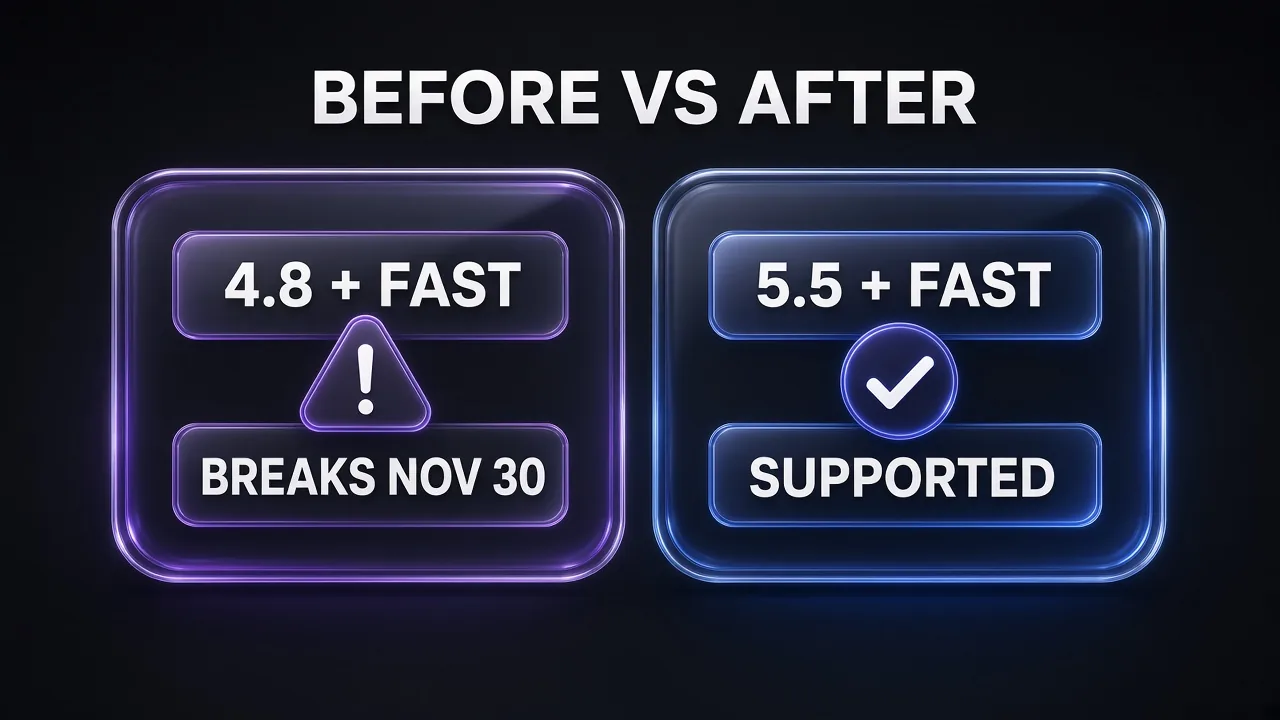
Opus 4.8 fast mode is deprecated and removed on November 30, 2026 with no fallback to standard speed. Here is how to migrate Claude Code and API callers to Opus 5.5 before requests start erroring.
Advertisement
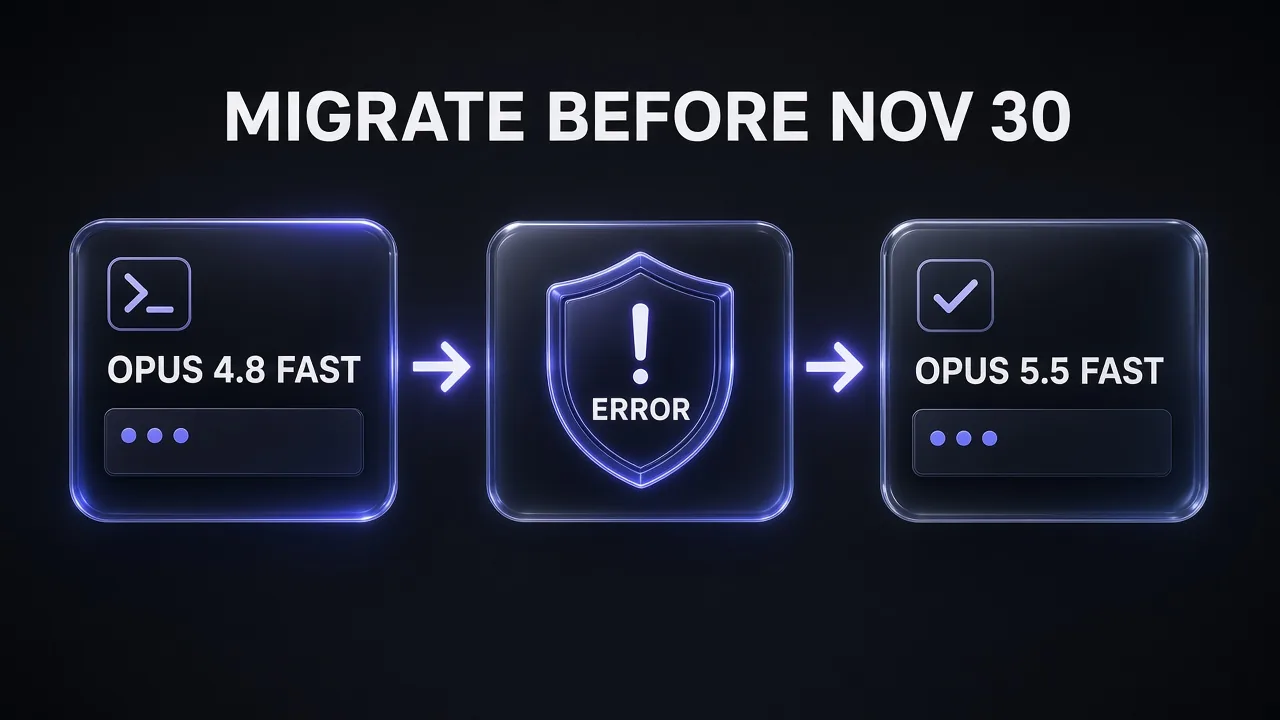
Short version: Opus 4.8 fast mode is deprecated as of October 30, 2026 and removed on November 30, 2026. After that date, a Claude Code or API request that pairs Opus 4.8 with fast mode returns an error. It does not quietly slow down to standard Opus 4.8. If you want the speedup, move to Opus 5.5 before the cutover. If you want to stay on Opus 4.8, turn fast mode off.
This is a migration tutorial, not a model review. You will check whether you are actually on the doomed combination, switch Claude Code to Opus 5.5 (or disable fast mode), clean settings and CI pins, and handle the API cases where swapping the model ID alone is not enough. For the model itself, see our Claude Opus 5.5 what's new guide. For the money side after you land, see Claude Opus 5.5 pricing, fast mode and caching.
Sources: the Claude Code changelog (entry 2.1.316), the Claude Code fast mode docs, the model configuration docs, Anthropic's API fast mode page and the Opus 5.5 migration guide, all checked on 6 November 2026. We have not run billed cutover tests ourselves; every date, price and command below comes from those pages.
What You'll Get From This Guide
- The exact cutover: deprecated 30 Oct 2026, removed 30 Nov 2026, errors with no fallback.
- A five-step Claude Code migration from "am I affected?" to a pinned Opus 5.5 default.
- An API checklist for
speed: "fast"plus the Opus 5.5 breaking changes that catch people who only rename the model. - Cost and plan notes so you know why fast mode on Opus 5.5 is cheaper per token than fast mode was on Opus 4.8, and why subscription users still need usage credits.
- Pitfalls for resumed sessions, project settings, gateways and Team/Enterprise enablement.
What Is Ending on November 30
Honest answer: only the fast configuration on Opus 4.8. Opus 4.8 as a model stays available. Fast mode on Opus 5.5 stays available. What dies is the pairing of Opus 4.8 + fast mode.
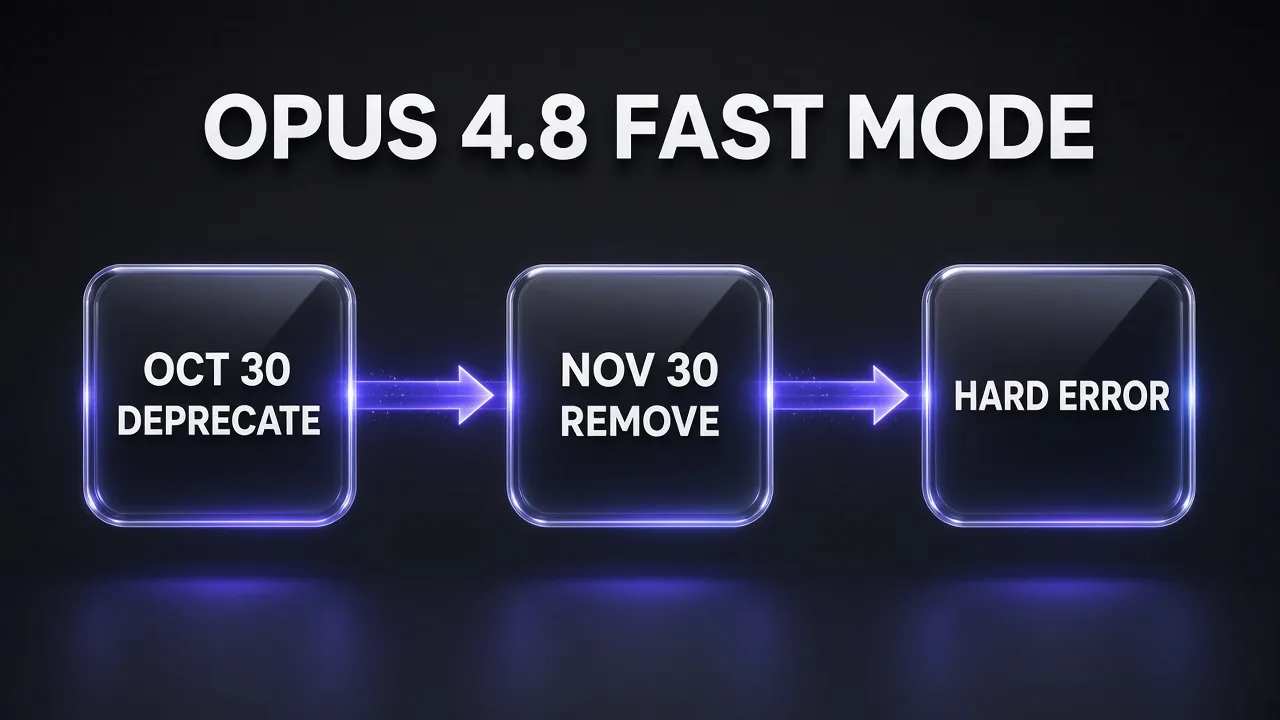
Claude Code 2.1.316 recorded the notice on 31 October 2026. The Changed line is blunt: fast mode for Opus 4.8 was deprecated as of 30 October 2026 and will be removed on 30 November 2026. After removal, fast mode requests on Opus 4.8 return an error and do not fall back to standard Opus 4.8. Anthropic's advice in that same line is to migrate to Opus 5.5 to keep the speedup.
The API docs say the same thing for Messages API and Managed Agents: after removal, requests to claude-opus-4-8 with speed: "fast" return an error. Migrate to Claude Opus 5.5.
One trap from an earlier cycle: Opus 4.7 fast mode was deprecated on 25 June 2026 and removed on 24 July 2026. Anthropic already showed that research-preview fast mode on an older Opus can go away on a fixed date. Treat 30 November as a hard deadline, not a soft warning.
Who Actually Needs to Act
Most people on a fresh Claude Code install are fine. On the Anthropic API, the opus alias already resolves to Opus 5.5, and from Claude Code v2.1.280 onward the fast-mode default model is Opus 5.5. You still need to act if any of these are true:
- You pinned Opus 4.8 with
/model,--model, a settingsmodelfield, orANTHROPIC_MODEL, and you leave fast mode on. - Your project or org settings still set
claude-opus-4-8(or a provider ID for 4.8) whilefastModeis true. - CI or headless runs launch with
claude -p --settings '{"fastMode": true}'against an Opus 4.8 model. - API, Agent SDK or gateway code sends
claude-opus-4-8(or the equivalent provider ID) withspeed: "fast".
You can skip the model upgrade if you are happy on standard Opus 4.8: run /fast off and leave the model alone. If you are choosing between Claude subscription tiers before you lean on usage credits for fast mode, start with our Claude Ultra vs Max vs Pro breakdown. You should still scan automation for hard-coded fast mode, because a forgotten flag will start failing on 30 November even if your interactive sessions look fine.
Pro tip: Run/statusand/modelin a fresh terminal before you change anything. Note the login method (Claude subscription vs API key), the active model, and whether the fast-mode icon is showing. That snapshot tells you which migration path below applies.
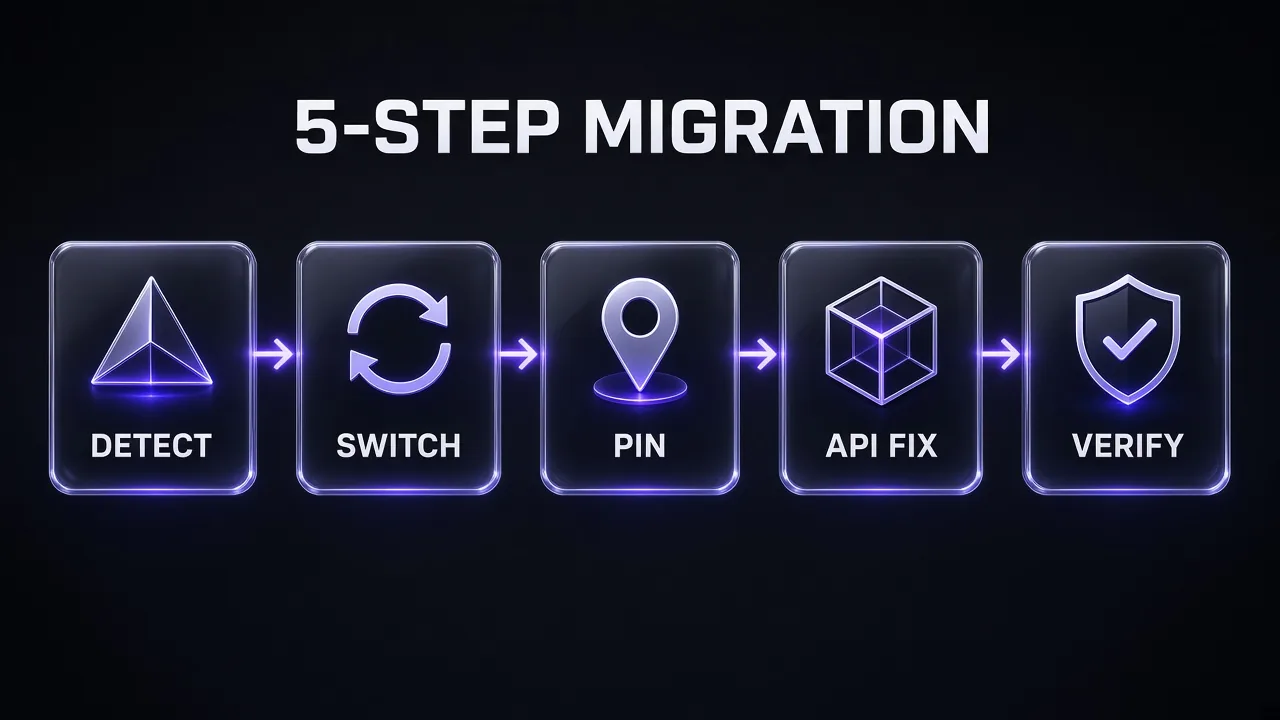
Migration Overview: Five Steps
| Step | What you do | Done when |
|---|---|---|
| 1 | Update Claude Code and confirm you are on the Opus 4.8 + fast pair | claude --version is at least 2.1.280 and you know your current model plus fast state |
| 2 | Switch the interactive session to Opus 5.5 (or turn fast mode off) | /model shows Opus 5.5 with fast on, or Opus 4.8 with fast off |
| 3 | Fix pins so new sessions stick | A brand-new launch starts on the model you chose |
| 4 | Update API, SDK, CI and gateway callers | No remaining claude-opus-4-8 + speed: "fast" paths |
| 5 | Re-check cost, credits and org enablement | Fast mode works on Opus 5.5 where you expect it, or is intentionally off |
Step 1: Update Claude Code and Detect the Bad Pair
Opus 5.5 needs Claude Code v2.1.280 or later. Sonnet 5.5 needs v2.1.284+. Run:
claude update
claude --version
Then open a new session and check what you are actually running:
/model
/fast
/status
You are on the doomed path only when the model is Opus 4.8 and fast mode is on. Fast mode alone on Opus 5.5 is fine. Opus 4.8 alone with fast mode off is fine until you later decide to upgrade for other reasons.
If you maintain several repos, also search the tree for pins before you trust the interactive UI:
rg -n "claude-opus-4-8|opus-4-8|fastMode|speed.?=.?['\"]fast['\"]" .
That catch-all finds settings JSON, launch scripts, SDK clients and leftover docs in one pass. For a wider audit across tickets and runbooks, a research agent such as Genspark is useful once you paste the same search terms plus your repo list.
Audit Opus 4.8 Fast Mode Pins
Search my notes and this repo for anything that still pairs Opus 4.8 with fast mode. Look for model IDs claude-opus-4-8, provider IDs containing opus-4-8, settings keys fastMode or speed: "fast", Claude Code launch flags, CI -p --settings JSON, and Agent SDK setModel calls. Return a checklist grouped by: Claude Code interactive, project/managed settings, CI/headless, API/SDK, and gateways. For each hit, say whether it will error after 30 November 2026 or is already safe.
Step 2: Switch Claude Code to Opus 5.5 (or Disable Fast Mode)
My take: if you liked fast mode on 4.8, move to Opus 5.5 rather than living without the speedup. Fast mode on Opus 5.5 is also cheaper per token than fast mode on Opus 4.8 ($8/$40 vs $10/$50 per million input/output tokens, per the Claude Code fast mode docs). If you want copy-ready coding prompts once Opus 5.5 is pinned, keep our 25 Opus 5.5 coding prompts nearby.
Keep the speedup
- Confirm you are on Claude Code v2.1.280+.
- Run
/modeland select Opus 5.5, or type/model opuson the Anthropic API (theopusalias resolves to Opus 5.5 there). - Press Enter to save it as your default. Press
sonly if you want this session alone. - Leave fast mode on. The docs say fast mode stays on after the switch. You should see a Fast mode ON confirmation when a switch toggles it.
/model opus
# or open the picker: /model
# then select Opus 5.5 and press Enter to save
To pin the exact ID instead of the moving alias:
/model claude-opus-5-5
Stay on Opus 4.8 at standard speed
/fast off
That is the supported "I am not migrating yet" path. Do not assume the API will demote you automatically after 30 November. It will not.
VS Code
The VS Code extension exposes a Toggle fast mode command when the selected model supports fast mode. Still use the model picker (or your shared settings) to land on Opus 5.5 first. A fast toggle on top of a pinned 4.8 is the failure mode this deadline creates.
Step 3: Make New Sessions Stick
Switching once is not enough if something outranks your choice on the next launch. Claude Code resolves models in this order: /model during the session, then --model at startup, then ANTHROPIC_MODEL, then the settings model field, then ANTHROPIC_DEFAULT_MODEL. Project and managed settings, plus an organization default that overrides user selection, reapply on every launch.
When a new session starts on a different model than you picked, the docs list the usual causes:
- You pressed
s(this session only), used--model, or ran/modelunder-p(non-interactive choices are not saved as the default). - Project or managed settings, shell
ANTHROPIC_MODEL, or an admin org default is winning. ~/.claude/settings.jsonis not writable, so the save never stuck.- You resumed with
claude --resumeor--continue, which usually keeps the old session's model.
Fix the pin, then verify with a fresh process, not a resumed one:
# user settings (written by /model when you press Enter)
# ~/.claude/settings.json should include something like:
# { "model": "claude-opus-5-5", "fastMode": true }

# clear a shell override if you have one
unset ANTHROPIC_MODEL

# fresh launch check
claude
/model
/fast
If your team stores shared instructions in AGENTS.md and CLAUDE.md files, add one boring line that names the required model and forbids Opus 4.8 + fast mode. Instruction files will not override Anthropic settings by themselves, but they stop humans and agents from reintroducing the pin in scripts.
Step 4: Migrate API, SDK and CI Callers
Claude Code users are mostly shielded from request-shape changes because the CLI builds the payload. Direct API users are not. Anthropic's migration guide is explicit: Managed Agents usually need only a model-name update; Messages API code must satisfy the Opus 5.5 request rules or the API returns 400.
Minimum fast-mode cutover:
# before (will error after 30 Nov 2026)
model="claude-opus-4-8"
speed="fast"

# after
model="claude-opus-5-5"
speed="fast"
That rename is necessary and not always sufficient. From the Opus 5.5 migration guide, every request to claude-opus-5-5 must also satisfy rules such as:
- Thinking: omit the field or send adaptive thinking.
thinking: {"type": "disabled"}and manualbudget_tokensare rejected. - Effort: control depth with effort (
low,medium,high,xhigh,max). Default ismedium. - Tool choice:
autoornoneonly. Forced tool choice is rejected. - Sampling: omit
temperature,top_pandtop_k. - Prefills: do not end messages with a prefilled assistant turn.
- From Opus 4.8 specifically: thinking now runs when the field was omitted; the prompt-cache minimum drops to 512 tokens; Priority Tier is not supported on Opus 5.5.
Anthropic even ships a Claude Code helper for this class of edit: run the bundled /claude-api skill with a prompt like "migrate this project to claude-opus-5-5". Use it on API clients; do not treat it as a substitute for reading the guide on production services.
Draft an Opus 5.5 API Migration Diff Plan
Act as a staff engineer. Given a Python or TypeScript Anthropic Messages API client that calls claude-opus-4-8 with speed set to fast, produce a migration plan to claude-opus-5-5. List every request field to add, remove or change per Anthropic's Opus 5.5 rules (thinking, effort, tool_choice, temperature/top_p/top_k, prefills, max_tokens covering thinking, Priority Tier). Output: (1) a checklist, (2) a before/after request sketch, (3) test cases that should 400 before the fix and succeed after. Do not invent prices or dates.
Headless Claude Code is its own corner case. Outside cloud sessions, /fast in -p mode only works when the session was launched with fast mode in --settings, for example:
claude -p --settings '{"fastMode": true, "model": "claude-opus-5-5"}' "run the test suite and summarize failures"
Update both keys together. Leaving fastMode: true next to an Opus 4.8 model is how CI goes red on 30 November.
If your agents scrape vendor docs or changelogs as part of a weekly dependency check, wire that job through Firecrawl rather than brittle HTML selectors. Our walkthrough of Firecrawl with Claude covers the scrape-and-summarize pattern.
Step 5: Recheck Cost, Credits and Org Gates
Fast mode is not free speed. Claude Code documents these fast-mode rates per million tokens:
| Model | Fast input | Fast output | Notes |
|---|---|---|---|
| Opus 5.5 | $8 | $40 | Preferred migration target; flat across the 1M context window |
| Opus 5 | $10 | $50 | Still supported for fast mode (research preview) |
| Opus 4.8 | $10 | $50 | Fast mode removed 30 Nov 2026 |
Standard Opus 5.5 API pricing is $4 input / $20 output per million tokens. Subscription Claude Code users (Pro, Max, Ultra, Team, Enterprise) pay for fast mode from usage credits, not from the plan's included rate limits. Until credits are on, /fast reports that fast mode requires usage credits.
Team and Enterprise add an Owner gate: fast mode is disabled by default until an Owner enables it under Organization settings for Claude Code. Managed settings can also force fastMode: false or require per-session opt-in. Console orgs need fast mode access provisioned for Opus 5 / 4.8 research-preview paths; Opus 5.5 has a default fast-mode rate limit on Start, Build and Scale usage tiers per the API docs.
Fast mode is not available on Amazon Bedrock, Google Cloud's Agent Platform, Microsoft Foundry or Claude Platform on AWS. If that is your path, you can still move coding quality to Opus 5.5 where the provider offers it, but you will not get the Anthropic fast-mode configuration there.
If your team is still debating whether coding agents belong in Claude Code versus another IDE agent after the model pin is fixed, our Claude Code vs Google Antigravity comparison covers that choice.
Pro tip: Enable fast mode at the start of a session when you can. The docs warn that the first enable in a deep conversation charges the full fast uncached input price for the entire context, because fast and standard speeds keep separate caches.
Tool Stack Around the Cutover
Migration week is a bad time to invent a new agent stack. Keep the tools that already understand your repo, and only add scrapers or research agents where they shorten the audit.
| Job | Tool | Why it fits this deadline |
|---|---|---|
| Interactive coding + model switch | Claude Code (/model, /fast) | Official path; saves model and fastMode |
| API client rewrite | Claude Code /claude-api skill + Opus 5.5 migration guide | Anthropic's own migrate prompt targets request-shape breakage |
| Repo and runbook audit | Genspark | Cross-check pins across notes, tickets and docs |
| Changelog / docs scrape | Firecrawl | Stable extraction for weekly "did the deadline move?" checks |
| Cheaper coding fallback while you re-budget credits | Z.ai (GLM) | Handy when you want a non-Anthropic coding lane during credit tuning |
| Multi-agent verification after the switch | Claude Code subagents / worktrees | Covered in our multi-agent Claude Code guide |
If you are also deciding when Opus 5.5 should win against other frontier models for coding, our GPT-6.1 Terra vs Claude Opus 5.5 vs Gemini 4 Argon comparison is the decision table.
Pitfalls That Will Still Break You After a Successful Switch
- Assuming fallback exists. Rate-limit cooldown on a supported fast-mode model can demote you to standard speed temporarily. The Opus 4.8 removal is different: the request errors. Do not copy the rate-limit mental model onto 30 November.
- Session-only switches.
sin the picker,--model, and/modelunder-pdo not rewrite your default. The next morning you are back on 4.8. - Resumed sessions.
--resume/--continuekeep the old model. Finish the cutover in a fresh launch. - Gateway availability checks. Fast mode availability is checked against
api.anthropic.comand does not followANTHROPIC_BASE_URL. A gateway that blocks that check can make/fastlie to you even when inference works. Fix egress or use the documented skip variables only when you understand the tradeoff. - Org policy. Team/Enterprise without Owner enablement, managed
fastMode: false, or anavailableModelslist that excludes the fast Opus model will refuse the toggle with an organization-disabled message. - Context bloat after the move. Opus 5.5 always thinks. Long sessions still rot. Apply the same context habits from our 12 context engineering patterns for Claude Code rather than blaming the new model.
- Wrong abstraction layer. If the real problem is "this should be a skill, an MCP server or a subagent," fix that after the model pin is safe. Our Skills vs MCP vs subagents breakdown is the decision guide.
Pro tip: Search once more on 29 November. Pins have a habit of reappearing in a teammate's dotfiles or a forgotten workflow YAML the day before a deadline.
Verdict
Short version: treat 30 November 2026 as a hard break for Opus 4.8 + fast mode. The supported fixes are simple. Update Claude Code past v2.1.280, move to Opus 5.5 and keep fast mode if you want the speedup, or run /fast off if you want to stay on Opus 4.8. Then chase every settings, CI and API pin that still names claude-opus-4-8 with speed: "fast".
Do the interactive switch today. Do the repo grep this week. Do the API request-shape pass before you celebrate, because Opus 5.5 rejects several patterns Opus 4.8 accepted. The deadline is calendar-fixed; the only open question is whether your automations still point at the old pair when it arrives.
Frequently Asked Questions
8 questions answered
opus alias on the Anthropic API), and leave fast mode on. Fast mode stays enabled after the switch. Confirm the next launch still starts on Opus 5.5.speed: "fast".model settings, ANTHROPIC_MODEL in your shell, an org default, a session-only picker choice, an unwritable ~/.claude/settings.json, or a resumed session that kept its old model. Fix the pin, then confirm with /model on a fresh launch.