The PromptsRush journal
AI ToolsBest Open-Weight Models Nov 2026: Kimi K3.1, LongCat-2.5, DeepSeek V4.1, Mistral Large 4
The best open-weight LLMs you can download in November 2026, ranked: Kimi K3.1 Pro for raw capability, MIT-licensed DeepSeek V4.1 Flash for value, LongCat-2.5, Mistral Large 4, GLM-5.3 and Qwen3.8, with licenses, API prices and hardware needs checked.
Advertisement
Short version: the best open-weight model you can download in November 2026 is Kimi K3.1 Pro. It scores 65.7% on Terminal-Bench 4.0 in Moonshot's own table, within a point of Claude Opus 5.5, and its weights are now on Hugging Face. The best value is DeepSeek V4.1 Flash (the 1017 update): MIT-licensed, about 510 GB of weights, and an API that costs $0.30 in and $1.20 out per million tokens at peak, half that off-peak. LongCat-2.5 is the surprise: Meituan put the 1.6-trillion-parameter weights out under plain MIT. And Mistral Large 4 is the pick for European teams and security work, as long as you aren't reselling it as an API.
We ranked six models, not just four, because GLM-5.3 and Qwen3.8 both belong in the conversation. For each one you get the size, the license in plain English, the API price, and the job it suits. If you already know you want Kimi, our Kimi K3.1 Pro explainer goes deeper on that one model.
Every spec and license below comes from the model's own Hugging Face card or license file, and every price from the vendor's pricing page, all re-checked on 12 November 2026. Benchmark numbers are vendor-reported, not our own runs, and each lab uses its own harness, so read them as a rough ranking rather than a league table.
Best Open-Weight Models at a Glance
Here's the whole field on one screen. "Weights" is the size of the official download on Hugging Face today, which tells you more about the hardware you'll need than the parameter count does.
| Model | Total / active params | Context | Weights | License | API price (in / out per 1M) | Best for |
|---|---|---|---|---|---|---|
| Kimi K3.1 Pro | 2.8T / 104B | 1M | ~1.56 TB (MXFP4) | Modified MIT, revenue and display clauses | $2.00 / $10.00 | Hardest coding and agent work |
| DeepSeek V4.1 Flash (1017) | 552B backbone / 8B–16B | 1M | ~510 GB | MIT | $0.30 / $1.20 peak, half off-peak | Best value, permissive license |
| LongCat-2.5 | 1.6T / ~48B | 1M (API) | ~1.34 TB (W4A4), ~3.56 TB full | MIT | $0.30 / $1.20 (limited-time) | Visual coding, browsing agents |
| Mistral Large 4 | ~1T / 49B | 1M | ~610 GB (NVFP4), ~1.06 TB full | Modified MIT, no API resale without a contract | $0.70 / $2.10 | EU sovereignty, cybersecurity, token efficiency |
| GLM-5.3 | not stated on card | – | ~756 GB | Modified MIT, review only above $10B revenue | $1.40 / $4.40 | Coding agents, cyber research |
| Qwen3.8 (2.4T-A95B) | 2.4T / 95B | 262K native, ~1M extended | ~4.9 TB | Modified MIT, revenue and display clauses | via Qwen Cloud (Qwen3.8-Max) | Largest open Qwen, broad harness support |
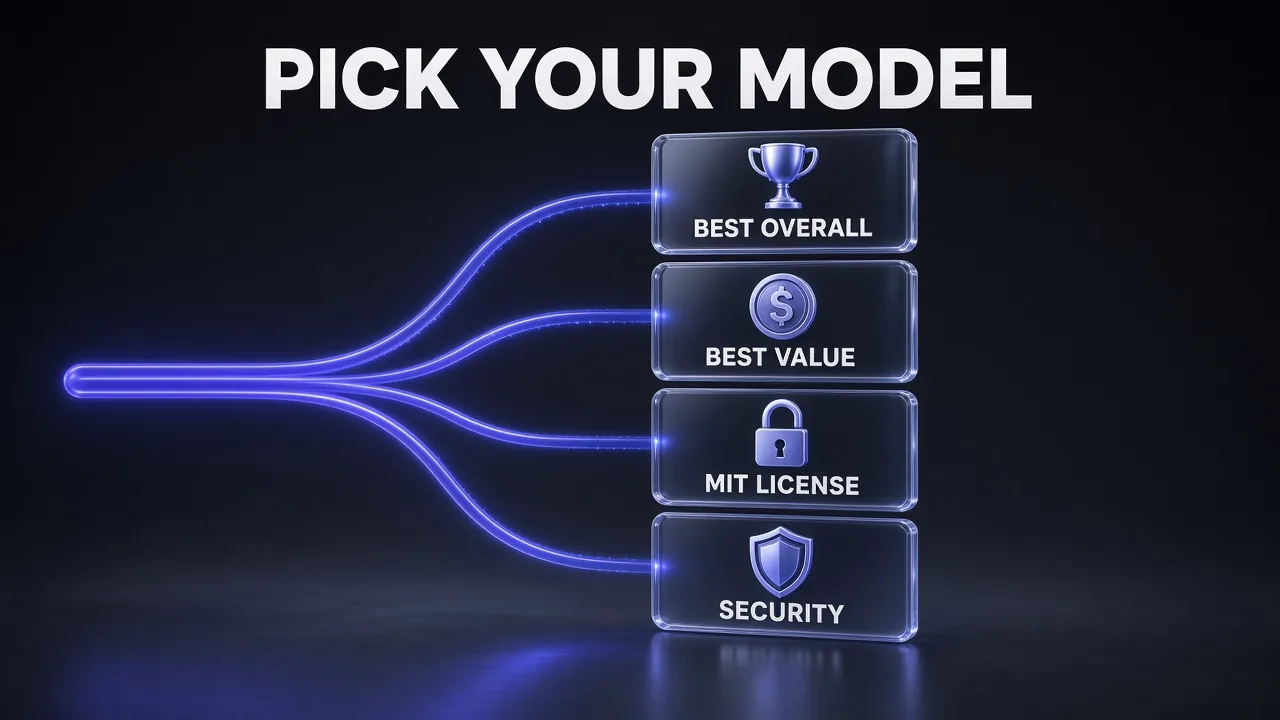
Honest answer on who should use what: if you have a GPU cluster and want the strongest open model, run Kimi. If you want something you can ship inside any product without reading a license twice, pick DeepSeek or LongCat. If you're in a regulated European business, Mistral Large 4 is the easiest conversation with your compliance team.
How We Ranked Them
"Best" depends on what you're doing, so we scored each model on four things that actually change the decision:
- Capability on agent work. Terminal-Bench 4.0 is the one coding benchmark all five labs report, so it's our common yardstick. Where a lab reports something more specific (browsing, cyber, vision), we mention it.
- License. "Open weights" covers everything from pure MIT to licenses that need a contract the moment you sell API access. That matters more than a few benchmark points.
- Cost to run. Both the first-party API price and the size of the weights you'd host yourself.
- Practicality. Inference engine support, chat templates, quantized checkpoints and context length.
We didn't rank on vibes or on a single leaderboard. If you'd rather compare these against closed models too, our AI model decision matrix lines up open and closed options by job.
1. Kimi K3.1 Pro: Best Open-Weight Model Overall
Kimi K3.1 Pro is Moonshot AI's post-trained upgrade of Kimi K3, and it's the closest an open model has come to the closed frontier. The model card lists 2.8 trillion total parameters with 104 billion active per token, a 1,048,576-token context window, and text plus image input. Weights ship in MXFP4 with quantization-aware training, which is why the download is about 1.56 TB rather than several times that.
Benchmarks
In Moonshot's table, K3.1 Pro scores 65.7% on Terminal-Bench 4.0, against 66.4% for Claude Opus 5.5 and 58.2% for GPT-6 Astra. On SWE Marathon v1.1 it posts 51.7%, ahead of Opus 5.5 at 46.3%. These are Moonshot's numbers at maximum reasoning effort, so treat them as the vendor's best case. For how it stacks up against the closed models on price, see our GPT-6.1 Terra vs Opus 5.5 comparison.
License and price
The Kimi K3.1-Pro License is MIT with two strings attached. If you run a model-as-a-service business with more than $20 million in revenue over 12 months, you need a separate agreement with Moonshot. And if your product passes 100 million monthly users or $20 million in monthly revenue, you have to show "Kimi K3.1-Pro" in the interface. Internal use is exempt from both. For nearly every startup and agency, that's effectively free to use.
On Moonshot's API, kimi-k3.1-pro costs $2.00 per million input tokens, $10.00 per million output and $0.20 for cached input, with batch jobs at 60% of standard. The full breakdown, including the Highspeed tier, is in our Kimi AI pricing guide.
Pick it if you need the strongest open model for long coding or research runs and you have serious hardware or are happy to use the API. Skip it if you want to self-host on a single box: 1.56 TB of weights is a data-centre job.
2. DeepSeek V4.1 Flash: Best Value and the Cleanest License
DeepSeek V4.1 Flash is the model most teams should try first. The 1017 release is a minor update that DeepSeek says improves reasoning, coding and agent scores while cutting output length. The architecture is unusual: a 552B-parameter backbone that activates only 8B parameters per token during prefill and 16B during decode, which is exactly why input-heavy agent workloads are so cheap on it.
Benchmarks
DeepSeek reports 42.3% on Terminal-Bench 4.0 and 77.0% on DeepSWE v1.1 for the 1017 checkpoint, up from 31.2% and 74.2% on the original V4.1 Flash. It sits well behind Kimi on the hardest terminal tasks but ahead of most of the field on repository-scale work. Reasoning effort is a dial from 1 to 100 rather than three presets, which makes it easy to tune cost per task, the same idea we covered in our guide to tuning subagent effort in Claude Code.
License and price
Plain MIT, for the repository and the weights. No revenue caps, no display requirement, no resale clause. It's the only top-tier model here, alongside LongCat-2.5, where the license needs no second reading.
The API model name is deepseek-flash, which DeepSeek's pricing page maps to DeepSeek-V4.1-Flash-1017. At peak it's $0.30 per million input tokens on a cache miss, $0.006 on a cache hit and $1.20 per million output. Off-peak rates are exactly half. Peak hours are 01:00–04:00 and 06:00–10:00 UTC on weekdays, which is 6:30–9:30 AM and 11:30 AM–3:30 PM in India, so batch jobs scheduled for the Indian evening land on the cheap rate. The API supports a 1M context, up to 384K output tokens, vision, and both OpenAI- and Anthropic-format endpoints.
Pro tip: The weights ship without a Jinja chat template. If you self-host, use DeepSeek's encoding.py reference or its deepseek-recipe library to build prompts; a guessed template will quietly break tool calls.
3. LongCat-2.5: The MIT Surprise From Meituan
LongCat-2.5 launched at the start of November as an API model, and Meituan has since put the weights on Hugging Face under the MIT license. It's a natively multimodal mixture-of-experts model with 1.6 trillion total parameters and about 48 billion active per token. Images are turned into discrete tokens that share a space with text, which is why its showcase work is visual: building interfaces from mockups, full-project builds and 3D generation.
Benchmarks
Meituan's in-house numbers put LongCat-2.5 at 38.5% on Terminal-Bench 4.0, 91.9% on BrowseComp, 83.1% on MCP Atlas and 78.6% on Vision2Web. The browsing and tool-use scores are the standout: if you're building a research agent that lives on MCP tools (our best MCP servers guide lists the ones worth wiring up), LongCat is worth a test. Meituan labels its own unstarred scores as "indicative only", which is a refreshingly honest caveat.
License and price
MIT for the weights, with the usual note that it grants no rights to Meituan's trademarks or patents. On LongCat's own API, pay-as-you-go pricing is a limited-time discount of $0.30 per million uncached input tokens, $0.006 cached and $1.20 output, with a 1M context and up to 256K output tokens. Meituan publishes no end date and no undiscounted rate, so don't build a budget on that price lasting.
The catch: the model card only documents deployment on NPU hardware (through Meituan's SGLang-FluentLLM fork), and the full BF16 download is about 3.56 TB. The W4A4 quantized repo is smaller at about 1.34 TB. For most readers that makes LongCat an API model with a very good license, not a weekend self-host project.
4. Mistral Large 4: Best for European Teams and Security Work
Mistral released the weights of Mistral Large 4, nicknamed Le Chonk, on 29 October after a public preview earlier in the month. It's a 1-trillion-parameter natively multimodal model with 49 billion active parameters (52 billion counting embeddings), 128 routed experts with 4 active per token, a 1M context window and fluency in more than 160 languages, including every official EU language. It was trained from scratch on Mistral's own infrastructure in Europe, which is the whole point for sovereignty-minded buyers.
Benchmarks
Mistral cites Artificial Analysis numbers rather than only its own: 48% on the Coding Agent Index, effectively tied with GLM-5.3 while using 47% fewer tokens per task, and 41% on Terminal-Bench 4.0. Its strongest claim is security work, with 51% on the Artificial Analysis Cyber Index and a 96.6% refusal rate on malicious cyber prompts in Mistral's testing. On the broader Intelligence Index v5 it scores 26, which Mistral calls the highest of any western open-weight model while admitting the leading Chinese models score higher.
License and price
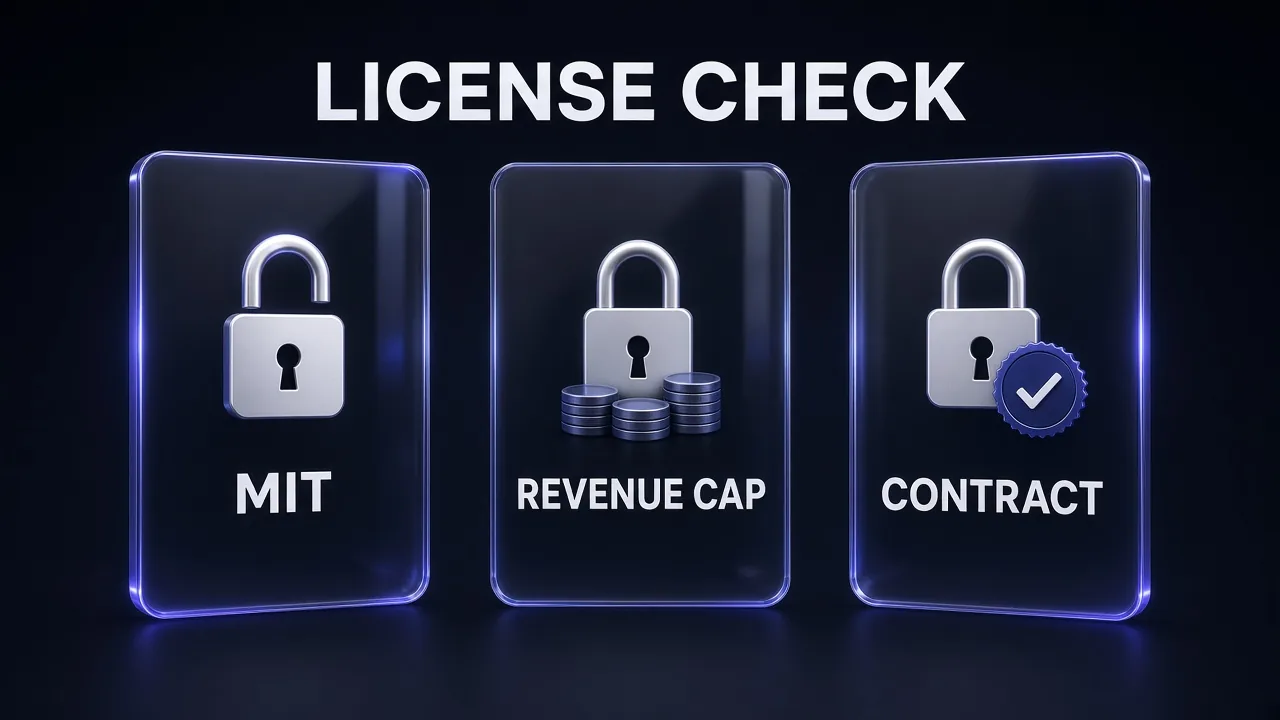
This is where you need to read carefully. The Mistral Ecosystem Open-Weight License is a modified MIT that allows commercial use, but any model-as-a-service business needs a separate commercial license from Mistral. There's no revenue threshold, unlike Kimi's $20 million. Using it inside your own product or internally is fine; selling raw API access to it is not.
On Mistral's API, mistral-large-4 costs $0.70 per million input tokens, $0.07 cached and $2.10 output. For self-hosting, the NVFP4 checkpoint (about 610 GB, built for Blackwell GPUs) is the practical choice, and Mistral Large 4 has the widest tooling here: vLLM, SGLang, transformers, llama.cpp GGUFs, and fine-tuning through Axolotl, Unsloth and TRL.
5. GLM-5.3: Strong Coding Agent With a Generous License
GLM-5.3 from Z.ai uses the same base model as GLM-5.2, with every gain coming from post-training. Z.ai calls it the most capable open-weights model for coding and reports a 50% jump over GLM-5.2 on its in-house Code Bench, plus 84.5% on CyberGym. In the other labs' tables it lands at 41.8% (Moonshot's) or 37.9% (DeepSeek's) on Terminal-Bench 4.0, which shows how much harness choice moves these numbers.
The license is the most relaxed of the modified-MIT group: the only condition is a Z.ai security review for model-as-a-service businesses earning more than $10 billion a year. On Z.ai's API, GLM-5.3 costs $1.40 in and $4.40 out per million tokens, and GLM-5.3-Flash drops to $0.15 and $0.50. Z.ai also sells coding plans from $18 a month for use inside Claude Code, Cline, Kilo Code and similar tools. We have 25 GLM-5.3 coding prompts if you want to put it to work straight away.
6. Qwen3.8 (2.4T-A95B): The Biggest Open Qwen Yet
For the first time, Alibaba's Qwen team has released a Max-class model as open weights. Qwen3.8-2.4T-A95B has 2.4 trillion total parameters with 95 billion active, a native 262,144-token context that extends to about 1 million, and a hybrid of Gated DeltaNet linear attention and gated full attention. It's also the heaviest download in this list at roughly 4.9 TB.
Two things keep it at number six for us. First, the open checkpoint is text-only; the official Qwen3.8-Max on Qwen Cloud adds vision input, non-thinking mode and built-in tools. Second, its license carries both a display clause (above 100 million monthly users or $20 million monthly revenue) and a separate-license requirement for model-as-a-service or AI work assistant businesses above $50 million a year. That second category explicitly covers AI coding and office tools, so check it before building one on Qwen.
Benchmarks Compared: Terminal-Bench 4.0
Terminal-Bench 4.0 is the one agentic coding test every lab here reports. The chart uses each model's own vendor figure; Claude Opus 5.5 is included as the closed-model reference from Moonshot's table.
Terminal-Bench 4.0, vendor-reported
Pass rate, %, each lab's own harness and max reasoning effort
Source: Moonshot, DeepSeek and Meituan Hugging Face model cards; Mistral blog (Artificial Analysis run); Moonshot card for GLM-5.3 and Opus 5.5
The takeaway: Kimi is in a league of its own among open models, and the next four sit in a tight 38–43% band where license and price should decide, not the benchmark. Long runs also degrade differently across models, which is one more reason to test on your own tasks; our explainer on context rot covers why a 1M window doesn't mean 1M useful tokens.
API Prices Compared
If you're not self-hosting, the first-party API price is what you pay. DeepSeek shown at its peak rate; it's half off-peak.
First-party API price per 1M tokens
Standard rates, US dollars, checked 12 Nov 2026
- Input
- Output
Source: Moonshot, DeepSeek, LongCat, Mistral and Z.ai pricing pages
Kimi costs roughly eight times as much per output token as DeepSeek, so it only earns its place on tasks where the cheaper models fail. For context, Claude Opus 5.5 lists at $4 in and $20 out; our Opus 5.5 pricing breakdown has the caching and batch details.
Self-Hosting: What It Really Takes
None of these models fit on a gaming PC, and most don't fit on a single eight-GPU server at full precision. Here's the practical picture from the official downloads:
- DeepSeek V4.1 Flash (~510 GB) is the lightest top-tier option. Its small active parameter count keeps decode fast once it's loaded.
- Mistral Large 4 NVFP4 (~610 GB) targets Blackwell GPUs and has the best tooling coverage, including llama.cpp GGUFs.
- GLM-5.3 (~756 GB) runs on SGLang, vLLM, TokenSpeed, transformers and KTransformers, plus Ascend NPUs.
- Kimi K3.1 Pro (~1.56 TB) needs vLLM, SGLang or TokenSpeed on a multi-node setup.
- LongCat-2.5 (~1.34 TB quantized) is documented for NPU deployment only today.
- Qwen3.8 (~4.9 TB) is a cluster-only model.
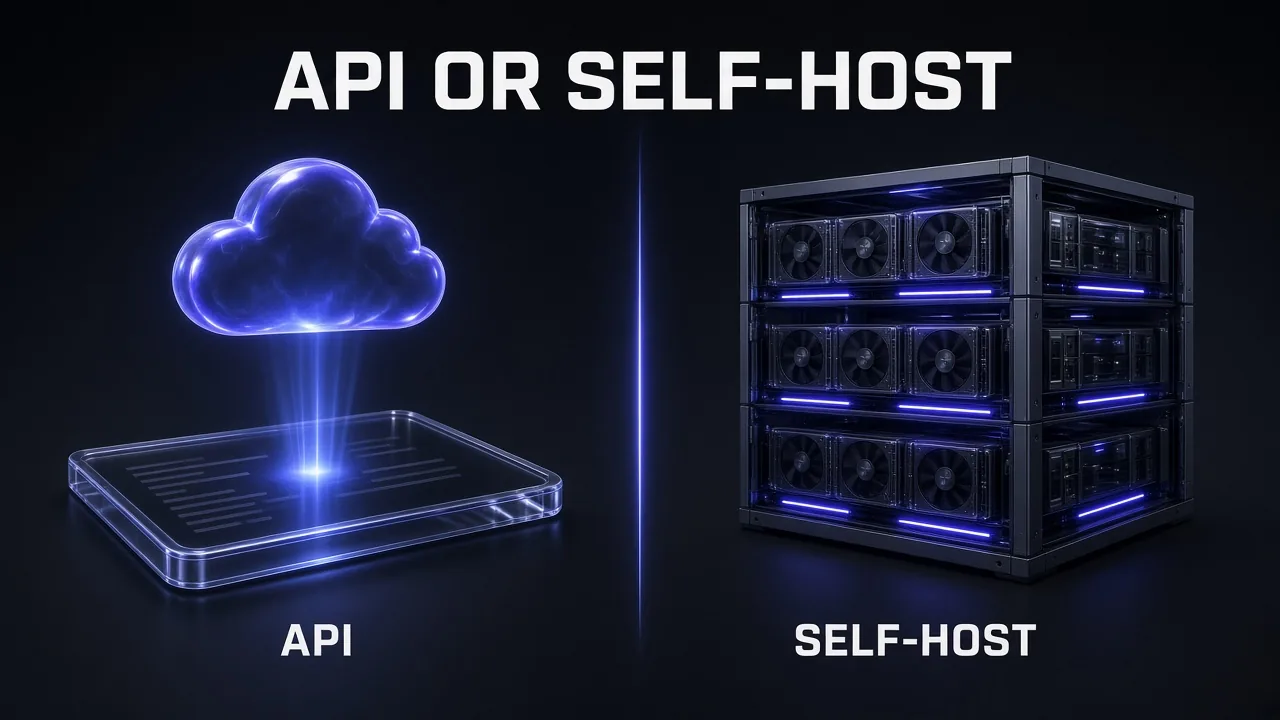
My take: unless you have a data-residency requirement or truly massive volume, use the first-party or a third-party API and keep the weights as your exit option. That's the real value of open weights for most teams: you're never locked in. If you're wiring several of these into one pipeline, our guide to multi-agent workflows in Claude Code shows how to route cheap and expensive models to different subagents.
Which Open-Weight Model Should You Use?
| If you need… | Use | Why |
|---|---|---|
| The strongest open model, full stop | Kimi K3.1 Pro | 65.7% Terminal-Bench 4.0, close to Opus 5.5 |
| Lowest cost per task | DeepSeek V4.1 Flash | $0.15–$0.30 in, MIT, 8B–16B active |
| A license with zero strings | DeepSeek V4.1 Flash or LongCat-2.5 | Both plain MIT |
| Browsing and MCP-heavy agents | LongCat-2.5 | 91.9% BrowseComp, 83.1% MCP Atlas (in-house) |
| EU data sovereignty or security work | Mistral Large 4 | Trained in Europe, 51% AA Cyber Index |
| A cheap coding plan in your IDE | GLM-5.3 | Plans from $18/month, Flash at $0.15 in |
| To resell inference as an API | DeepSeek, LongCat or GLM-5.3 | Mistral needs a contract; Kimi and Qwen have revenue caps |
Common Mistakes When Choosing an Open Model
- Comparing benchmarks across vendor tables. GLM-5.3 scores 41.8% or 37.9% on the same test depending on whose table you read. Compare within one table, or run your own tasks.
- Assuming "open" means MIT. Four of the six have extra clauses. The one that bites most often is Mistral's flat ban on API resale without a contract.
- Budgeting on launch prices. LongCat's rate is explicitly limited-time, and DeepSeek's cheapest rate only applies off-peak.
- Ignoring chat templates. DeepSeek ships none, Kimi needs the full assistant message (including reasoning) passed back each turn, and GLM-5.3 defaults
clear_thinkingto false, which its card says to switch on for chat. Read the usage section of the model card before you wire up tools.
Our Verdict
Kimi K3.1 Pro is the best open-weight model in November 2026 and the only one that genuinely trades blows with Claude Opus 5.5 on agentic coding. DeepSeek V4.1 Flash is the one we'd put into production first, because MIT plus a $0.30 input price is very hard to argue with. LongCat-2.5 is the release to watch: an MIT trillion-parameter model with standout browsing scores, held back only by NPU-only deployment docs. Mistral Large 4 wins on sovereignty and security, and GLM-5.3 is the best-value coding companion if you live in an IDE.
Frequently Asked Questions
10 questions answered