The PromptsRush journal
AI ToolsElevenLabs vs VEED Dubbing API vs HeyGen Translate (2026)
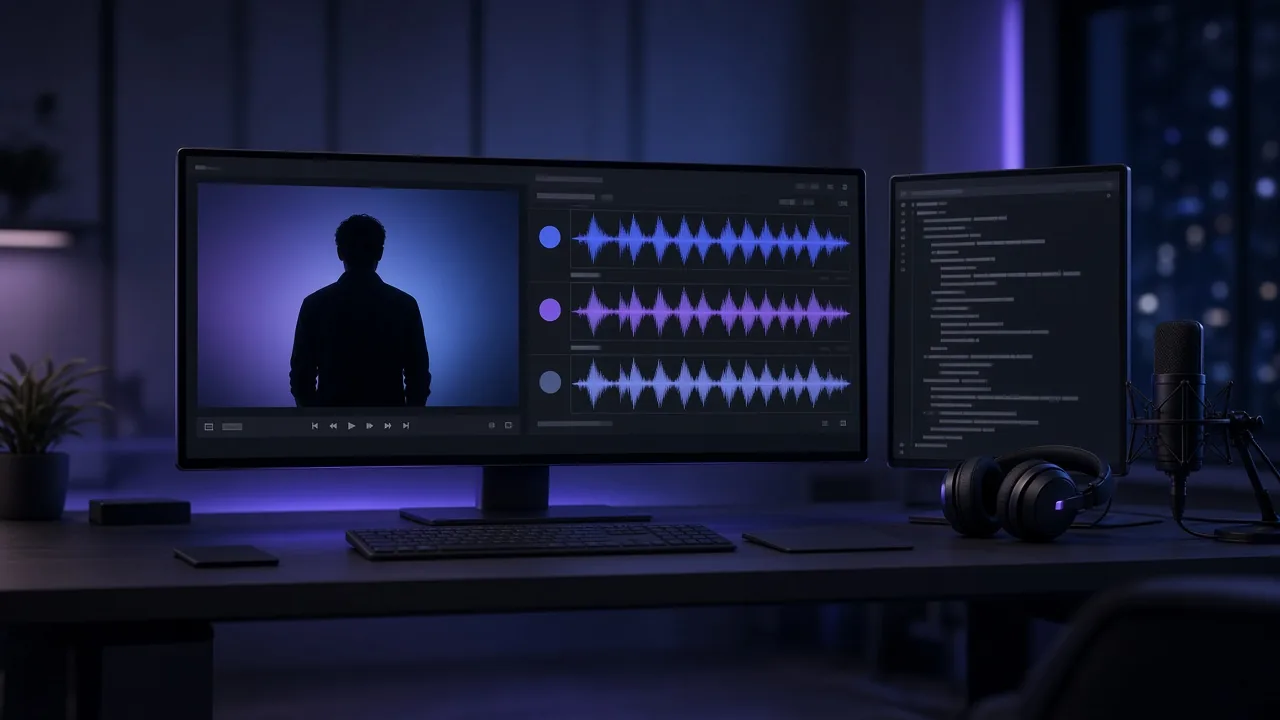
VEED just launched a lip-syncing Dubbing API. We compare it with ElevenLabs Dubbing v2 and HeyGen's Video Translation API on verified per-minute prices, languages, length limits, lip sync and developer workflow, and show when audio-only dubbing is the smarter buy.
Advertisement
Short version: if you need translated video where the speaker's lips actually match the new language, the new VEED Dubbing API is the simplest thing you can call today: one request, a video URL and a language code, $0.11 per second on Standard or $0.18 on Pro. If you only need the translated voice track, ElevenLabs Dubbing v2 does that for $2.20 a minute, a fraction of VEED's price, but it does not move anyone's mouth. HeyGen sits in between: the deepest workflow (proofreading, glossaries, batches of 100) and lip sync in two quality modes, with API prices you only see after you sign in.
This AI dubbing API comparison is built from each vendor's own launch post, pricing page and API reference as they read on 15 November 2026. We have not run paid benchmark jobs through all three, so there are no "we tested" quality scores here; what you get is the verified price, limits and developer surface for each, plus the maths that decides most buying decisions. This morning's ElevenLabs review covers the rest of that platform; this post is only about putting dubbing behind an API.
Quick Verdict: Which AI Dubbing API Fits Which Job
| VEED Dubbing API | ElevenLabs Dubbing API | HeyGen Video Translation API | |
|---|---|---|---|
| What comes back | Dubbed video with lip sync | Dubbed audio + preview video (no lip sync) | Dubbed video with lip sync, or audio only |
| Price (public) | $0.11/s Standard, $0.18/s Pro | $2.20/min v2; $0.33-$0.50/min v1 | Shown in the API dashboard after sign-in |
| Per minute | $6.60 / $10.80 | $2.20 (v2) | Not publicly listed |
| Languages | 100 marketed (86 codes in docs) / 94 + 14 dialects | 90+ (94 codes + 14 dialects on v2) | 175+ languages and dialects |
| Max length | 10 minutes per request | 3 GB per file via API | 30 min per video on Creator/Pro web plans |
| Multi-speaker | Pro only | Yes, up to 32 speakers | Yes (speaker_num hint) |
| Best for | One-call lip-synced dubs | Cheap, high-quality voice tracks | Reviewed, branded localisation at scale |
My take: most teams should start by deciding whether they need lip sync at all. That one question cuts the price by roughly three to five times, and it is the real difference between these three APIs.
What an AI Dubbing API Actually Does
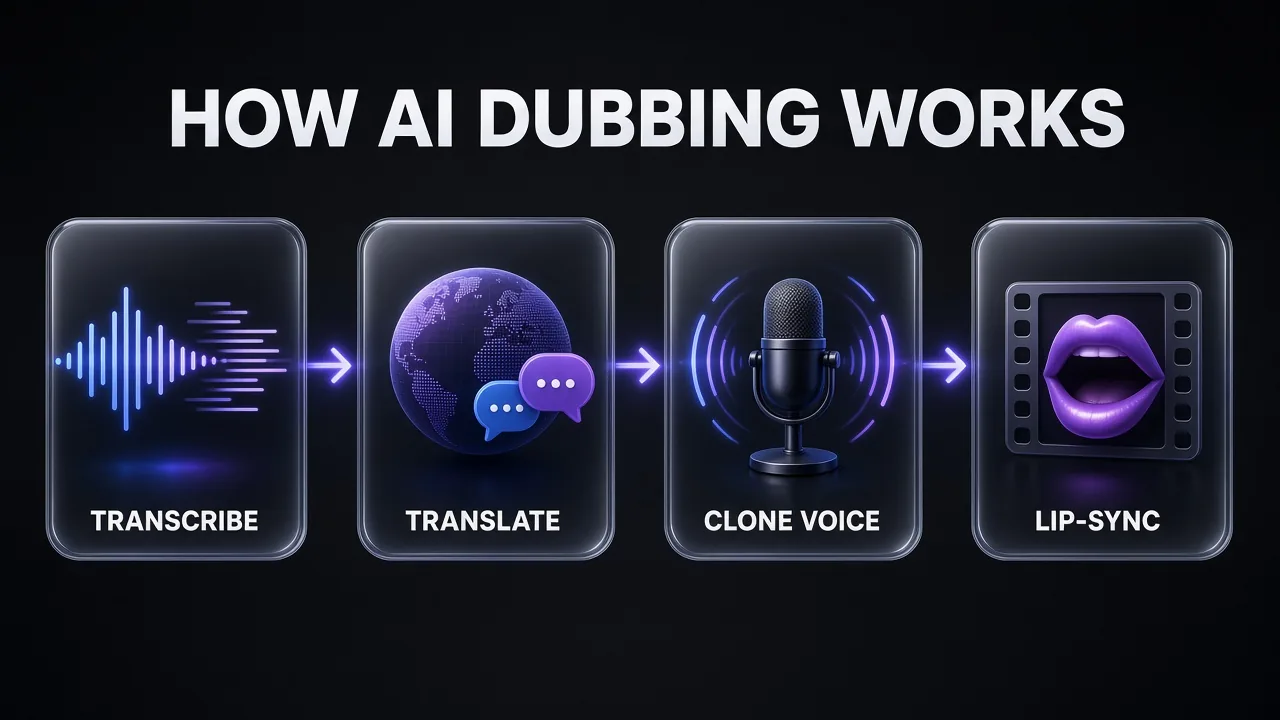
Every dubbing API runs the same four-stage pipeline, whether it exposes the stages or hides them behind one endpoint:
- Transcribe the source speech and work out who is speaking when.
- Translate the transcript, ideally adapting phrasing so it fits the original timing.
- Clone and speak: generate the translated line in a clone of each original speaker's voice, keeping tone and emotion.
- Lip-sync (optional): re-render the speaker's mouth so it matches the new audio.
The first three stages are an audio problem, which is why a voice company like ElevenLabs does them well and cheaply. The fourth is a video-generation problem: a model has to redraw part of the face, frame by frame, at broadcast quality. That is where the cost jumps. If you have read our AI video pricing per second breakdown, the pattern will look familiar: anything that generates pixels costs far more per second than anything that only generates sound.
VEED Dubbing API: The New Option (Launched 28 October)
The calendar note for this post said VEED launched a dubbing API in late October, and VEED's own site confirms it. Its newsroom post, "Introducing VEED's Dubbing API: Video that Travels", says the API went live on 28 October 2026 on VEED's self-serve API, after an early-access period with launch partners from mid-October, and that it would also arrive on fal in early November.
How it works
You send one request with a public video URL and a target language. VEED transcribes, translates, clones each speaker's voice and lip-syncs the result. There is no voice training step and no per-speaker setup: the clone comes from the video you send. The call is asynchronous. You get a 202 Accepted with a job_id, then poll until the job is COMPLETED or FAILED, or let a webhook tell you (VEED's API page says webhooks are supported across its APIs).
Standard vs Pro
Standard (/v1/dubbing) | Pro (/v1/dubbing-pro) | |
|---|---|---|
| Price | $0.11 per second ($6.60/min) | $0.18 per second ($10.80/min) |
| Languages | 100 marketed; 86 language codes listed in the API docs | 94 languages + 14 dialects (e.g. es-MX, pt-BR, en-GB, fr-CA) |
| Lip sync | Yes | "Precise" lip sync, multi-speaker |
| Background audio | Not promised | Kept |
| Voice cloning strength | Not exposed | 0-10, default 7 |
| Max video length | 10 minutes | 10 minutes |
VEED bills per second of video processed, only when a job completes, with no seat fees or minimums; high-volume teams can ask sales for custom pricing. Its own example: a one-minute clip costs $6.60 on Standard and $10.80 on Pro.
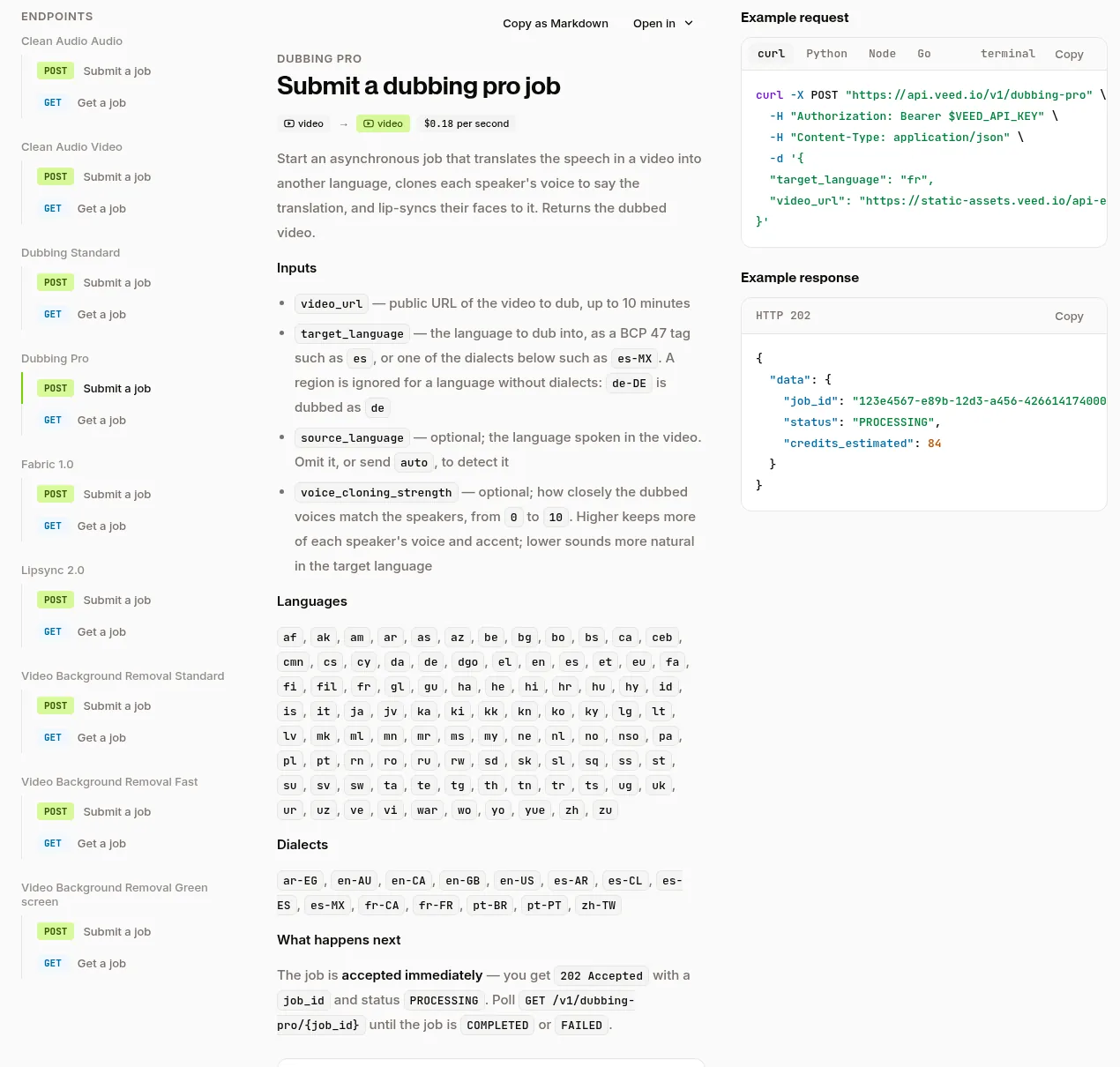
One honest flag: VEED's marketing says Standard covers 100 languages, but the language list in its own Standard API reference has 86 codes today. If a specific language matters to you, check the reference, not the landing page. The voice_cloning_strength dial on Pro is worth understanding before your first job: higher values keep more of the speaker's own voice and accent, lower values sound more native in the target language.
Pro tip: Pick Pro for anything with two people on screen. VEED's own FAQ says multi-speaker videos such as podcasts and interviews are a Pro feature, and Standard is the cheaper single-speaker path.
ElevenLabs Dubbing API: Best Voice Track for the Money
ElevenLabs has offered dubbing through its API for a long time; what changed in 2026 is the model. Dubbing v2, now the default, "conditions on the source performance, not a transcript", so tone, emotion and delivery carry across. It sits on the same ElevenAPI pay-as-you-go rate card covered in our ElevenLabs pricing guide.
Prices on the API rate card
- Dubbing v2: $2.20 per minute of source audio. Plans include a few minutes each month (3 on Starter, 10 on Creator, 45 on Pro, 136 on Scale, 450 on Business).
- Dubbing v1 (legacy): $0.33 per minute with a watermark, $0.50 per minute without.
- Billing is per source minute, and each extra target language is charged separately. Creating a project charges at least one language up front.
What you get, and what you don't
The developer docs are refreshingly direct about limits. Dubbing v2 handles up to 32 speakers per file, keeps the background audio, accepts files up to 3 GB through the API, and offers the same 0-10 cloning-strength control (default 7). You can pass up to 1,000 keyterms so brand and product names survive transcription and translation, and register webhooks instead of polling.
The catch: ElevenLabs does not lip-sync. Its docs call the dubbed video "a high-quality preview, not a production master", usually 1080p, and recommend downloading the dubbed audio and swapping it onto your original video. Dubbing v2 is also still labelled Alpha. Self-serve plans run up to 3 dubbing jobs at once (Enterprise defaults to 10), and editing transcripts or regenerating segments through the API is Enterprise-only on v2. The good news: failed v2 jobs are not charged.
Honest answer: for voice-over-style content (screen recordings, explainers with B-roll, podcasts, faceless YouTube) you do not need lip sync, and ElevenLabs gives you the best-sounding track at a third or less of VEED's price. Our guide to repurposing YouTube videos with AI shows where a translated audio track slots into that workflow.
HeyGen Video Translation API: The Most Complete Workflow
HeyGen's translation endpoint is POST /v3/video-translations, and it does more around the dub than either rival. One request can list several output_languages and returns one job ID per language. The docs describe 175+ languages and dialects, and the same lip-sync engine runs in two modes:
- Speed (default): faster, "adequate" translation, standard lip sync. Best for faces with little movement and quick drafts.
- Precision: slower, context- and gender-aware translation, and avatar inference that re-renders the mouth. Built for faces that move, side angles and occlusions.
The extras are where HeyGen earns its place. A proofread workflow lets you generate the translated SRT, edit it, upload it back and only then render, so you are not paying for a lip-synced video with a mistranslated product name. A brand glossary holds do-not-translate terms and forced translations. translate_audio_only returns just the new audio, batches take up to 100 translation requests per call, and finished jobs include SRT and VTT captions. If you already use HeyGen for avatars, our HeyGen review explains how these pieces fit the rest of the platform.
The pricing gap
Here is the frustrating part. HeyGen's API bills pay-as-you-go in US dollars from a prepaid balance, but the rate card on platform.heygen.com only loads after you sign in, and the developer docs point there rather than listing prices. Third-party trackers quote different numbers for the same operation, so we are not repeating any of them. Check the dashboard before you budget. HeyGen does document that translations are charged on the source duration, even when dynamic duration makes the output longer.
On the web app, translation is included in the credit plans: Creator is $29 a month (600 credits) and Pro starts at $49 (1,000 credits). Both allow translated videos of up to 30 minutes and the full 175-language list; the Free plan caps translations at 1 minute and 30+ languages. Our HeyGen Video explainer covers how those credits stretch across the rest of the app.
Price Per Minute, Compared
Only two of the three publish API prices, so this chart compares what can be verified: ElevenLabs' two dubbing models against VEED's two tiers. HeyGen is left out on purpose rather than guessed.
AI dubbing API price per minute of video
Public list prices, one target language, 15 Nov 2026
Source: elevenlabs.io/pricing/api and VEED API docs, checked 15 Nov 2026
Scale it up to real jobs and the gap is hard to ignore:
| Job (one target language) | ElevenLabs v2 | VEED Standard | VEED Pro |
|---|---|---|---|
| 60-second ad | $2.20 | $6.60 | $10.80 |
| 10-minute lesson | $22 | $66 | $108 |
| 1-hour course, 3 languages | $396 | $1,188 | $1,944 |
Two caveats keep this fair. First, the ElevenLabs number buys a voice track, not a lip-synced video, so it is not a like-for-like product. Second, VEED caps each request at 10 minutes, so an hour of footage means splitting the video into at least six jobs. Prices exclude tax on all of them.
Hidden Costs and Gotchas Before You Ship
- Every language is a separate charge. All three bill per source minute or second per target language, so a five-language launch costs five times the single-language figure. ElevenLabs also charges the first language as soon as you create a project, before any output exists.
- Length caps force splitting. VEED's 10-minute limit means long videos need cutting into chunks and re-joining, and every cut is a place where voice and timing can drift between segments.
- Download links expire. VEED's result URLs expire after 24 hours by default (you can raise that to 30 days with a header), so store outputs in your own bucket as soon as a job completes.
- Re-runs cost money. A mistranslated brand name means paying for the whole clip again. HeyGen's proofread step and ElevenLabs' keyterms exist for exactly this reason; VEED's reference does not document a term list, so test names on a short clip first.
- Output is not always a master file. ElevenLabs says its dubbed video is usually 1080p and at most stereo; plan to put the dubbed audio back on your original edit.
- Concurrency limits. ElevenLabs self-serve plans run three dubbing jobs at a time, so a library-scale backlog needs a queue on your side.
Lip-Synced Dubbing vs Audio-Only Dubbing
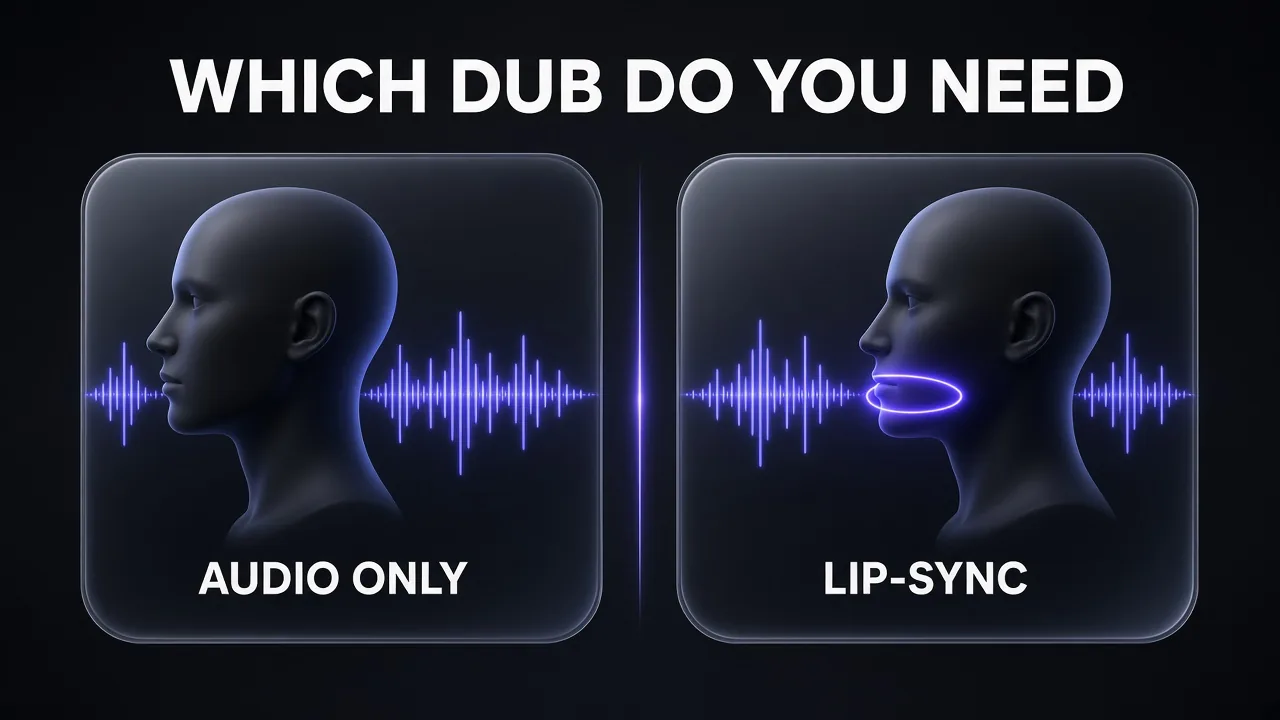
This is the decision that matters more than the vendor. Lip sync earns its price when a face fills the frame and viewers watch the mouth: talking-head ads, founder videos, testimonials, course instructors on camera. It is wasted money on screen recordings, product demos with a small picture-in-picture face, animated explainers and anything where the speaker is off camera.
A useful middle path: dub audio with ElevenLabs, then lip-sync only the clips that need it. VEED sells lip sync on its own (its Lip Sync 2.0 API lists $0.07 per second, or $4.20 a minute), and HeyGen has a separate Lipsync API that takes your own audio in Speed or Precision mode. ElevenLabs v2 plus VEED Lip Sync works out to about $6.40 a minute, roughly VEED Standard's price, but lets you pick the voice model and re-sync only the face-on shots. For a talking-head ad pipeline built this way, see our AI UGC ad factory tutorial.
Developer Experience Side by Side
| VEED | ElevenLabs | HeyGen | |
|---|---|---|---|
| Endpoint | /v1/dubbing, /v1/dubbing-pro | dubbing projects + language targets | /v3/video-translations |
| Input | Public video URL | File upload or source URL | URL or uploaded asset ID |
| Languages per request | One | One per language target (first prepaid) | Several (one ID each) |
| Async + webhooks | Yes | Yes (up to 3 webhook IDs) | Yes (callback_url) |
| Term control | Not in VEED's docs | Up to 1,000 keyterms | Brand glossary |
| Human review step | No | Transcript editing (Enterprise on v2) | Proofread SRT before render |
| Also available on | fal (Standard and Pro) | ElevenLabs app, ElevenCreative plans | HeyGen web app, MCP, CLI |
VEED wins on simplicity: two inputs and you are done. ElevenLabs wins on control over the audio. HeyGen wins on review: it is the only one that lets a non-developer approve the translated script before you pay for the render. If you run these calls from an agent, our Promptsrush AI builder stack shows how we wire media APIs into Claude and MCP workflows.
A good keyterm or glossary list is the cheapest quality upgrade on any of the three. This prompt builds one from your script:
Build a Dubbing Glossary From Your Script
You are a localisation lead preparing a video for AI dubbing into [TARGET LANGUAGES].
Read the transcript below and produce two lists.
1. DO NOT TRANSLATE: every brand name, product name, feature name, person's name, acronym and URL that must stay exactly as written. One per line, max 5 words each.
2. FORCED TRANSLATIONS: terms that must always be translated one specific way in each target language (job titles, legal phrases, recurring calls to action). Format: source term | language | required translation.
Flag any line where a literal translation would run much longer than the original and suggest a shorter wording that keeps the meaning.
Transcript:
[PASTE TRANSCRIPT]
The Language-List Coincidence Worth Knowing
While checking languages we noticed something buyers should know. The 94 language codes and 14 dialects in VEED's Dubbing Pro reference are the same, code for code, as the Dubbing v2 list in ElevenLabs' documentation, and VEED Standard's 86 codes match the list ElevenLabs publishes for Dubbing v1. Both expose a 0-10 cloning-strength dial with a default of 7. Neither company says anything about a relationship, and we are not claiming one. It does mean that if you are choosing between them purely on language coverage, there is no difference to choose on; compare lip sync, price and workflow instead.
Which One Should You Pick?
- You want one API call that returns a finished, lip-synced video: VEED Dubbing API. Standard for single-speaker clips, Pro for interviews, podcasts or a specific accent.
- You need the translated voice, not the mouth: ElevenLabs Dubbing v2 at $2.20 a minute, then swap the audio onto your master file.
- A human has to approve translations, or brand terms keep breaking: HeyGen, for the proofread step and brand glossary, especially if your team already makes avatar videos there.
- You localise long courses: ElevenLabs for the bulk audio, with lip sync only on instructor-on-camera segments. VEED's 10-minute cap and per-second price make full-length lip-sync expensive.
- You are building a product with dubbing as a feature: VEED or ElevenLabs, because both publish self-serve per-unit prices you can put into a margin model today.
If you are still choosing the wider toolset, our best AI video stack for 2026 and Descript vs HeyGen comparison cover the editing side.
Verdict
The VEED Dubbing API is the most interesting launch in this space this autumn because it turns lip-synced dubbing into a single, publicly priced call. At $6.60 to $10.80 a minute it is not cheap, but it is honest pricing for a job that used to need a studio. ElevenLabs remains the value pick: if your audience never sees a mouth up close, Dubbing v2 gives you the best-sounding translated voice at $2.20 a minute. HeyGen is the safest choice for teams that need review, glossaries and batches, held back only by API prices hidden behind a login.
Our pick for most creators: dub with ElevenLabs first, and pay for lip sync only on the shots where a face fills the frame.
Frequently Asked Questions
Frequently Asked Questions
10 questions answered