The PromptsRush journal
AI ToolsElevenLabs Review 2026: Voices, Dubbing, Music & Agents
Our ElevenLabs review for November 2026: what Eleven v4 changes, how cloning, Studio, dubbing, music, Scribe v3 and ElevenAgents work, what the shared credit pool really buys on each plan, and how it compares with Cartesia, Murf and Descript.
Advertisement
Short version: ElevenLabs is still the AI voice platform to beat in November 2026. Eleven v4, released on 28 September, is the most controllable text-to-speech model the company has shipped, and the same account now covers dubbing, music, sound effects, transcription, image and video generation, and full voice agents. The catch is that everything runs on one shared credit pool, so the plan that looks cheap for voiceovers gets expensive the moment you start dubbing video or generating music.
This ElevenLabs review is built from ElevenLabs' own pricing pages, product pages, blog and developer changelog as they read on 15 November 2026, cross-checked against Cartesia's, Murf's and Descript's public pricing. If you only want the plan maths, our ElevenLabs pricing breakdown of Starter, Creator and Pro goes deeper on cost per minute. Here the question is broader: what does ElevenLabs actually do well in 2026, where does it fall short, and who should pay for it?
What Is ElevenLabs?
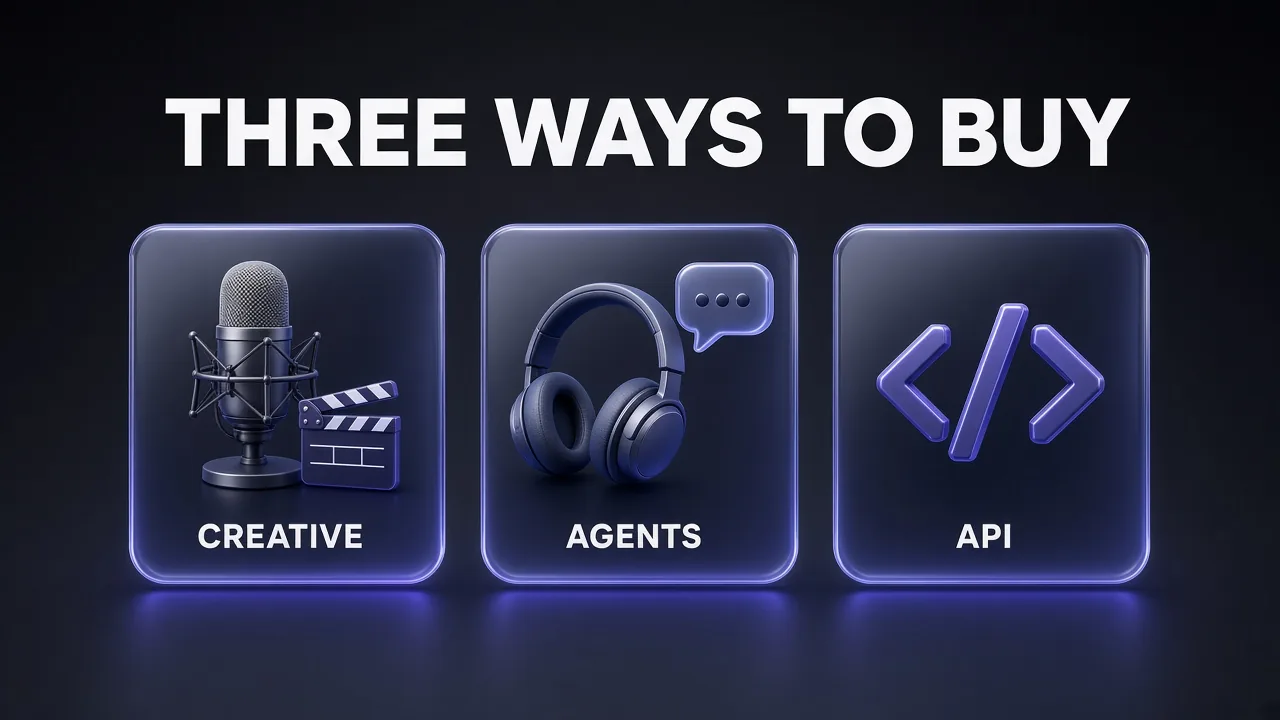
ElevenLabs started as a text-to-speech company and is now an audio-first AI platform sold in three separate products. Knowing which one you are buying saves a lot of confusion, because each has its own pricing tab.
- ElevenCreative: the web app for creators and marketers. Text to Speech, Voice Design, voice cloning, Studio for long-form projects, Dubbing, Music, Sound Effects, Voice Changer, Voice Isolator, Image & Video, Flows and Ads Engine. Billed in credits.
- ElevenAgents: the platform for building voice and chat agents for support, sales and operations, with phone, web and WhatsApp channels. Billed in call minutes.
- ElevenAPI: direct developer access to the models (speech, transcription, music, dubbing, realtime). Billed per character, minute or hour.
The company is also big now. ElevenLabs announced it had crossed $500M in annual recurring revenue in May 2026 and that its valuation rose to $22 billion at the end of September. That scale matters to a buyer for one practical reason: the product ships fast. Between 28 September and 9 November it released a new flagship voice model, a speech-to-speech agent model, a new transcription model and a new sound-effects model. If you are mapping where voice sits next to models, skills and video tools, our Promptsrush AI builder stack shows the whole picture.
Key Features in 2026
Eleven v4: the new flagship voice model
Eleven v4 is the reason to look at ElevenLabs again this year. ElevenLabs describes it as a new architecture that "reads a script the way a voice actor would", and the practical changes are easy to list:
- Inline direction: you write tags such as
[whispers],[laughs],[long pause]or even sound cues like[door slams]straight into the script, and v4 follows them more reliably than v3 did, per ElevenLabs. - 90+ languages, with a cloned voice able to speak other languages with a native accent while keeping its identity.
- Stable speakers: regenerate a line many times and it should still sound like the same person, which was a real pain point with v3 on long projects.
- Professional Voice Clones are back. They were not supported on v3; the changelog confirms PVCs on v4 as of 2 November.
- Up to 10,000 characters per generation, with context stitching for longer scripts.
Two things to know before you switch. First, SSML tags such as <break> are disabled in v4, so old scripts that rely on them need rewriting with natural-language tags like [pause]. Second, ElevenLabs' own FAQ says clones created before v4 launched need retraining for v4 to work well (it is a one-click retrain in the voice list).
On quality claims: ElevenLabs says v4 ranks first on the Artificial Analysis voice leaderboard and was preferred by about 75% of listeners in blind head-to-head tests. Treat the second number as a vendor-run comparison; it is useful as a direction, not as an independent benchmark.
Pro tip: Direction tags work best when they describe delivery, not emotion labels alone. "[tired, half-laughing]" gives v4 more to work with than "[sad]". Keep one tag per sentence change, or the read starts to sound over-acted.
If you write scripts with an LLM first, ask it to output v4-ready tags directly. This prompt does that:
Write an Eleven v4 Voiceover Script With Audio Tags
You are a voiceover director writing for the Eleven v4 text-to-speech model.

Write a [LENGTH: e.g. 60-second] voiceover script for [TOPIC / PRODUCT] aimed at [AUDIENCE].
Tone: [e.g. warm, confident, slightly playful].

Rules:
- Use inline audio tags in square brackets to direct delivery, e.g. [warm], [excited], [whispers], [short pause], [long pause], [laughs softly].
- Put a tag only where the delivery changes, never on every sentence.
- Do not use SSML tags like break; use [pause] or [long pause] instead.
- Spell out numbers, acronyms and brand names the way they should be spoken.
- Keep sentences short enough to breathe; no sentence longer than 20 words.
- Add one optional sound cue in brackets if it helps the scene, e.g. [soft keyboard clicks].

Return only the script, then a list of any words that need a pronunciation dictionary entry.
Eleven v4 Turbo and Eleven Realtime for live conversation
Eleven v4 Turbo is the low-latency sibling, aimed at agents and real-time apps. ElevenLabs quotes a median inference latency of about 100 ms and a median time to first speech of about 150 ms, with the same expressive range as v4.
On 20 October ElevenLabs went a step further with Eleven Realtime, a speech-to-speech model family where one model ID handles recognition, turn-taking, the LLM and speech. There are two versions: v1 Mini for natural conversation at low cost, and v1 Max for multi-step tasks with tool calls. The Realtime API is compatible with OpenAI's Realtime API, so an existing integration can switch by changing the endpoint and model name. In Artificial Analysis' independent evaluation (as reported by ElevenLabs), v1 Max answered 98.8% of Big Bench Audio questions correctly and started speaking in 0.57 seconds on average.
Voice cloning, Voice Design and the voice library
You get three ways to pick a voice. Instant Voice Cloning (Starter and up) now needs as little as 10 seconds of audio on v4. Professional Voice Cloning (Creator and up) trains a higher-fidelity copy from longer recordings. Voice Design generates a new voice from a one-sentence description, which is handy when you need a character and have no recording.
Then there is the library: ElevenLabs lists 20,000+ community and stock voices, all usable with v4. Voice owners earn money when others use their voices, and ElevenLabs reported in May that creators had earned $22 million that way. Every clone, instant or professional, requires verified consent from the voice's owner.
For creators building an AI presenter, the cloned voice is half the job. Our guide on how to create an AI avatar for YouTube shows how a cloned voice and an avatar fit together into a faceless channel.
Studio for long-form audio
Studio is the project editor for audiobooks, podcasts and long narration. You paste or import a script, assign voices per paragraph or character, and render chapters. Free accounts get 3 Studio projects and Starter gets 20, per the pricing page. Eleven v4's more reliable request stitching is aimed squarely at this use: a full audiobook should sound like one continuous take.
Dubbing (briefly)
Dubbing v2 launched on 28 May 2026 and conditions on the original speaker's performance, so tone, pacing and emotion carry into the translated track instead of being rebuilt from a transcript. It supports 90+ languages in ElevenCreative, and enterprise teams can add human translators and mixing through ElevenProductions.
Dubbing is also the fastest way to drain credits. The pricing page lists 2,000 credits per minute for automatic dubbing with a watermark, 3,000 without, 5,000 in Dubbing Studio with a watermark and 10,000 without. On the Creator plan's 121,000 credits, that is roughly 12 minutes of watermark-free Dubbing Studio output a month. We will compare ElevenLabs' dubbing head to head with other dubbing tools in a separate post; for this review, the takeaway is that dubbing works well but is priced for occasional use on the lower plans.
Music and sound effects
Eleven Music turns a text prompt into a full track, with or without vocals, and lets you regenerate one section (say, the bridge) without touching the rest. Music v2 arrived in May with section-by-section composition and better multilingual vocals, and the developer docs now list Music v2.5 as the most advanced model, with improved quality and prompt adherence. ElevenLabs says the music models were built with artists, labels and publishers and are cleared for commercial use; the pricing page ties commercial music use to Starter and above.
Sound Effects generates clips from a description ("rain on a tin roof, distant thunder"). SFX v3 became the default model on 2 November, with closer prompt following and fewer clipping artefacts on high-pitched sounds, per the changelog. A sound effect costs about 200 credits per generation and music about 900 credits per minute.
Speech to Text with Scribe v3
Scribe is the transcription side. Scribe v3 and Scribe v3 Live landed in the API on 9 November; ElevenLabs says v3 makes 27% fewer word errors than Scribe v2 on the FLEURS benchmark and labels speakers more accurately, while Live adds turn prediction and a keyterm library of up to 10,000 terms. Through the API, Scribe v3 costs $0.20 per hour of audio. For creators, Scribe sits behind Studio's captions and subtitles, which pairs well with the clip-and-caption workflow in our guide to repurposing YouTube videos with AI.
Image & Video, Flows and Ads Engine
This is the part of ElevenLabs most people have not noticed. Inside ElevenCreative you can now generate images and video with third-party models. The image-to-video page currently lists Veo 3.1, Seedance 2.5 Flash, Gemini Omni Flash 1.2 and 1.1, FLUX 3 Max, Kling 4.0, and MiniMax H3 and H3 Max. Video generation needs a paid plan, and credits are shown before each run.
Flows is a node canvas that chains 50+ image and video models with ElevenLabs' audio models: generate an image, animate it, add a voiceover, lip-sync it, score it. Flows Agent (June 2026) builds those pipelines from a chat prompt and can pause before expensive steps. Ads Engine (June 2026) connects to Google Ads and Meta Ads, pulls existing creatives and localises text, images and video for new markets.
Honest answer: these tools are useful if you already live in ElevenLabs, but they are not a reason to choose it. If video is your main output, a video-first platform gives you more control per model. Our Kling 4.0 vs Wan 3 comparison and AI video cost-per-second guide are better starting points for picking the video model itself.
ElevenAgents for voice and chat agents
ElevenAgents is where ElevenLabs is putting most of its enterprise energy. You configure an agent with a prompt, knowledge base, tools and workflows, then deploy it on phone, web, WhatsApp or contact-centre channels. You can choose the speech models, the LLM, or one of the Realtime speech-to-speech models from a dropdown. Agents are billed by call minutes, separately from the creative credit pool, and LLM usage is charged on top.
What's New: ElevenLabs Summit NYC (11 November 2026)
Four days before this review, ElevenLabs used its New York Summit to set out where the platform is going. Most of it targets businesses, and several items were announced as coming rather than shipped, so read this list as a roadmap:
- Memory for ElevenAgents: agents will keep a structured record of returning, authenticated customers, such as language preference or best time to call.
- Routines: an automation layer to run multi-step work before, during and after a conversation, like emailing a report or writing to a CRM.
- Interaction Engine (preview): handles turn-taking and picks a cheaper or stronger LLM for each part of a conversation.
- ElevenAI: a new app for dictation and meeting notes powered by Scribe v3, with free early access opening at the Summit.
- Fine-tuning of some open-source language models and ElevenLabs voice models on a company's own data, "in the coming months".
- ElevenLabs Partner Program and Marketplace for industry-specific agents built by partners.
For a solo creator, none of this changes the buying decision today. For a team evaluating voice agents, Memory and Routines are the two to watch, because they move ElevenAgents from "answers calls" toward "handles the follow-up work too".
How to Use ElevenLabs: Your First Voiceover in Five Steps
- Create a free account. You get 10,000 credits a month, roughly 10 minutes of speech, with no card needed. Free output is for personal use only.
- Pick or make a voice. Browse the voice library by use case (narration, conversational, advertisement), describe one in Voice Design, or, on Starter and up, clone your own with Instant Voice Cloning.
- Choose the model. Use Eleven v4 for produced content. Use a Flash or v4 Turbo model only when speed matters more than nuance, such as live apps.
- Write with direction tags. Paste your script, add tags like
[warm]or[short pause]where delivery should change, and add a pronunciation dictionary entry for brand names. - Generate, then fix single lines. Listen through, regenerate only the lines that miss, and export as MP3 (or WAV/PCM on plans that allow it). For anything longer than a few minutes, move the script into Studio.
If you are making ads, the next step is pairing the voice with visuals. Our AI UGC ad factory tutorial shows ElevenLabs voiceovers feeding Arcads actors and HeyGen avatars in one repeatable pipeline.
ElevenLabs Pricing in November 2026
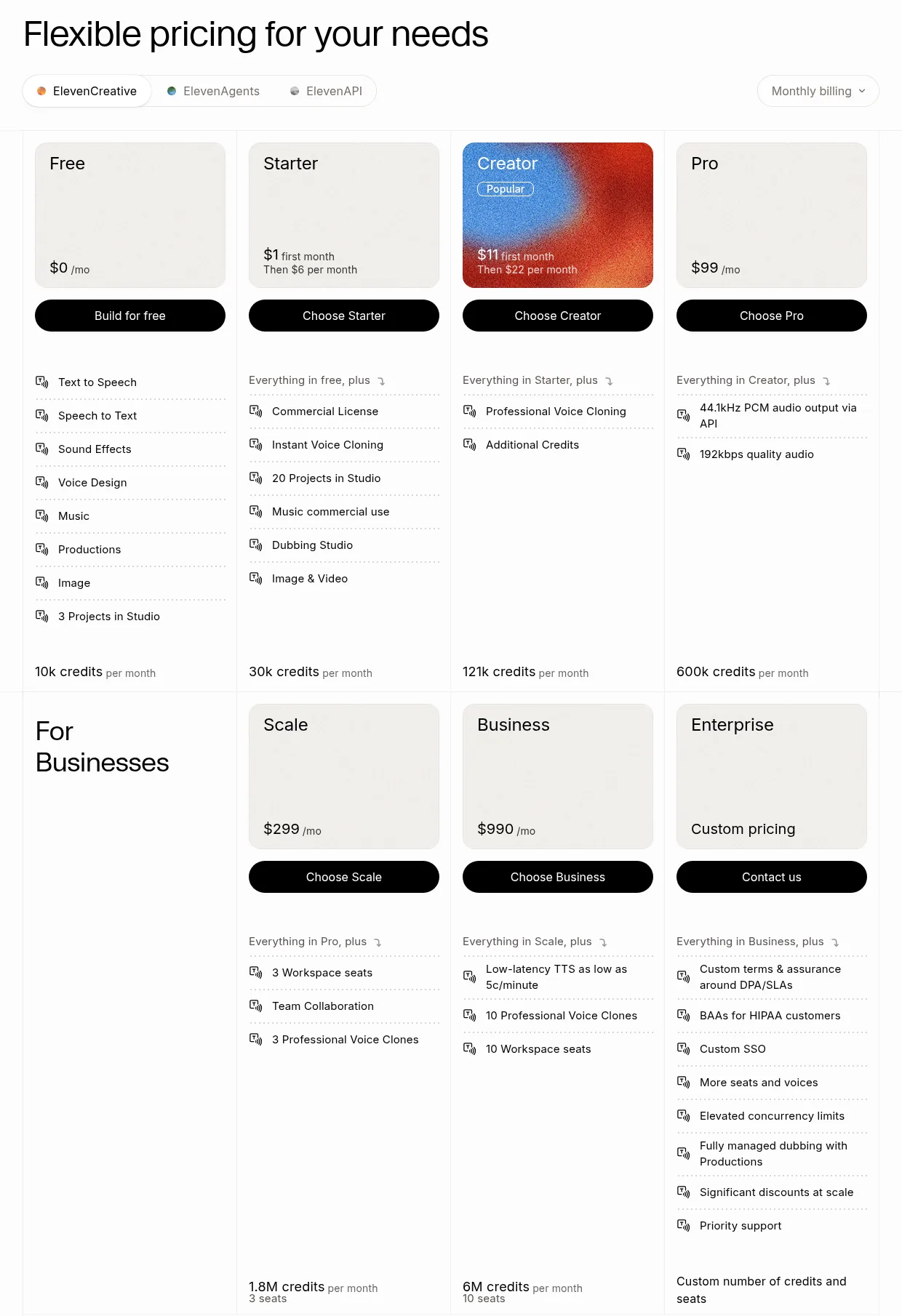
All ElevenCreative plans draw from one monthly credit allowance. Here is the lineup as listed on 15 November 2026 (prices exclude taxes):
| Plan | Monthly | Annual (per month) | Credits / month | What it adds |
|---|---|---|---|---|
| Free | $0 | n/a | 10,000 | Personal use, 3 Studio projects |
| Starter | $6 | $5 | 30,000 | Commercial license, instant cloning, Dubbing Studio, Image & Video |
| Creator | $22 ($11 first month) | $18.33 | 121,000 | Professional voice cloning, extra credits |
| Pro | $99 | $82.50 | 600,000 | 44.1 kHz PCM via API, 192 kbps audio |
| Scale | $299 | $249.17 | 1,800,000 | 3 seats, 3 professional clones |
| Business | $990 | $825 | 6,000,000 | 10 seats, 10 professional clones, low-latency TTS from 5¢/min |
| Enterprise | Custom | Custom | Custom | SSO, DPA/SLA, HIPAA BAAs, managed dubbing |
When we checked, the pricing page was also showing a $1 first-month offer on Starter. Treat any first-month discount as temporary and budget on the regular price.
The credit pool is where most surprises come from. Text to speech costs about 1 credit per character, but other tools cost far more per minute, so the same plan buys very different amounts depending on what you make:
| Tool | Approx. credits | On Creator's 121,000 credits |
|---|---|---|
| Text to Speech | 1 per character (~1,000 per minute) | ~2 hours of speech |
| Speech to Text | 330 per minute | ~6 hours transcribed |
| Music | 900 per minute | ~2 hours of music |
| Sound Effects | 200 per generation | ~600 effects |
| Voice Changer / Isolator | 1,000 per minute | ~2 hours |
| Dubbing Studio, no watermark | 10,000 per minute | ~12 minutes |
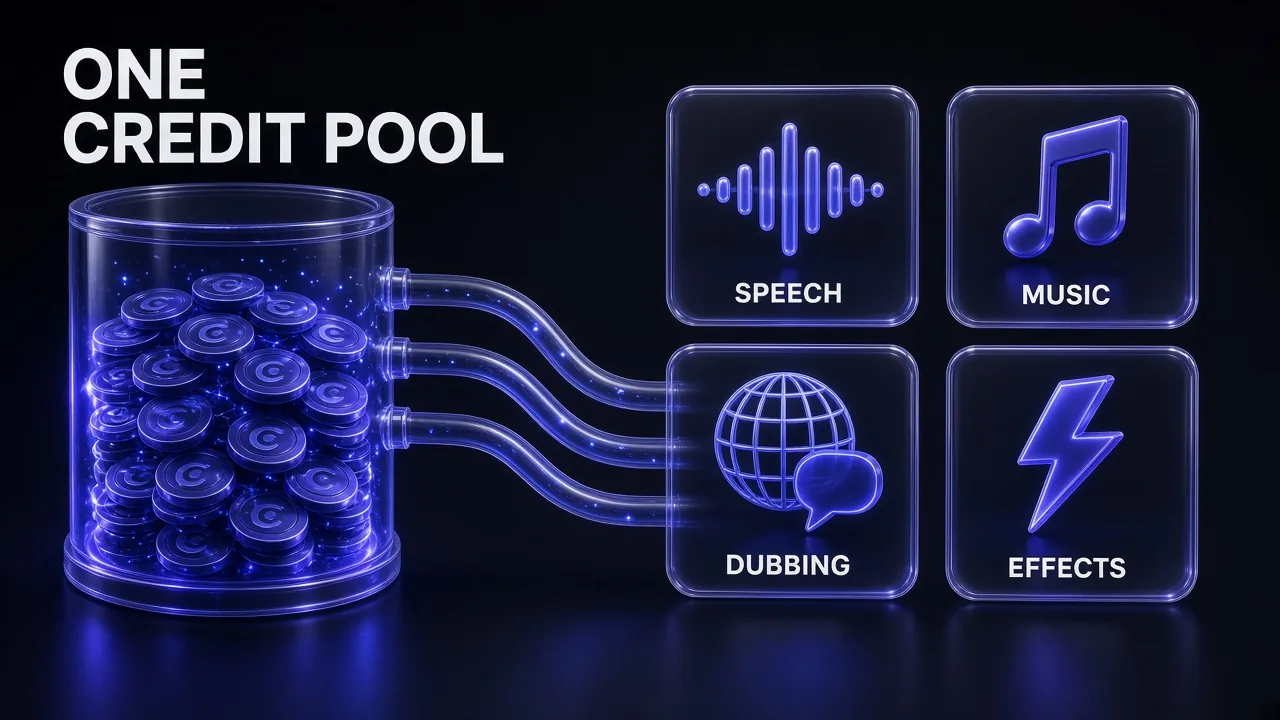
Unused credits roll over for up to two months while you stay on a paid plan, but you lose them if you downgrade or cancel. ElevenAgents is priced separately: Free includes 15 call minutes, Starter 75, Creator 275, Pro 1,238, Scale 3,738 and Business 12,375, with extra minutes at $0.08 and LLM costs on top. Developers on ElevenAPI pay per use instead, for example $0.08 per 1,000 characters for Eleven v4 and $0.04 for v4 Turbo.
For which tier fits which kind of creator, and why cost per minute flattens above Pro, see our full ElevenLabs pricing guide.
ElevenLabs vs Cartesia vs Murf vs Descript
ElevenLabs does not have one rival; it has a different rival for each job. These three cover the most common reasons people shop around. Prices are from each vendor's pricing page on 15 November 2026.
| ElevenLabs | Cartesia | Murf (API) | Descript | |
|---|---|---|---|---|
| Best for | All-round voice, cloning, music, agents | Low-latency voice for developers and agents | Cheap high-volume TTS via API | Editing video and podcasts, with AI voice built in |
| Entry paid price | $6/mo (30,000 credits) | $5/mo Pro (100K credits) | Pay per use | $24/mo Hobbyist ($16 billed annually) |
| TTS price signal | API: $0.08 per 1K chars (v4), $0.04 (v4 Turbo) | 1 credit per character on Sonic | $0.01 per 1K chars (Falcon), $0.03 studio quality | Included in plan credits |
| Voice agents | ElevenAgents, $0.08/min extra + LLM | Agents from $0.03/min (plus telephony and LLM) | Real-time TTS for agents | No |
| Music and SFX | Yes, both | No | No | Stock library |
| Dubbing | Dubbing v2, 90+ languages | No | Separate Dub product | Business plan, 30+ languages |
My take: pick Cartesia if you are building a voice agent and every millisecond and cent per minute matters. Pick Murf's API if you need very large volumes of plain narration at the lowest per-character rate. Pick Descript if you are editing video anyway and want voice fixes inside the editor; our Descript review covers that workflow. Pick ElevenLabs when voice quality, emotional range and breadth (cloning, music, effects, agents) matter more than the lowest unit price.
Who Should Use ElevenLabs (and Who Should Not)
ElevenLabs is a strong fit if you
- publish voiceovers, narration or audiobooks and care about delivery, not just clarity;
- want your own cloned voice that can speak other languages;
- need music, sound effects and voice from one licensed source for client work;
- are building a voice agent and want strong voices with phone and WhatsApp channels ready to go.
Look elsewhere if you
- mainly need to dub long videos every week on a small budget, because dubbing burns credits roughly 10 times faster than speech;
- only need basic text to speech at the lowest possible price per character;
- want a talking avatar or full video editor first; a voice platform is only half that stack.
For that last group, the usual answer is to pair ElevenLabs with an avatar tool. HeyGen handles the on-screen presenter while ElevenLabs supplies the voice; our HeyGen review covers the avatar side in detail. For the whole toolchain, see our best AI video stack for 2026.
Pros and Cons
Pros
- Eleven v4 gives fine control over delivery with plain-language tags, in 90+ languages.
- Professional Voice Clones work on the newest model again.
- One account covers speech, cloning, dubbing, music, sound effects, transcription and agents.
- Generous free tier for testing, and a commercial license from $6 a month.
- Fast release cadence: Eleven v4, Eleven Realtime, SFX v3 and Scribe v3 all shipped between late September and mid-November.
Cons
- The shared credit pool makes real costs hard to predict once you mix tools.
- Dubbing and voice changing are expensive per minute on lower plans.
- Three products with three pricing tabs confuse first-time buyers.
- Older clones and SSML-based scripts need rework for v4.
- Several headline agent features (Memory, Routines, fine-tuning) were announced but not yet generally available.
Verdict: Is ElevenLabs Worth It in 2026?
Yes, for most people who need a voice that sounds directed rather than read. Eleven v4 closes the two gaps that made v3 frustrating, unstable speakers and no professional clones, and the breadth of the platform means one subscription covers voice, music and effects for a typical creator. Start on Free, move to Starter the day you publish anything commercial, and go to Creator if you want a professional clone of your own voice.
Where we would hold back: heavy dubbing on a small plan, and pure high-volume narration where cheaper APIs exist. And if you are buying ElevenAgents for a business, judge it on what ships today, not on the Summit roadmap.
Frequently Asked Questions
Frequently Asked Questions
10 questions answered