ElevenLabs Pricing 2026: Starter, Creator, or Pro?
Every ElevenLabs plan with the real per-minute maths. The cost per minute is flat from Pro upward — so the only reasons to upgrade are credits, seats, concurrency and audio format. Here is which tier fits you.
Advertisement
Most ElevenLabs pricing guides list the plans and stop. That is the least useful part, because the plans are on the pricing page and you can read them yourself. The question worth answering is where the money actually stops buying you more — and the answer is more interesting than the tier names suggest.
Here is the short version of what the numbers show: the cost per minute of generated audio is essentially flat from Pro upward. Pro, Scale and Business all land within a fraction of a cent of each other. Above Creator you are not buying cheaper speech. You are buying seats, concurrency, professional voice clones and audio fidelity. Once you see that, choosing between Starter, Creator and Pro becomes a much simpler decision.
Everything below is taken from the live ElevenLabs pricing page and official documentation, captured while writing this.
Every Plan, With the Real Numbers
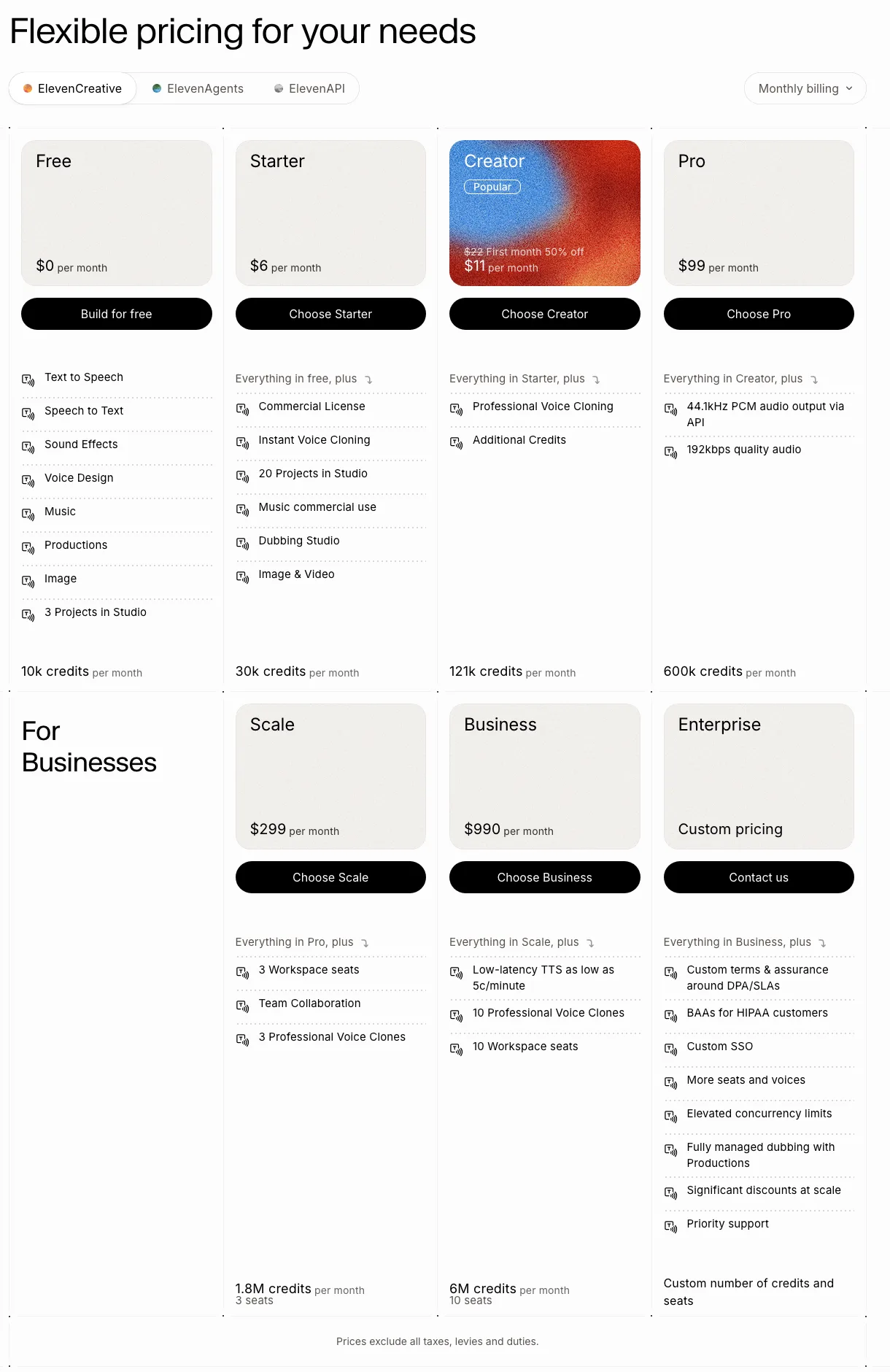
| Plan | Monthly | Annual (per month) | Credits/month | Headline addition |
|---|---|---|---|---|
| Free | $0 | — | 10,000 | No commercial license, no cloning |
| Starter | $6 | $5 ($60/yr) | 30,000 | Commercial license + instant voice cloning |
| Creator | $22 (first month $11) | $18.33 ($220/yr) | 121,000 | Professional voice cloning |
| Pro | $99 | $82.50 ($990/yr) | 600,000 | 44.1kHz PCM via API, 192kbps audio |
| Scale | $299 | $249.17 ($2,990/yr) | 1,800,000 | 3 seats, 3 pro voice clones |
| Business | $990 | $825 ($9,900/yr) | 6,000,000 | 10 seats, 10 clones, low-latency TTS |
| Enterprise | Custom | Custom | DPA/SLA, HIPAA BAAs, SSO, priority support | |
Two things to note before going further. Prices exclude taxes, levies and duties, so your actual charge will be higher depending on where you are. And these are the ElevenCreative plans — ElevenAgents (conversational AI) and ElevenAPI are priced separately on their own tabs, which is the single most common source of confusion when someone quotes an ElevenLabs price that does not match yours.
What a Credit Actually Buys
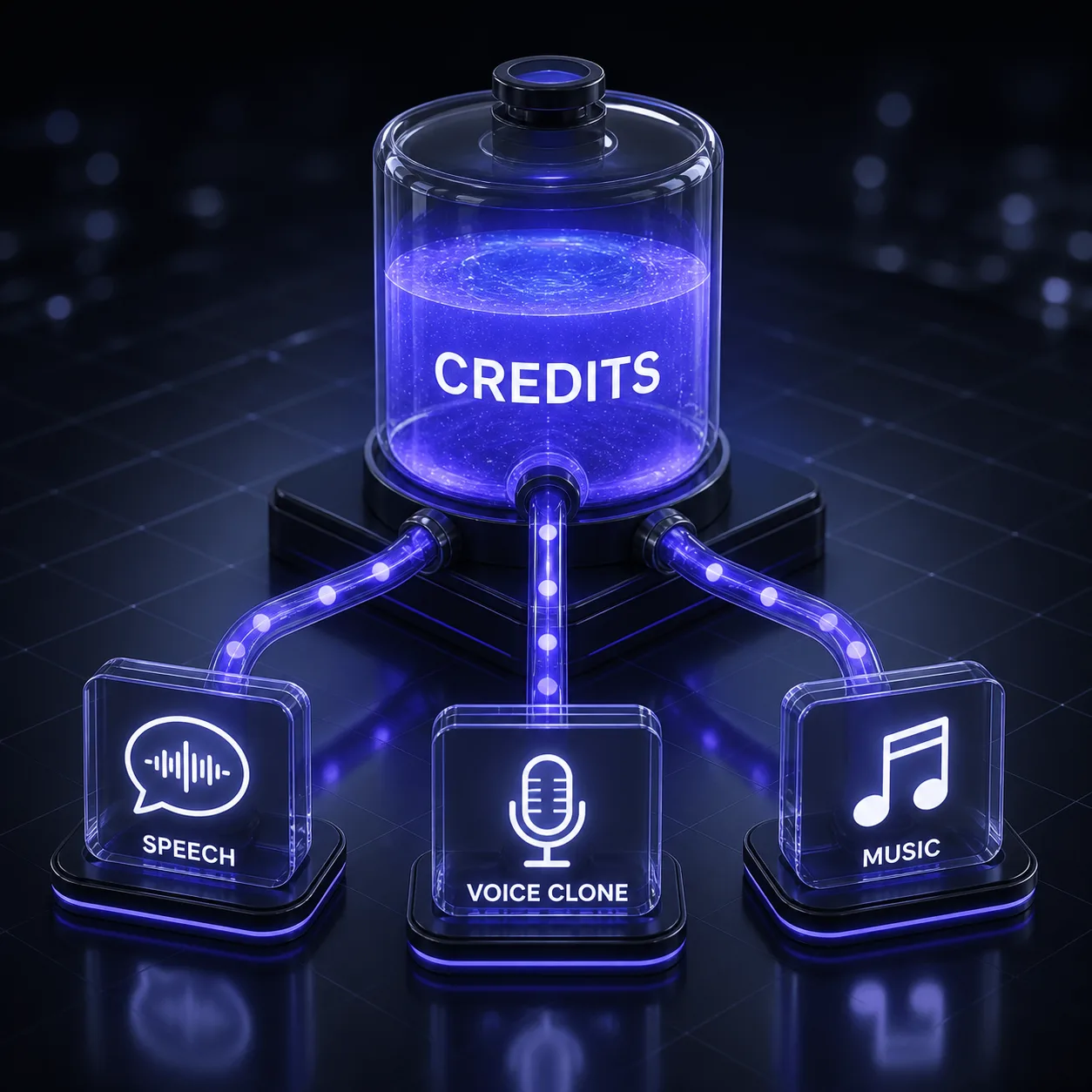
Credits are a shared pool drawn down by everything on the platform — text to speech, speech to text, voice cloning, sound effects, music. They are not minutes, which is why the plan comparison feels slippery.
The working rule: on the standard Multilingual v2 model, one character costs one credit, and roughly 1,000 characters of text produces about a minute of speech. So about 1,000 credits per minute. The Flash models cost roughly half that per character, so the same credit balance stretches to roughly double the audio — at a quality trade-off you should judge for your use case rather than take on faith.
Using the standard 1,000-credits-per-minute rule, here is what each plan actually buys:
| Plan | Credits | ≈ Minutes of speech | ≈ In practice |
|---|---|---|---|
| Free | 10,000 | ~10 min | Testing voices, nothing more |
| Starter | 30,000 | ~30 min | ~6 five-minute videos a month |
| Creator | 121,000 | ~2 hours | Weekly podcast, or steady short-form output |
| Pro | 600,000 | ~10 hours | Audiobook production, daily publishing |
| Scale | 1,800,000 | ~30 hours | Small team, multiple shows or clients |
| Business | 6,000,000 | ~100 hours | Production application traffic |
Where the Cost Curve Flattens

This is the part worth your attention. Divide the monthly price by the minutes it buys:
| Plan | Cost per minute (monthly) | Cost per minute (annual) |
|---|---|---|
| Starter | $0.200 | $0.167 |
| Creator | $0.182 | $0.152 |
| Pro | $0.165 | $0.138 |
| Scale | $0.166 | $0.138 |
| Business | $0.165 | $0.138 |
Read that column again. Pro, Scale and Business are the same price per minute. Spending $990 instead of $99 does not make your audio cheaper — it buys you ten times more of it at an identical unit rate, plus seats, clones and the low-latency option.
The practical consequences:
- There is no volume discount to chase above Pro. Move up only when you genuinely exhaust the credits or need the seats, not in hope of a better rate.
- Creator costs about 10% more per minute than Pro. That is a small penalty. If your usage sits anywhere near Creator's ceiling, staying on Creator and occasionally topping up is often smarter than a 4.5x price jump to Pro.
- Starter is the worst per-minute rate of any paid plan — and it does not matter, because nobody buys Starter for volume. They buy it for the commercial license.
- Annual billing takes roughly 17% off across the board. The relative shape does not change; every plan just moves down together.
The one genuine exception is Business, which lists low-latency TTS at as low as 5¢ per minute. That is a different rate structure for a different workload, and it is the only place in the lineup where the unit economics actually shift.
Starter — $6/month
What it unlocks: commercial license, instant voice cloning, 20 Studio projects, commercial use of generated music, Dubbing Studio, and Image & Video.
Starter exists to solve one problem: the Free plan gives you no commercial rights and no voice cloning, so anything you publish or monetise is off-limits. Six dollars fixes that. The 30,000 credits are almost beside the point — that is roughly half an hour of audio, which you will burn through quickly if voice is central to your work.
Choose Starter if: you need legal cover to publish, you produce under about 30 minutes of audio a month, and instant cloning is enough for your voice needs. Typical fit — a solo creator narrating short videos, or someone adding voiceover to product clips alongside a tool like OpenArt for the visuals.
Skip Starter if: you already know you want a high-fidelity clone of your own voice. That is professional voice cloning, and it starts at Creator. Paying $6 first and upgrading a month later just costs you a month.
Creator — $22/month (first month $11)
What it unlocks: professional voice cloning and 121,000 credits — about four times Starter's allowance for under four times the price.
Creator is the plan most people should be on, and ElevenLabs marks it "Popular" for a reason that survives scrutiny. Professional voice cloning is the real dividing line in the lineup: instant cloning produces a serviceable approximation from a short sample, while professional cloning trains on substantially more audio and is what people mean when they say a clone is indistinguishable. If your own voice is your brand, this is the tier where that becomes possible.
Two hours of audio a month covers a weekly podcast, a steady short-form publishing schedule, or a decent volume of client work. The first month at $11 makes it cheap to test properly.
Choose Creator if: you publish regularly, you want a high-quality clone of a specific voice, and you produce under roughly two hours of finished audio a month.
Skip Creator if: you are consistently running out of credits before the month ends. At that point you are paying overage friction on top of a plan, and Pro's larger pool is the cleaner answer.
Pro — $99/month
What it unlocks: 600,000 credits, 44.1kHz PCM audio output via API, and 192kbps quality audio.
Pro is where the plan stops being about access and starts being about output quality and volume. The audio specifications matter more than they sound: 44.1kHz PCM is uncompressed CD-quality output, which is what you want if the audio goes into a proper edit, gets mixed with music, or ends up in a broadcast or audiobook pipeline. Compressed formats degrade further every time you re-encode; PCM does not.
Ten hours a month is genuine production volume — an audiobook, a daily show, or an application generating audio for users.
Choose Pro if: any of three things is true — you exceed Creator's credits, you need uncompressed audio for post-production, or you need the concurrency (see below). Not because you expect a better rate, because there is not one.
Skip Pro if: you are buying it for prestige or headroom you will not use. The jump from $22 to $99 is 4.5x for the same price per minute. If you are using half of Creator's credits, Pro is dead money.
Scale, Business and Enterprise
Scale ($299) adds 1.8M credits, 3 workspace seats, team collaboration and 3 professional voice clones. The seats are the reason to buy it — this is the first plan built for more than one person.
Business ($990) adds 6M credits, 10 seats, 10 professional voice clones and low-latency TTS from 5¢/minute. That last item is the interesting one and the only real break in the flat unit pricing.
Enterprise is custom, and the list tells you exactly who it is for: custom terms around DPA and SLAs, BAAs for HIPAA customers, custom SSO, elevated concurrency limits, fully managed dubbing, discounts at scale and priority support. If you need a BAA, you already know it, and no self-serve tier will do.
Worth flagging: Scale and Business have identical concurrency limits. The extra $691 a month buys credits, seats, clones and the low-latency rate — not more parallel throughput.
The Constraint Nobody Reads: Concurrency
Credits limit how much you can generate in a month. Concurrency limits how much you can generate at once, and it is the constraint that actually breaks production applications. These are the official per-tier limits:
| Plan | Multilingual v2 | Flash | Speech to Text | Realtime STT | Music |
|---|---|---|---|---|---|
| Free | 2 | 4 | 8 | 6 | 0 |
| Starter | 3 | 6 | 12 | 9 | 2 |
| Creator | 5 | 10 | 20 | 15 | 2 |
| Pro | 10 | 20 | 40 | 30 | 2 |
| Scale | 15 | 30 | 60 | 45 | 5 |
| Business | 15 | 30 | 60 | 45 | 5 |
| Enterprise | Elevated across the board | ||||
Your plan also determines queue priority, not just parallel capacity. If you are building anything that generates audio for multiple users simultaneously, work out your peak concurrent requests before you pick a tier — this is where teams get surprised, and it is a much harder wall to work around than running low on credits.
Note also that music concurrency is 0 on Free and caps at 2 all the way through Pro. If music generation is central to your workflow, Scale is the first plan that gives you meaningful room.
Things That Catch People Out
- Credit rollover is limited and tier-dependent. Paid plans are widely reported to roll unused credits for up to two months, with no rollover on Free and Starter. This is not stated on the pricing page itself, so confirm it in your account billing settings before you plan around it.
- Downgrading burns credits. If you cancel or downgrade, your subscription runs to the end of the billing period and unused paid credits then expire. Do not stockpile.
- The Creator intro price is one month only. $11 for month one, $22 after. Budget for the real number.
- Taxes are extra. The page states prices exclude all taxes, levies and duties.
- Agents and API are separate products. ElevenAgents and ElevenAPI have their own pricing tabs. A Creator subscription does not set your agent costs.
- Voice clone counts are a real limit. Professional voice clones are capped per tier — 3 on Scale, 10 on Business. If you manage voices for several brands or clients, count them before choosing.
The Verdict
Run down this list and stop at the first line that describes you:
- Just testing? Free. Ten minutes is enough to judge the voices, and you will know within an hour.
- Publishing anything commercially, low volume? Starter, $6. You are buying the licence, not the credits.
- Want a high-fidelity clone of your own voice? Creator, $22. Professional cloning starts here, and the first month is half price.
- Publishing regularly, under two hours a month? Creator. This is the right answer for most individual creators.
- Exceeding Creator's credits, or need uncompressed audio for post? Pro, $99 — but only for those reasons.
- More than one person needs access? Scale, $299. Seats are the deciding feature.
- Running production traffic or needing low-latency at volume? Business, $990, where the 5¢/minute rate finally changes the maths.
- Need HIPAA, SSO, an SLA or a DPA? Enterprise. Nothing else will satisfy procurement.
The mistake to avoid is upgrading for a better unit price. There is not one above Pro. Upgrade when you hit a wall — credits, seats, concurrency, clone count or audio format — and not before. And if you are weighing this against the wider AI tooling budget, our breakdowns of HeyGen pricing, Higgsfield pricing and Claude pricing use the same lens.
Keep Reading
More pricing breakdowns and voice tooling: HeyGen pricing explained, Higgsfield pricing, Claude pricing, Genspark plans compared, best AI UGC ad platforms, and the Hedra review. Or browse all guides and prompts on PromptsRush.
Frequently Asked Questions
9 questions answered