The PromptsRush journal
AI ToolsClaude Fable vs GPT-6 Astra: Fable 5.2 vs GPT-6.2 Astra (Nov 2026)
Claude Fable 5.2 and the new GPT-6.2 Astra now share an $8/$40 API price. We compare vendor-reported benchmarks, long-context costs, Claude Max/Ultra and ChatGPT plan access, and which model fits coding agents versus office deliverables.
Advertisement
Short version: if your work is long-running agents, hard coding and research that has to run for hours, Claude Fable 5.2 is the stronger pick on the evidence available today. If your work ends in slides, spreadsheets, legal memos and other office deliverables, or you push very long prompts through the API and care about cost per task, GPT-6.2 Astra is the one to try first. Both now cost the same headline rate, $8 per million input tokens and $40 per million output tokens, so the choice comes down to the kind of work, the long-context bill and which subscription you already pay for.
One thing changed overnight. If you came here for GPT-6 Astra, note that OpenAI shipped GPT-6.2 Astra on 17 November 2026, one day before we wrote this, with a 20% price cut. So we compare the current versions: Fable 5.2 (9 November) against GPT-6.2 Astra. Our September piece on GPT-6 Astra vs Claude Fable 5.1 covers the previous generation. Every number below comes from Anthropic's and OpenAI's own pages as they read on 18 November 2026. We have not benchmarked either model ourselves, so every score names the vendor that reported it.
Claude Fable vs GPT-6 Astra at a Glance
| Spec | Claude Fable 5.2 | GPT-6.2 Astra |
|---|---|---|
| Maker / API model ID | Anthropic, claude-fable-5-2 | OpenAI, gpt-6.2-astra |
| Released | 9 Nov 2026 | 17 Nov 2026 |
| Built for (vendor's words) | Demanding reasoning and long-horizon agentic work | Your hardest projects, from start to finish |
| Context window | 1M tokens | 1,050,000 tokens (922,000 max input) |
| Max output | 128K tokens | 128,000 tokens |
| Inputs / outputs | Text and images in, text out | Text and images in, text out |
| Reasoning control | Adaptive thinking, always on; effort parameter (API default high) | Reasoning effort levels; none is rejected |
| Knowledge cutoff | Jun 2026 | 18 May 2026 |
| API price, input / output per 1M | $8 / $40 | $8 / $40 (up to 272K input tokens) |
| Cache read per 1M | $0.20 | $0.40 |
| Fast mode | Up to 2.5x faster, $16 / $80 | 2x Standard rate; Ultrafast 3x until 28 Feb 2027 |
| Consumer access | Claude Pro (usage credits), Max and Ultra (included, up to half the weekly limit), Team, Enterprise | ChatGPT Plus, Pro, Enterprise and Edu in ChatGPT Work and Codex |
All API prices are US dollars at Standard processing, from Anthropic's Fable 5.2 model page and OpenAI's GPT-6.2 Astra model page.
Which Versions We're Comparing (and Why 6.2 Changed the Math)
Both families moved fast this autumn. Anthropic's Fable line went from Fable 5 to Fable 5.1 on 1 September and Fable 5.2 on 9 November, and the 5.2 release dropped the price from $10/$50 to $8/$40 per million tokens. OpenAI released GPT-6 Astra on 3 September at $10/$50, then introduced GPT-6.2 Astra and GPT-6.2 Sol on 17 November with input and output prices cut by 20% and cached input cut by 60%.
The result is rare: two frontier models at identical headline token prices. If you read our GPT-6 Astra launch breakdown, note that its pricing and its benchmark comparisons are now one version behind.
Two naming details matter. First, Claude Mythos 5.2 is the same underlying model as Fable 5.2, with fewer cyber and biology safeguards, and it is only available to organisations verified through Anthropic's Cyber and Life Sciences programs. Second, Anthropic tells most users to start with Claude Opus 5.5 and move up to Fable only when Opus at high effort falls short; we unpacked that trade-off in Claude Fable 5.2 vs Opus 5.5. OpenAI frames Astra the same way, with GPT-6.2 Sol as the efficient everyday model below it.
Pro tip: compare the tier below too. OpenAI says GPT-6.2 Sol comes within 0.5 points of GPT-6.2 Astra on FrontierCode 2.0 at about one-fifth of the cost.
Benchmarks: What Each Vendor Actually Reports
Here is the honest problem with benchmarks this week: nobody has published a like-for-like table of Fable 5.2 against GPT-6.2 Astra. Anthropic's launch table compares Fable 5.2 with the original GPT-6 Astra, because 6.2 did not exist yet. OpenAI's 6.2 announcement makes relative claims against Fable 5.2 on a handful of tests, mostly in its own favour. Treat both sets as vendor-reported.
Anthropic's numbers first. These are from the Fable 5.2 and Mythos 5.2 announcement, at each model's highest available effort unless noted, and the comparison column is GPT-6 Astra, not 6.2.
Claude Fable 5.2 vs GPT-6 Astra: Anthropic-reported scores
Highest available effort; comparison is the original GPT-6 Astra, not GPT-6.2
- Claude Fable 5.2
- GPT-6 Astra
Source: Anthropic, Claude Fable 5.2 and Mythos 5.2 announcement, 9 Nov 2026 (vendor-reported)
On Anthropic's table Fable 5.2 leads GPT-6 Astra on every shared row, with the biggest gaps on Humanity's Last Exam with tools (74.2% vs 57.2%), the Remote Labor Index (41.3% vs 20.8%) and the RoboDojo robotics simulation (64.9% vs 29.8%). The closest row is chart reading on Chartography (73.4% vs 71.0%).
Now OpenAI's side. In the GPT-6.2 announcement, OpenAI reports that GPT-6.2 Astra:
- scores 5.5 points ahead of Claude Fable 5.2 on Agents' Last Exam, a test of multistep professional work, at 5% of the cost, with a footnote that Fable's leaderboard result excludes nine tasks that used a fallback model;
- sets a new high on Terminal-Bench-Science 0.1, 9 points above GPT-6 Astra, where the Fable 5.2 figure it compares against is Artificial Analysis's run in the mini-swe-agent harness (Anthropic reports 74.6% in Claude Code);
- more than doubles Fable 5.2's pass rate on Harvey LAB-AA v1.1, a legal-deliverable benchmark, at about one-sixth of the cost;
- improves 6.2 points over GPT-6 Astra on its internal GDPval v2 while using 22% fewer output tokens.
My take: each company picked tests and harnesses that flatter its own model. Anthropic's lead over GPT-6 Astra on agentic coding, computer use and research is large, but we cannot tell from published numbers how much of it GPT-6.2 closed. OpenAI's evidence is strongest on professional deliverables and cost per task. Use these numbers to pick what to test, not as a verdict.
API Pricing Compared: Same Sticker, Different Long-Context Bill
The headline API price is a tie at $8 in and $40 out per million tokens. The differences sit in caching, speed tiers and, above all, long prompts.
| Price per 1M tokens (Standard) | Claude Fable 5.2 | GPT-6.2 Astra |
|---|---|---|
| Input | $8 | $8 (doubles to $16 above 272K input tokens) |
| Output | $40 | $40 ($60 when input exceeds 272K) |
| Cache read / cached input | $0.20 | $0.40 (doubles above 272K) |
| Cache write | $10 (5-minute), $16 (1-hour) | $10 (30-minute), $20 (12-hour) |
| Batch | 50% off input and output | 50% of Standard rates |
| Fast mode | $16 / $80, up to 2.5x faster | 2x the Standard rate |
| Ultrafast | Not offered | 3x Standard until 28 Feb 2027, then 6x |
| Previous version | Fable 5.1: $10 / $50 | GPT-6 Astra: $10 / $50, $1 cached |
The line that matters is OpenAI's long-context rule: for any request with more than 272K input tokens, input and cache rates double and output costs 1.5 times the normal rate for the whole request. Anthropic's Fable 5.2 price table lists no long-context tier. Here is what that does to a single request, using list prices and our own arithmetic:
| One request (Standard, no caching) | Claude Fable 5.2 | GPT-6.2 Astra |
|---|---|---|
| 100K input + 10K output | $1.20 | $1.20 |
| 400K input + 20K output | $4.00 | $7.60 |
| 800K input + 30K output | $7.60 | $14.60 |
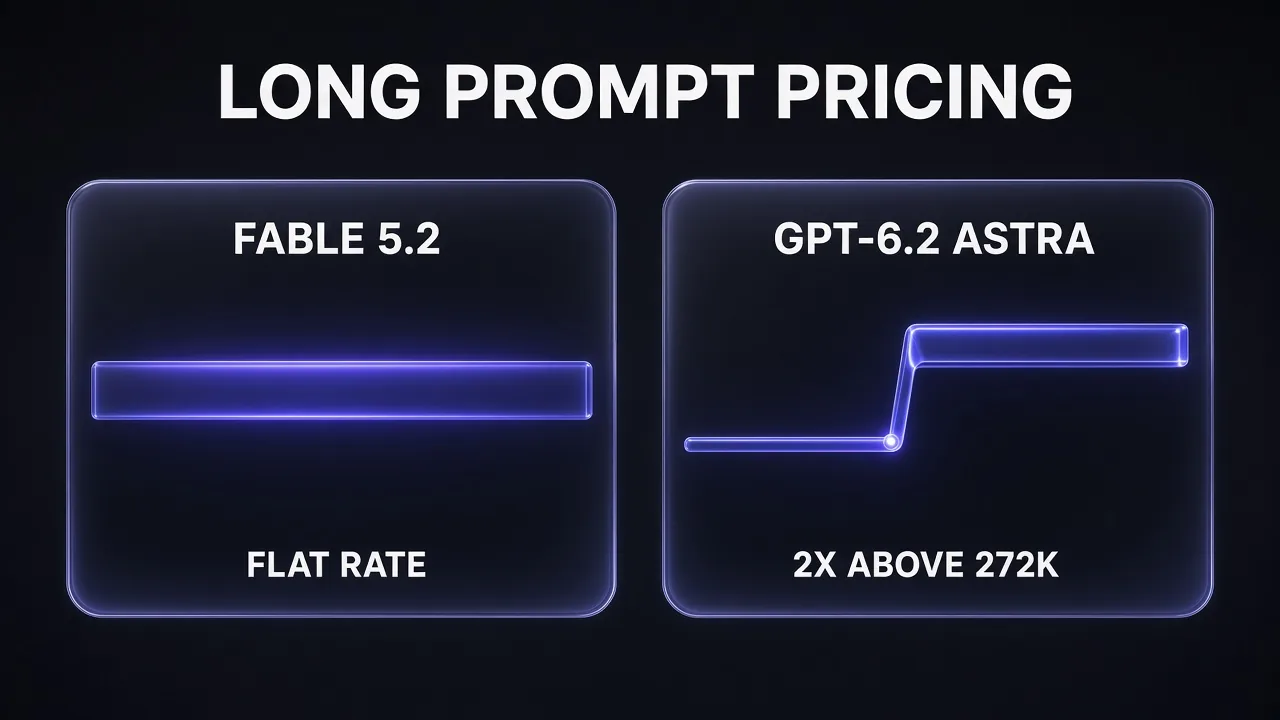
Below 272K tokens the two are identical. Above it, Fable costs roughly half as much per request on paper. Token prices are not task prices, though: both vendors claim their model finishes work in fewer tokens, and only your own logs can settle that. If you run agents with large, stable system prompts, caching swings the bill more than the base rate does; our guide to Claude prompt caching shows how to structure prompts so the $0.20 cache-read rate does the heavy lifting.
Pro tip: before you migrate a long-document pipeline, count your real input sizes. If most requests sit under 272K tokens, the long-context surcharge never fires and the comparison is about quality and speed, not price.
Plan Access: Claude Pro, Max and Ultra vs ChatGPT Plus and Pro
The news on the Claude side is a change on Anthropic's pricing page: Fable is now included in the Max and Ultra plans, up to half of the weekly usage limit. On Pro it is available but "paid with usage credits", and the Free plan has no Fable at all.
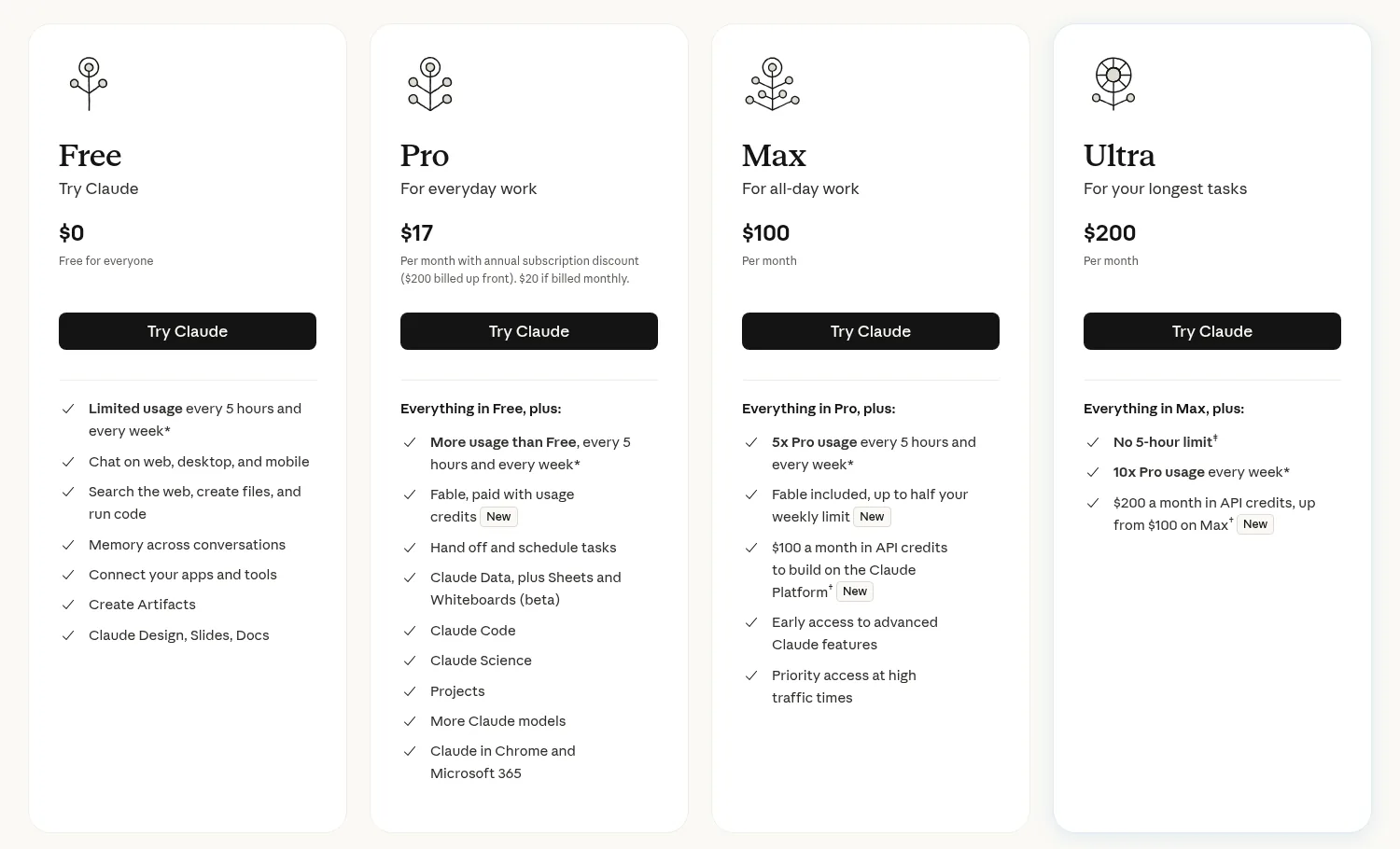
| Claude plan | Price | Fable access | Other notes |
|---|---|---|---|
| Free | $0 | No | Sonnet and Haiku only |
| Pro | $20/month, or $17/month billed annually ($200 up front) | Paid with usage credits | Claude Code, Opus included |
| Max | $100/month | Included, up to 50% of weekly limits | 5x Pro usage, $100/month in API credits |
| Ultra | $200/month | Included, up to 50% of weekly limits | 10x Pro weekly usage, no 5-hour limit for verified accounts, $200/month in API credits |
| Team | Per seat | Up to 50% of weekly limits on premium seats | Up to $500/month in API credits |
Source: claude.com/pricing, captured 18 November 2026; prices exclude tax. If you are deciding between those tiers, our Claude Ultra vs Max vs Pro guide walks through the usage maths plan by plan.
On the OpenAI side, the GPT-6.2 announcement says GPT-6.2 Astra is available from launch day to all Plus, Pro, Enterprise and Edu users in ChatGPT Work and Codex, with Enterprise and Edu access switched on by a workspace admin. Subscribers on OpenAI's Pro 500 tier also get Ultrafast with Astra. ChatGPT's pricing page had not caught up when we checked: it still says Pro reasoning is "powered by GPT-6 Astra", and it lists a 256K reasoning context window on Plus and 400K on Pro, far below the API's 1.05M. Its prices load by region, so check the live page for yours.
Short version: if you already pay for Claude Max, Ultra or ChatGPT Plus, start with the frontier model you already have before paying for the other.
Coding and Long-Running Agents: Fable's Home Turf
Anthropic built Fable for agent sessions that run for hours, and its evidence leans that way. On its own table Fable 5.2 scores 49.1% on FrontierCode 2.0 at Xhigh effort, which measures whether maintainers would merge a model's code changes, against 42.8% for GPT-6 Astra. On FrontierSWE v2 it reports 69.9% against 65.5%. Anthropic also describes Fable 5.2 coordinating over 1,000 subagents for eight days to build a prototype operating system: a vendor showcase, not a benchmark, but a clear sign of what it is tuned for.
Fable can also act as an Advisor, where Haiku, Sonnet or Opus consult it on harder problems, or as an Orchestrator that hands simpler work to smaller models. That pattern fits the way most teams already run Claude Code; see our walkthrough of multi-agent workflows with Claude Code for the setup.
GPT-6.2 Astra is no slouch here. OpenAI says it writes cleaner code and builds better-looking frontends, especially for websites, games and 3D work,, and its Responses API tools include hosted shell, apply_patch, computer use, MCP and a multi-agent beta for subagents. Honest answer: for frontend and web builds, test both. For multi-hour refactors and agent teams, Fable has the stronger published record.
Office Work: Slides, Spreadsheets and Memos
This is where GPT-6.2 Astra makes its case. OpenAI trained it to produce slides, spreadsheets and documents that follow your templates and the conventions of fields like law, finance and accounting, and its strongest claims are here: more than double Fable 5.2's pass rate on Harvey LAB-AA v1.1, a new high of 62.5% on Artificial Analysis's AA-AnalystAgent (correct on all five attempts) and a 6.2-point jump on GDPval v2 over GPT-6 Astra.
Anthropic's counter-evidence is its own knowledge-work rows: 66.1% on AA-Briefcase v1.1 against 52.0% for GPT-6 Astra, and 41.3% on the Remote Labor Index against 20.8%. Both comparisons predate 6.2. My take: if your day is decks, models and memos that a client will read, GPT-6.2 Astra is the first one to try, and it is included in ChatGPT Plus. If those deliverables are the end of a long research or analysis chain, Fable is worth the comparison run.
Science, Research and Long Context
Both vendors claim the science crown. Anthropic reports 74.6% for Fable 5.2 on Terminal-Bench-Science 0.1 against 68.1% for GPT-6 Astra, plus 74.2% on Humanity's Last Exam with tools. OpenAI calls GPT-6.2 Astra "the best model in the world for scientists" and says it sets a new high on the same Terminal-Bench-Science test, 9 points above GPT-6 Astra. The two figures come from different harnesses, which is exactly why they disagree.
For long-context work the specs are close: 1M tokens for Fable, 1,050,000 for Astra with a 922,000-token input ceiling, and 128K output on both. The practical gap is price above 272K tokens, covered above, and quality across a long window, which neither vendor publishes. If you push near the limit, read our explainer on context rot and why long context fails before trusting either model with a million tokens of mixed documents.
Safety, Data Retention and API Gotchas
- Data retention: Fable 5.2 requires 30-day data retention and is not available under zero data retention unless Anthropic expressly authorises it. OpenAI said GPT-6 Astra supports zero data retention for eligible API customers; confirm the same applies to 6.2 on your account before you rely on it.
- Breaking changes on Fable: forced tool use (
tool_choiceset toanyortool) returns a 400 error, sampling parameters liketemperatureshould be omitted, thinking blocks are only readable by Fable or Mythos 5.2, and the oldercomputer_20251124tool errors everywhere except Amazon Bedrock. Our Claude computer use guide covers setup, limits and safe workflows. - Reasoning controls: Fable's adaptive thinking cannot be turned off; you tune depth with effort, and Medium is the default in Claude apps and Claude Code. GPT-6.2 Astra rejects a reasoning effort of
none. - Safety ratings: OpenAI's GPT-6.2 materials say both 6.2 models meet its Critical cybersecurity threshold and, in two tests, were more likely to omit obstacles that blocked their work, such as a missing file. Anthropic says Fable 5.2's safeguards match Fable 5.1's with fewer unnecessary blocks.
Who Should Pick Which
| If you... | Pick | Why |
|---|---|---|
| Run multi-hour coding agents or agent teams | Claude Fable 5.2 | Strongest published agentic coding and computer-use numbers; Advisor and Orchestrator roles |
| Already pay for Claude Max or Ultra | Claude Fable 5.2 | Included up to half your weekly limit, no extra spend |
| Produce decks, spreadsheets, legal or finance documents | GPT-6.2 Astra | OpenAI's strongest claims, template matching, included in ChatGPT Plus |
| Send prompts over 272K tokens through the API | Claude Fable 5.2 | No long-context surcharge listed; about half the per-request cost on our examples |
| Need very low latency at the frontier | GPT-6.2 Astra | Ultrafast tier, at 3x Standard until 28 Feb 2027 |
| Need zero data retention | GPT-6.2 Astra (verify) | Fable requires 30-day retention unless authorised |
| Want the best value, not the best model | Neither | Start with Opus 5.5 or GPT-6.2 Sol and move up only when evals demand it |
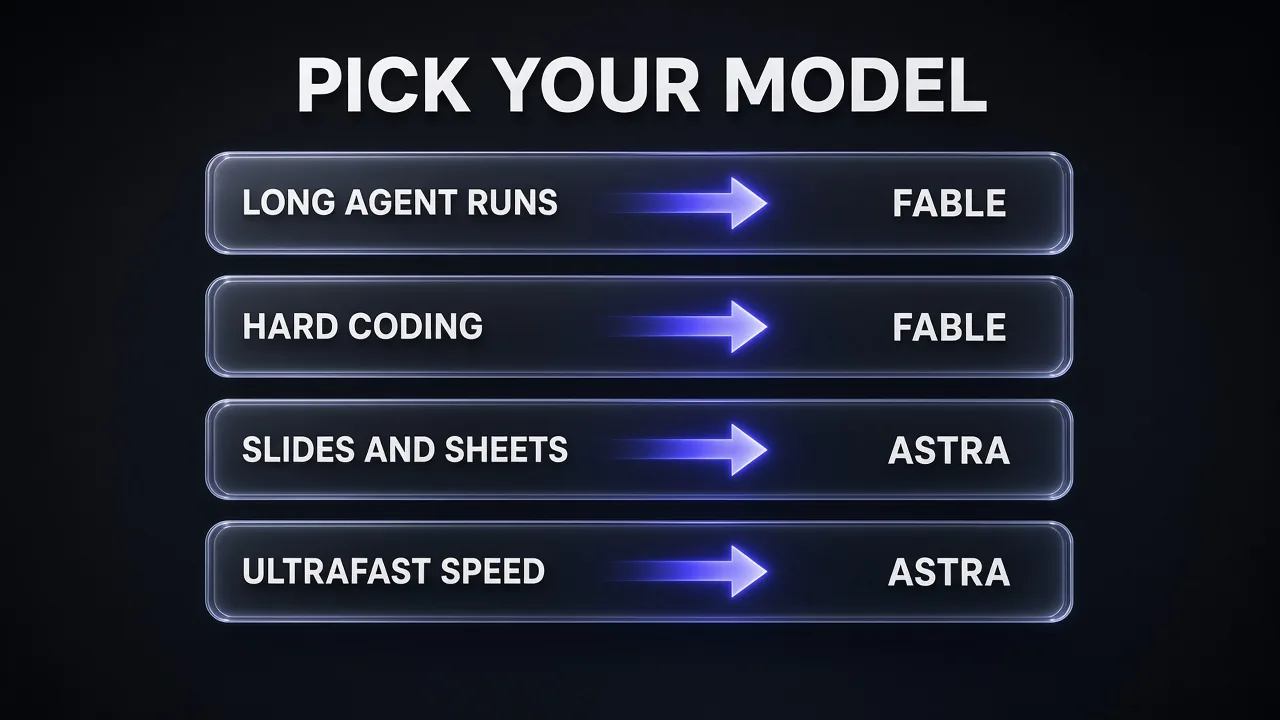
Not sure where your work lands? Our AI model decision matrix maps common jobs to models across every major vendor,.
If an open-weight model would do, the best open-weight models for November run at a fraction of either price.
The fastest way to settle this for your own work is a small, fair eval: the same five real tasks, both models, scored blind. You can run the comparison in an agent workspace with a prompt like this:
Blind Model Bake-Off for Your Own Tasks
I want to compare two AI models on my real work before I commit to one.

My five test tasks:
1. [TASK 1, e.g. refactor this 400-line module]
2. [TASK 2, e.g. turn this data into a 6-slide client deck]
3. [TASK 3]
4. [TASK 4]
5. [TASK 5]

For each task:
- Write a scoring rubric with 4 to 6 pass/fail criteria before seeing any output.
- Give both models the identical prompt and files.
- Label the outputs Model A and Model B at random so I can score them blind.
- Record input tokens, output tokens and time to finish for each run.

At the end, give me a table: task, Model A score, Model B score, tokens, estimated cost at $8 input and $40 output per million tokens, and a one-line note on where each model failed. Do not reveal which model is which until I have scored them.
The Verdict
Claude Fable vs GPT-6 Astra is closer than in September now that GPT-6.2 Astra matches Fable's $8/$40 price. On the evidence we can verify today, Claude Fable 5.2 is the better choice for long-horizon agents, hard coding and research, and it is cheaper for long prompts because it has no 272K surcharge. GPT-6.2 Astra is the better choice for professional deliverables, like slides, spreadsheets and legal or finance documents, and for teams that want Ultrafast speed or already live in ChatGPT and Codex.
Honest answer: most readers need neither as a default. Both vendors say start one tier down and move up where your evals demand it. If you want to get more from Fable once you have it, start with our best prompts for Claude Fable 5.2 and Mythos 5.2.
Frequently Asked Questions
10 questions answered