The PromptsRush journal
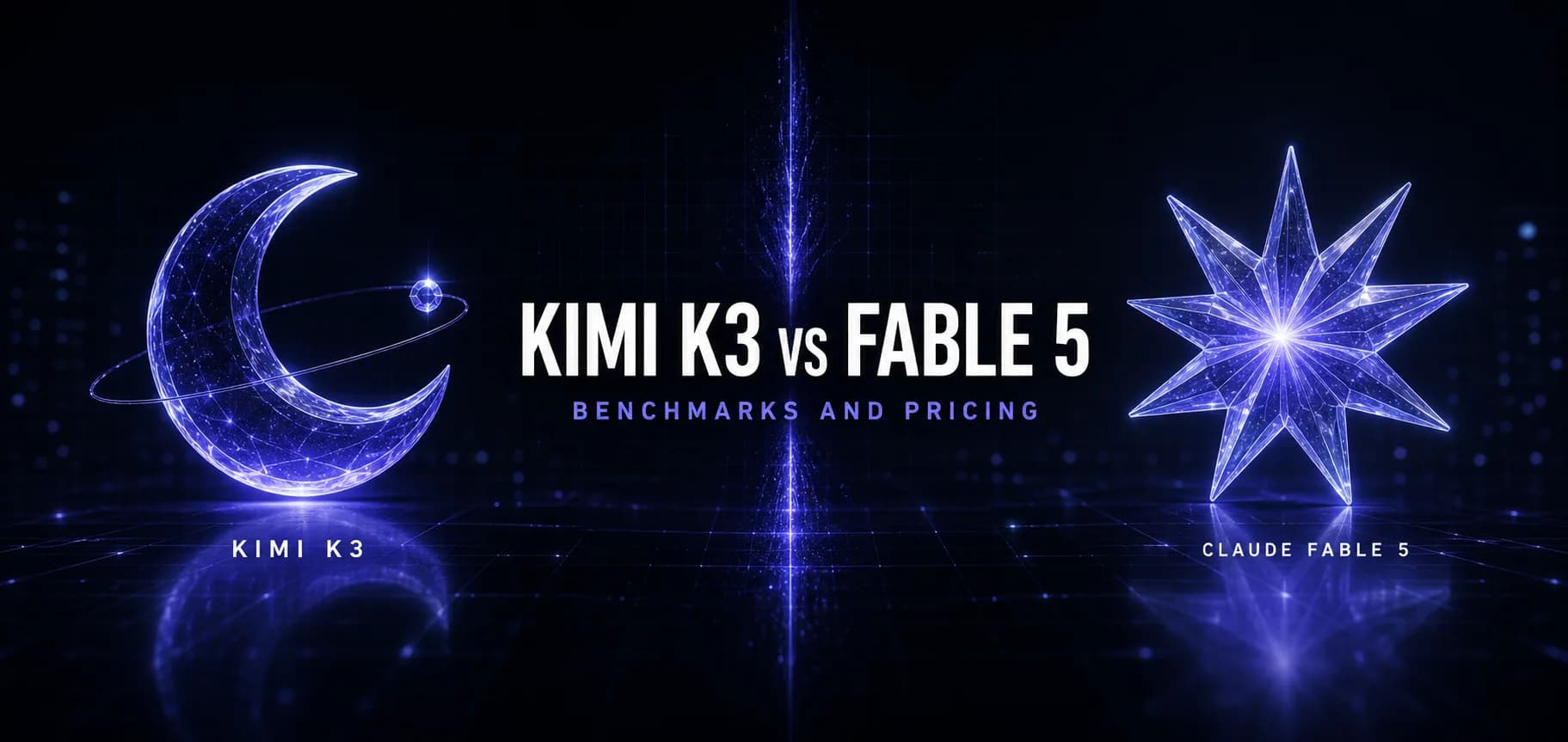
AI ToolsKimi K3 vs Fable 5: Detailed Comparison & Benchmarks
Moonshot's 2.8T open-weight Kimi K3 against Claude Fable 5: the 8-6 benchmark split, the 3x price gap, the token-efficiency asterisk, and which to actually use.
Advertisement
Kimi K3 is the first open-weight model that makes the "open can't compete at the frontier" argument sound dated. Moonshot AI's 2.8-trillion-parameter release — the largest open-weight model ever shipped — beats Claude Fable 5 on real coding benchmarks at roughly a third of the token price. Fable 5 still wins the overall scorecard, and there's a token-efficiency asterisk on K3's price advantage that most coverage skips. Here's the whole picture in five minutes.
At a Glance
| Dimension | Kimi K3 | Claude Fable 5 |
|---|---|---|
| Maker | Moonshot AI — unveiled July 16, 2026 | Anthropic — Mythos-class flagship |
| Size / access | 2.8T params, open weights (promised by July 27) | Closed, API + Claude apps |
| API price (per 1M tokens) | $3 in / $15 out ($0.30 cached input) | $10 in / $50 out |
| Head-to-head benchmarks (14 shared) | Wins 6 | Wins 8 |
| Signature wins | Arena Frontend Code (#1, 1,679 Elo), SWE Marathon, Program Bench | FrontierSWE, HLE-Full, overall aggregate |
| Reasoning control | Single "max" effort only — always verbose | Adjustable depth |
Snapshot dated late July 2026 — both vendors move fast, and K3's weights weren't yet downloadable at the time of writing.
Benchmarks: A Real Split, Not an Upset
Of the 14 benchmarks both vendors report head-to-head, Fable 5 wins eight, K3 wins six — and the pattern in the split matters more than the count. K3's wins cluster in hands-on coding: it took the #1 spot on Arena's blind frontend-coding vote at 1,679 Elo (ahead of Fable 5), and leads on SWE Marathon and Program Bench. Fable 5 holds the harder-reasoning ground: FrontierSWE, HLE-Full, and the overall aggregate intelligence rankings, where Artificial Analysis's private evals place K3 second — trailing only Fable 5.
Read that as: for producing working UI code in a blind taste test, K3 is legitimately at the front of the field. For the long, ambiguous, multi-step engineering work where Fable 5 also beat GPT-5.6 Sol, Anthropic's flagship is still the model to beat. An open-weight model going 6-for-14 against the best closed model in the world would have been unthinkable a year ago — that's the actual headline.
Pricing: 3x Cheaper, With an Asterisk
List price is a rout: $3/$15 per million tokens against Fable 5's $10/$50, and K3's cached input drops to $0.30 — a 90% discount that makes repeated-context workloads (agents re-reading the same codebase) even cheaper. It's also a big step up from Moonshot's own K2.6 pricing ($0.95/$4), which tells you where they think this model sits.
The asterisk: K3 only runs at maximum reasoning effort, and it's token-hungry doing it — early testing showed it burning ~13,000 reasoning tokens to produce a ~3,400-token answer on a simple prompt. You can't dial it down for easy tasks the way you can with Claude's tiers. In practice the effective cost gap on mixed workloads is closer to 2x than 3x, and for high-volume simple tasks a cheap fast model (Sonnet 5 on the Claude side) beats both flagships anyway. Fable 5 also comes bundled in Claude's $20-200/month plans — for individuals, that subscription math often beats any API price.
Open Weights: The Part That Isn't About Benchmarks
K3's real differentiation isn't a score — it's the download link. Open weights mean self-hosting for data-sovereignty requirements, fine-tuning on your own domain, no vendor lock-in, and a floor under the whole market's pricing. The honest caveats: a 2.8T-parameter model demands serious multi-GPU infrastructure most teams don't have (third-party hosted API access will be how most people actually use it), and "weights promised by July 27" was still a promise at publish time. If the release lands as stated, K3 becomes the default answer to "what's the best model I can actually own?"
Which One Should You Use?
- Frontend and UI-heavy coding at volume: K3 — it's winning the blind votes, and at a third of the price you can afford more iterations.
- Complex, ambiguous, multi-step engineering: Fable 5 — the FrontierSWE/aggregate lead matches what we see in real repo work with our Fable 5 workflows.
- Self-hosting, fine-tuning, or data-sovereignty requirements: K3, by default — Fable 5 has no open option.
- Anything where reliability costs more than tokens: Fable 5 — adjustable reasoning, a mature safety record, and the ecosystem around the Fable/Mythos line.
- Cost-sensitive agent pipelines: Trial K3 seriously — the cached-input pricing is built for exactly that shape of workload, but budget for its verbose reasoning.
The Verdict
Fable 5 remains the best model you can use; Kimi K3 is the best model you may soon be able to own — and it's close enough that the choice is now about your constraints, not about quality. If Moonshot ships the weights on schedule, the frontier stops being a closed club, and that pressure benefits everyone's pricing, Anthropic's included. The 2026 model market just got its third serious player — see how the other two split the crown in GPT-5.6 vs Fable 5.
Keep Reading
The comparison shelf: GPT-5.6 vs Fable 5, Fable 5 vs GPT-5.5 vs Gemini 3.5 Flash, and Fable 5 vs Opus 4.8 benchmarks. Or browse all guides and AI models on PromptsRush.
Frequently Asked Questions
5 questions answered