42+ Best Prompts for AI UGC Videos
42 copy-paste prompts for AI UGC ads — hooks, testimonials, problem-solution scripts, platform-native cuts, anti-uncanny avatar briefs, and the testing loop that turns one winner into ten.
Advertisement
UGC ads work because they do not look like ads. That is the whole mechanism, and it is also why most AI-generated UGC fails — it comes out polished, symmetrical, evenly lit, and reads as a commercial within half a second. The prompt is where you either preserve the roughness that makes the format work, or sand it off.
This is a working set of 42 prompts covering the whole pipeline: writing the script, directing the shot, generating the video, producing variants, and testing what actually performs. Every one is a template with bracketed fields you replace.
They are tool-agnostic by design. Script prompts run in any capable LLM. Video prompts are written for image-to-video and text-to-video engines — Kling, Veo, Sora, Seedance — and for avatar platforms like Arcads and HeyGen. Each category flags which engine it targets.
How to Use This Sheet
- Everything in [SQUARE BRACKETS] is yours to replace. Leave nothing unfilled — an unreplaced placeholder is the fastest way to a generic output.
- Fill the brief fields properly. "[AUDIENCE]" as "women 25-40" produces nothing useful. "New mothers, 28-38, sleep-deprived, buying one-handed on a phone at 2am" produces a usable ad.
- Script prompts and video prompts are different jobs. Write the script first, approve it, then feed the approved lines into a video prompt. Doing both at once gives you a mediocre version of each.
- One variable per test. Change the hook, or the presenter, or the setting — never all three, or the result teaches you nothing.
Nine Rules That Make Any UGC Prompt Better
These apply to every prompt below and matter more than the specific wording:
- Specify imperfection explicitly. Models default to polished. Ask for handheld sway, uneven lighting, a slightly off-centre frame, background clutter. "Shot on a phone" is not enough — describe the flaws.
- The first second is the whole ad. Put movement or a spoken word in frame one. Slow builds are wasted renders on a feed.
- Real people do not speak in marketing copy. Ban brand language in the prompt. Ask for contractions, filler words, and one incomplete sentence.
- Faces sell, hands demonstrate. A face in the opening frame lifts stopping power; hands are what make the product feel real. Use both, in that order.
- Name the room, not the mood. "A cluttered bathroom counter with a half-used tube of toothpaste visible" beats "a relatable home setting" every time.
- Lock the product. Any prompt using your real product must state that the label, colour and shape cannot change. Models redesign packaging silently.
- Vertical by default. 9:16 unless you have a reason. Compose so the middle third carries the meaning — captions cover the bottom, UI covers the top.
- Write the caption separately. Never bake text into the generated video. Copy changes should not cost you a re-render.
- Say what must NOT happen. Negative direction is underused and disproportionately effective: no studio lighting, no colour grading, no music-video cuts, no direct-to-camera brand pitch.
Category 1 — Hooks and Openers (Prompts 1–7)
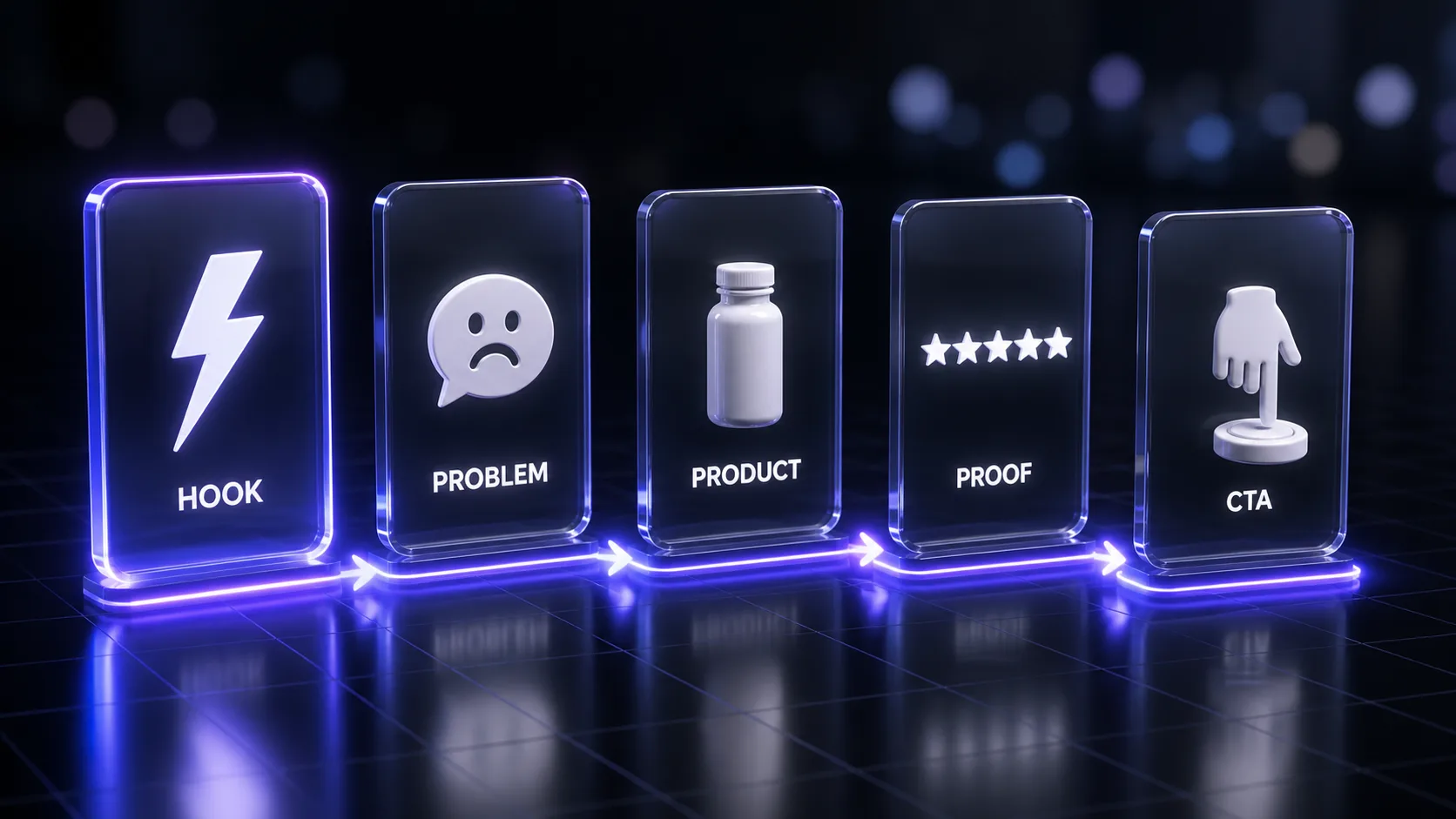
Engine: LLM for scripts, video model for shot direction. The hook carries more performance variance than everything else combined. Generate many, test cheaply.
1. The Hook Bank
Produces a spread of angles rather than ten rewrites of one idea.
Act as a direct-response copywriter who writes for TikTok, not for brands.

Product: [PRODUCT — one line on what it is and does]
Audience: [AUDIENCE — age, situation, and the single biggest frustration they feel]
Offer: [OFFER OR PRICE POINT]

Write 15 spoken hooks for a UGC video ad. Rules:
- Each under 12 words, and speakable in under 3 seconds
- Each uses a DIFFERENT psychological angle: problem agitation, contrarian take, curiosity gap, specific result, social proof, confession, warning, comparison, question, mistake reveal, time pressure, insider knowledge, before/after, cost framing, identity
- Sound like a person talking to a friend — contractions, no brand voice, no exclamation marks
- Never open with "Are you tired of"

Label each with its angle. Then rank your top 3 and say in one sentence why each would stop a thumb.
2. The Pattern Interrupt Opener
For the first 1.5 seconds, where the scroll decision happens.
Generate a 3-second vertical video opener for a UGC-style ad.

Talent: [GENDER], [AGE RANGE], [BRIEF LOOK — natural, minimal styling, everyday clothing]
Setting: [SPECIFIC ROOM WITH ONE MESSY DETAIL]

Action: within the first 8 frames the person does something visually abrupt — [CHOOSE ONE: holds the product up directly into the lens / turns sharply toward camera mid-motion / points off-frame then whips back]. They are already speaking when the clip starts, mid-sentence.

Camera: handheld selfie framing at arm's length, natural sway, slightly low angle, the frame settling a beat after the motion.
Lighting: available indoor light only. Uneven. No fill, no ring light, no colour grading.

Do not: start on a static frame, fade in, use studio lighting, or centre the subject perfectly.

Duration: 3 seconds. Aspect ratio: 9:16.
3. The Confession Opener
Vulnerability outperforms enthusiasm on most consumer categories.
Write and direct a 5-second UGC opener built on a confession.

Product: [PRODUCT]
Confession angle: the speaker admits [AN EMBARRASSING OR RELATABLE FAILURE related to the problem the product solves].

Script: one spoken sentence, under 15 words, delivered slightly reluctantly — a small pause before the admission.
Talent: [GENDER], [AGE RANGE], no makeup, hair not styled, wearing [EVERYDAY GARMENT].
Setting: [SPECIFIC PRIVATE SPACE — car, bedroom, bathroom], seated, phone propped or held.
Camera: static-ish handheld, face filling the upper-middle third, eyes to lens.
Tone: quiet and honest. No smiling into the camera, no upbeat energy, no music.

Duration: 5 seconds. Aspect ratio: 9:16.
4. The Contrarian Claim
Works when your category is crowded with identical claims.
Write 8 contrarian hooks for [PRODUCT] aimed at [AUDIENCE].

Each hook must contradict a belief the audience currently holds about [CATEGORY]. Structure: state the common belief, then reject it, in one breath.

Constraints:
- Under 14 words
- The contradiction must be defensible — I have to be able to back it up in the next 10 seconds
- No hype words, no absolutes I cannot support
- Do not disparage named competitors

For each, write the single sentence that would follow it to make the claim land.
5. The Visual Proof Opener
Show the result before saying anything about it.
Generate a 4-second vertical UGC opener that leads with visual evidence.

Open on: [THE RESULT OR TRANSFORMATION, shown directly — e.g. the finished surface / the empty container / the before-and-after held side by side], filling the frame, no context yet.
At 2 seconds: hands pull back to reveal [THE PRODUCT] and the wider setting.

Talent: hands only, [SKIN TONE], unmanicured, no jewellery.
Camera: close handheld, small natural drift, one quick reframe as the hands pull back.
Lighting: flat, ordinary domestic daylight. No styling.

Lock: the product label, colour and shape must match the uploaded reference exactly.
Do not: add text overlays, use slow motion, or cut to a different angle.

Duration: 4 seconds. Aspect ratio: 9:16.
6. The Mid-Conversation Open
Starting mid-thought feels stolen from a real video rather than made for an ad.
Write a UGC script that begins mid-sentence, as if the viewer joined a video already in progress.

Product: [PRODUCT]
Audience: [AUDIENCE]

The first spoken words must complete a thought the viewer never heard the start of — e.g. beginning with "...and that is when I realised", "...so I stopped doing it entirely", "...which nobody tells you about".

Write 6 variations. Each: the opening fragment plus the next two sentences. Under 30 words total per variation. Conversational, unpolished, one filler word allowed per variation.
7. The Question Hook With a Wrong Answer
Poses a question, then immediately breaks the expected answer.
Write 8 two-line hooks for [PRODUCT] where line one asks a question the audience thinks they know the answer to, and line two gives them a different one.

Audience: [AUDIENCE]
The false belief to break: [WHAT THEY WRONGLY ASSUME]

Rules:
- Line one under 10 words, line two under 12
- The reversal must be genuinely surprising, not a rhetorical trick
- Written for speech, not for reading
- No clickbait framing I cannot substantiate

Flag any hook that overpromises so I can cut it.
Category 2 — Product Demo and Testimonial (Prompts 8–14)
Engine: avatar platforms and image-to-video. The middle of the ad, where belief is built or lost.
8. The Honest Testimonial Script
Includes a minor criticism, which is what makes the praise credible.
Write a 20-second UGC testimonial script for [PRODUCT].

Speaker: [AUDIENCE PERSONA — who they are and what they were struggling with]
Result they got: [SPECIFIC, MODEST, VERIFIABLE OUTCOME]

Structure:
1. What they tried before and why it failed (5s)
2. What changed when they used [PRODUCT] (8s)
3. One small honest criticism — something genuinely imperfect about it (3s)
4. Why they still use it (4s)

Rules:
- Conversational speech: contractions, one filler word, one sentence that trails off
- No superlatives, no "life-changing", no "game-changer"
- The criticism must be real and minor, not a humble-brag
- Do not make claims about [REGULATED CLAIM AREA — health, income, results guarantees]

Output the script as spoken lines with rough timings.
9. The One-Take Demo
Single continuous shot — no cuts, which reads as unedited and therefore honest.
Generate a 15-second single-take UGC product demonstration. No cuts.

Talent: [GENDER], [AGE RANGE], natural styling, [EVERYDAY CLOTHING]
Setting: [SPECIFIC ROOM], real clutter visible in the background — [NAME TWO ORDINARY OBJECTS]

Sequence in one continuous shot:
- 0–3s: speaking to camera, product not yet visible
- 3–6s: reaches off-frame, brings the product in, shows the front
- 6–12s: performs [THE KEY USE ACTION] fully, looking at the product not the camera
- 12–15s: looks back up to camera, reacts, says one closing line

Camera: handheld throughout, one continuous move, natural sway, the framing loosening as they reach and tightening as they return. Focus hunts once, briefly.
Lighting: one window off-frame [LEFT/RIGHT], no fill.

Lock: product label, colour, shape exactly as the uploaded reference. Hands must have five fingers and natural proportions.
Do not: cut, zoom digitally, colour grade, or add music.

Duration: 15 seconds. Aspect ratio: 9:16.
10. The Skeptic-to-Convert Arc
Models the exact journey your cold audience is on.
Write a 25-second UGC script following a skeptic becoming a believer about [PRODUCT].

Audience: [AUDIENCE]
Their specific objection: [THE REAL REASON THEY DO NOT BUY]

Beats:
1. State the objection plainly, as their own past view (6s)
2. What made them try it anyway — a specific trigger, not curiosity (6s)
3. The moment the objection was disproven — one concrete detail (8s)
4. What they would say to someone still holding that objection (5s)

Rules:
- The objection must be the strongest version of it, not a straw man
- Include one specific number, date, or detail that only a real user would mention
- No brand language anywhere
- End without a hard sell
11. The Comparison Demo
Side-by-side against the old way, not against a named competitor.
Generate a 15-second UGC comparison video for [PRODUCT].

Structure: the same person performs the same task twice in the same location and framing.
- 0–7s: the old way — [DESCRIBE THE CURRENT METHOD], visibly awkward or slow, with one small realistic frustration
- 7–8s: hard cut, no transition effect
- 8–15s: with [PRODUCT] — same task, visibly easier, ending with a small satisfied reaction

Critical: identical camera angle, distance and lighting in both halves. Only the method and the outcome change.

Talent: [GENDER], [AGE RANGE], natural, unstyled.
Setting: [SPECIFIC ROOM].
Camera: locked-off phone-on-a-surface framing, slightly crooked.
Do not: use split screen, add labels, use slow motion, or exaggerate the difficulty of the old method beyond [WHAT IS ACTUALLY TRUE].

Duration: 15 seconds. Aspect ratio: 9:16.
12. The Unboxing With a Reaction
The reaction, not the packaging, is the content.
Generate a 12-second UGC unboxing clip for [PRODUCT].

Point of view: first-person, hands and forearms only, phone propped on a surface.
Sequence: a [COLOUR] mailer is opened, packaging parted, product lifted out and turned once. Product fully visible by the 6-second mark.
Reaction: one small genuine moment — [CHOOSE ONE: a pause when they feel the weight / turning it over twice / a quiet "oh"]. Understated, not performed.

Setting: [SURFACE] with ordinary surroundings visible — a laptop edge, a mug, a cable.
Camera: fixed 45-degree angle, slight drift, no repositioning.
Lighting: ordinary indoor daylight.

Lock: the product must match the uploaded reference exactly in label, colour and proportion.
Do not: linger on packaging, add music, or use a satisfying-ASMR style edit.

Duration: 12 seconds. Aspect ratio: 9:16.
13. The Use-Case Montage Script
For products whose value is breadth rather than depth.
Write a 20-second UGC script showing [PRODUCT] used in [NUMBER] different situations.

Audience: [AUDIENCE]
Situations to cover: [LIST THEM]

Rules:
- One spoken line per situation, under 10 words each
- Each line names a specific moment, not a benefit — "in the car on the school run", not "on the go"
- Lines connect as one continuous thought, not a list
- The last situation should be the least obvious one

For each line, also specify the shot: setting, framing, and what the hands are doing.
14. The Objection Handler
Targets the specific hesitation that kills your conversion rate.
Write a 15-second UGC script that addresses one purchase objection head-on.

Product: [PRODUCT]
Objection: [THE OBJECTION — e.g. price, effort, whether it works for their situation]

Structure:
1. Name the objection in the viewer's own words, sympathetically (4s)
2. Concede what is legitimate about it — do not dismiss it (3s)
3. Give the specific reason it turned out not to matter, with a concrete detail (6s)
4. One honest closing line (2s)

Rules:
- Never say "but" immediately after the concession — it erases it
- Include one number or specific fact
- Do not compare to a named competitor
- If the objection is price, do not argue value abstractly; give the actual maths
Category 3 — Problem, Solution and Storytelling (Prompts 15–20)
Engine: LLM for scripts, video model for shot direction. Narrative structures that hold attention past the three-second mark.
15. The Micro-Story
A complete arc in twenty seconds.
Write a 20-second UGC micro-story that ends with [PRODUCT] as the resolution.

Protagonist: [AUDIENCE PERSONA]
Inciting moment: [THE SPECIFIC BAD MOMENT — a real scene, a time of day, a place]
Resolution: how [PRODUCT] changed the next occurrence of that moment

Rules:
- Open in the middle of the scene, not with setup
- One sensory detail that makes it specific and real
- The product enters no earlier than the 10-second mark
- Ends on the changed moment, not on a pitch
- Told in past tense, first person, as if recounting it to a friend
16. The Problem-Agitate-Solve Shoot
The classic structure, directed as a shot list.
Generate a 15-second UGC problem-solution video.

Beat 1 (0–4s): the problem happening — [DESCRIBE THE FRUSTRATING MOMENT]. Handheld, tight, slightly unstable framing. Flat, cool, unflattering light.
Beat 2 (4–7s): the frustration peaks. One small realistic physical reaction — a sigh, a hand through hair, setting something down too hard. No dialogue.
Beat 3 (7–11s): [PRODUCT] enters. Steadier camera, warmer light. Used once, simply.
Beat 4 (11–15s): the resolved state, same room, calm. Ends on a clean frame with the upper third clear for a caption.

Talent: [GENDER], [AGE RANGE], unstyled.
Setting: [SPECIFIC ROOM] throughout — do not change location.

Do not: use stock-style acting, exaggerate the frustration, or add music.

Duration: 15 seconds. Aspect ratio: 9:16.
17. The Day-in-the-Life Insert
Product placement inside content that would exist anyway.
Write a 25-second day-in-the-life UGC script where [PRODUCT] appears naturally rather than being the subject.

Persona: [AUDIENCE PERSONA] and their actual morning or evening routine
Product placement: [PRODUCT] used at [WHICH POINT IN THE ROUTINE]

Rules:
- At least 60% of the script is about the routine, not the product
- The product gets one unforced mention, phrased as an aside
- No transition into a pitch — the routine simply continues afterwards
- Specific times, specific places, specific small annoyances

Also give me the shot list: one line per scene with framing and setting.
18. The Mistake I Made
Regret framing converts because it warns rather than sells.
Write a 20-second UGC script framed as a mistake the speaker made and wants to spare others.

Product: [PRODUCT]
The mistake: [WHAT THEY DID WRONG BEFORE — e.g. bought the cheap version, waited too long, used it incorrectly]

Structure:
1. "I wasted [TIME/MONEY] doing this" — state the cost plainly (5s)
2. What they thought at the time, and why it was reasonable (6s)
3. What they know now (6s)
4. What they would tell someone at the start (3s)

Rules:
- No shaming the viewer
- The cost must be specific
- Do not make the old approach sound stupid — it should sound like a reasonable choice that turned out wrong
19. The Two-Person Dialogue
Overheard conversations feel less like advertising than monologues.
Write a 20-second two-person UGC dialogue about [PRODUCT].

Person A: [PERSONA] — the one who already uses it, casual, not evangelical
Person B: [PERSONA] — skeptical, asks the question the audience is thinking

Rules:
- B asks the real objection, not a softball
- A does not give a perfect answer — one hesitation or "I mean, honestly..."
- They talk over each other once
- No conclusion or summary; the conversation just moves on
- Under 60 words total

Then specify the shot: setting, how the phone is positioned, and what else is in frame.
20. The Trend-Format Adaptation
Fits your message into a format the platform already rewards.
Adapt [PRODUCT] into the following native format: [DESCRIBE THE TREND OR FORMAT — e.g. "things I wish I knew at 25" / a get-ready-with-me / a POV / a text-on-screen list].

Audience: [AUDIENCE]
Core message: [THE ONE THING THE AD MUST COMMUNICATE]

Rules:
- The format comes first; the product must fit inside it, not replace it
- The product appears no earlier than one third of the way through
- Match the pacing and speech patterns native to the format
- Do not explain the format or wink at it

Give me the script with timings, plus the shot direction for each beat.
Category 4 — Social Proof and Trust (Prompts 21–26)
Engine: LLM, with video direction where noted. Content whose job is to make the claim believable.
21. Review-to-Script Conversion
Turns your real reviews into ads without inventing anything.
Below are real customer reviews of [PRODUCT]. Turn the strongest ones into UGC ad scripts.

REVIEWS:
[PASTE 10-20 REAL REVIEWS]

For each of the 5 best:
1. Identify the specific emotional trigger and the concrete detail that makes it credible
2. Write a 15-second spoken script preserving that person's actual phrasing and priorities
3. Note which audience segment it would resonate with
4. Specify the presenter type who should deliver it

Rules:
- Do not invent claims, results, or details not present in the review
- Keep the reviewer's imperfect grammar where it adds authenticity
- Flag any review making a claim I should not use in advertising
22. The Specific-Number Testimonial
Precision reads as true; round numbers read as marketing.
Write 6 UGC testimonial openers for [PRODUCT] that each lead with a specific, unrounded number.

Verified facts I can use: [LIST REAL NUMBERS — usage duration, quantity, measurable outcome]

Rules:
- Use awkward, precise numbers, not round ones
- The number must come from the facts above — invent nothing
- Under 15 words each
- The number should feel incidental to the speaker, not presented as a statistic

For each, add the follow-up sentence that makes the number meaningful.
23. The Community Signal
Positions the product as something a group already knows about.
Write a 15-second UGC script that frames [PRODUCT] as something [SPECIFIC COMMUNITY] already uses.

Community: [BE SPECIFIC — not "moms" but "the night-shift nurses I work with"]
Audience: [AUDIENCE]

Structure:
1. Name the community and how the speaker belongs to it (4s)
2. How the product spread within it — a specific transmission story (7s)
3. Why the speaker finally tried it (4s)

Rules:
- Insider detail only a member of that community would know
- No claims about how many people use it that I cannot substantiate
- Casual, in-group language
24. The Expert-Adjacent Angle
Credibility without claiming credentials you do not have.
Write a 20-second UGC script where the speaker has relevant experience but makes no formal expert claim.

Speaker's background: [RELEVANT BUT INFORMAL EXPERIENCE — e.g. "I have been doing this for eleven years", "I test these for a living"]
Product: [PRODUCT]

Rules:
- Never claim a credential, title, or qualification
- The experience should show through what they notice, not what they assert
- Include one technical detail a novice would not mention
- Explicitly avoid any statement that could read as professional advice in [YOUR CATEGORY]
- One honest limitation about who this is not for
25. The Repeat-Purchase Signal
Buying it again is stronger proof than praise.
Write 6 short UGC scripts (12 seconds each) built on repeat purchase rather than first impressions.

Product: [PRODUCT]
Real repeat behaviour: [WHAT ACTUALLY HAPPENS — reorder cycle, quantity, duration of use]

Each script should convey: this is not new to me, I have bought it more than once, and here is the unremarkable reason why.

Rules:
- Understated tone — no enthusiasm
- One mundane detail about the reordering itself
- Do not restate product features; imply them through habit
- No claims beyond the real behaviour above
26. The Public Comparison Reaction
Responds to a criticism rather than pretending it does not exist.
Write a 20-second UGC script responding to a common criticism of [PRODUCT OR CATEGORY].

The criticism: [THE ACTUAL CRITICISM PEOPLE MAKE]
What is fair about it: [BE HONEST]
What it misses: [THE LEGITIMATE COUNTERPOINT]

Structure:
1. Repeat the criticism accurately and without defensiveness (5s)
2. Agree with the part that is true (5s)
3. Explain the specific context it ignores (7s)
4. Leave the decision with the viewer (3s)

Rules:
- Do not win the argument — concede genuinely
- No sarcasm, no defensiveness
- Do not name or attack competitors
Category 5 — Platform-Native Formats (Prompts 27–32)
Engine: video models, with platform-specific composition. The same message needs different shapes per surface.
27. TikTok-Native Composition
Generate a 15-second UGC ad composed for TikTok specifically.

Composition rules:
- 9:16, with the meaningful action in the middle 60% of the frame
- Top 15% and bottom 20% kept visually simple — platform UI and captions sit there
- The subject never occupies the exact centre; slightly off-axis throughout

Talent: [GENDER], [AGE RANGE], styled the way [AUDIENCE] actually dresses, not aspirationally.
Setting: [SPECIFIC ROOM] with real clutter.
Camera: handheld, one reframe mid-clip, mild focus hunt once.
Energy: fast speech, no pauses longer than half a second.
Lighting: available light only, colour cast left uncorrected.

Do not: use cinematic grading, symmetrical framing, slow motion, or a music-video edit rhythm.

Duration: 15 seconds. Aspect ratio: 9:16.
28. Instagram Reels Variant
Take the following approved UGC script and re-shoot it for Instagram Reels.

SCRIPT: [PASTE APPROVED SCRIPT]

Adjust for the platform:
- Slightly more considered styling and cleaner setting than a TikTok cut, without becoming polished
- Marginally slower pacing; one held beat where TikTok would cut
- Colour left natural but not degraded
- The product visible earlier, by the 5-second mark

Keep: the spoken script exactly as written, the handheld camera feel, and the absence of studio lighting.

Duration: 15 seconds. Aspect ratio: 9:16.
29. The Meta Feed 1:1 Cut
Recompose the following UGC ad for the Meta feed at 1:1.

SOURCE: [DESCRIBE THE 9:16 ORIGINAL OR PASTE ITS PROMPT]

Adjust:
- Square framing with the subject in the left or right third, leaving clear space for a caption overlay
- Wider framing than the vertical cut — show more of the setting for context
- The product must remain legible at small size; bring it closer to camera than the vertical version
- Opening action still lands within the first second

Keep: the same talent, setting, lighting and script.

Duration: [10/15] seconds. Aspect ratio: 1:1.
30. The Silent-Autoplay Version
Most feed views start muted. This version works without audio.
Generate a 15-second UGC ad that communicates fully with the sound off.

Requirements:
- The story is carried by action and facial expression, not speech
- Every key beat is visually legible: the problem is shown, the product use is shown, the result is shown
- The speaker's expressions carry the emotional arc
- Compose with the lower third clear for burned-in captions to be added later

Talent: [GENDER], [AGE RANGE], expressive but not theatrical.
Setting: [SPECIFIC ROOM].
Camera: handheld, framing tight enough that expression reads on a small screen.

Do not: rely on any spoken information, add on-screen text, or use gestures that only make sense with audio.

Duration: 15 seconds. Aspect ratio: 9:16.
31. The YouTube Shorts Cut
Adapt the following UGC ad for YouTube Shorts.

SOURCE: [PASTE SCRIPT OR PROMPT]

Adjust for the platform:
- Slightly longer runway — the hook can take 2 seconds rather than 1
- More explanation permitted; this audience tolerates a full sentence of context
- End on a clear next step rather than an open ending
- Retain vertical framing with the subject in the middle third

Duration: [20/30] seconds. Aspect ratio: 9:16.
32. The Multi-Format Package
One brief, every placement, in a single pass.
I have one approved UGC concept. Produce the full placement package.

CONCEPT: [PASTE THE APPROVED SCRIPT AND SHOT DIRECTION]

Give me:
1. A 9:16 15-second TikTok cut — fastest pacing, roughest look
2. A 9:16 15-second Reels cut — marginally cleaner
3. A 1:1 10-second Meta feed cut — wider framing, caption space
4. A 9:16 30-second Shorts cut — extra context
5. A 6-second bumper using only the strongest 6 seconds

For each: what changes and what stays identical. Keep the talent, product and core message constant across all five so the test is clean.
Category 6 — Avatar, Voice and Script Direction (Prompts 33–38)
Engine: avatar platforms and voice tools. Where AI-generated UGC most often gives itself away.
33. The Anti-Uncanny Avatar Brief
Directly targets the tells that make AI presenters read as fake.
Generate an AI avatar UGC video with these anti-uncanny constraints.

Talent: [GENDER], [AGE RANGE], [ETHNICITY IF RELEVANT TO AUDIENCE], everyday appearance — visible skin texture, no symmetrical features, hair slightly imperfect, wearing [ORDINARY GARMENT WITH A WRINKLE].

Delivery requirements:
- Eye contact breaks at least twice, naturally, as if thinking
- One small self-touch — hair, collar, jaw
- Blink rate irregular
- Head moves continuously; never perfectly still
- The mouth closes fully between sentences

Setting: [SPECIFIC ROOM] with depth behind the subject, not a flat wall. One background object slightly out of place.
Camera: handheld, subject slightly off-centre, at a natural phone-holding height.

Do not: centre the face perfectly, use even lighting, keep the head still, or produce a continuous unbroken smile.

Script: [PASTE SCRIPT]
Duration: [N] seconds. Aspect ratio: 9:16.
34. The Spoken-Word Rewrite
Written copy read aloud sounds written. This fixes it.
Rewrite the following script so it sounds spoken rather than written.

SCRIPT: [PASTE]

Apply:
- Contractions everywhere
- Break every sentence over 15 words into two
- Add one filler ("honestly", "I mean", "like") — no more than one
- One sentence that trails off or restarts
- Replace any word the speaker would not use in conversation
- Move the most important word in each sentence to the end

Do not change the meaning, the claims, or the length by more than 10%. Return the rewrite plus a one-line note on what read as written before.
35. The Voice Direction Brief
For text-to-speech that needs to sound like a person, not a narrator.
Produce a voice direction brief for the following UGC script.

SCRIPT: [PASTE]
Speaker: [AGE, GENDER, REGION, AND WHAT THEY DO]

Specify:
- Overall pace in words per minute, and where it should speed up or slow down
- Exactly which words carry emphasis, marked inline
- Where the pauses fall, and how long
- Where the voice should rise or drop in pitch
- Which line should sound least rehearsed

Tone target: [e.g. a friend explaining something over coffee — mildly distracted, warm, unpolished]

Explicitly avoid: announcer cadence, uniform pacing, and rising intonation at the end of statements.
36. The Casting Brief
Presenter mismatch kills more UGC ads than script quality does.
Recommend the presenter profile for this UGC ad.

Product: [PRODUCT]
Audience: [AUDIENCE — be specific]
Message: [CORE MESSAGE]
Platform: [PLATFORM]

Give me:
1. Age range, gender, and general look — and why that specific profile
2. What they should be wearing, precisely
3. Their apparent relationship to the product: current user, new user, or skeptic
4. Speaking style and energy level
5. The setting they should be filmed in
6. Two profiles to actively avoid for this audience, with reasons

Base the recommendation on who this audience trusts, not on who is most attractive.
37. The Accent and Locale Adaptation
Adapt the following UGC script for [TARGET MARKET].

SCRIPT: [PASTE]

Adjust:
- Vocabulary and idiom to local usage
- Any currency, measurement, date or size reference
- Cultural references that would not land
- The setting details to match how homes and daily life actually look there

Keep the structure, timing and claims identical.

Also flag: anything in the original that would read as odd, rude, or unintentionally funny in that market, and any claim that may be regulated differently there.
38. The Caption Package
Captions written separately, as they should be.
Write the on-screen caption track for this UGC video.

SCRIPT: [PASTE]

Produce:
- Caption text broken into on-screen chunks of 3-5 words, timed to the speech
- Which words to emphasise visually, and how many per clip (no more than three)
- A hook caption for the first 2 seconds that adds information rather than repeating the spoken line
- A closing caption with the call to action

Rules:
- Captions must not duplicate the spoken words exactly for the whole clip — they should reinforce, not mirror
- Nothing in the bottom 20% or top 15% of frame
- No emoji beyond one, if any
Category 7 — Variants, Testing and Scale (Prompts 39–42)

Engine: LLM plus your video platform. Where the actual performance gains come from.
39. The Variant Matrix
Systematic coverage instead of guessing.
Build a testing matrix for this UGC concept.

CONCEPT: [PASTE THE APPROVED SCRIPT]
Budget: [N] variants total

Vary these independently:
- Hook (5 options across different psychological angles)
- Presenter profile (3 options)
- Setting (2 options)
- Call to action (2 options)

Give me:
1. The full matrix, with the [N] specific combinations worth testing first
2. Which single variable to isolate in round one and why
3. What result would tell me to kill each variant
4. What to test in round two depending on round one

Prioritise learning per unit spent, not coverage. Tell me explicitly which combinations I should NOT bother testing.
40. The Hook Swap
Cheapest meaningful test available.
I have one UGC ad performing at [METRIC]. I want to test hooks without re-shooting the body.

EXISTING AD: [DESCRIBE OR PASTE SCRIPT]
Current hook: [PASTE]

Write 10 replacement hooks that:
- Fit the existing body without any change to it
- Match the original in length within half a second
- Each take a different angle from the current one and from each other
- Preserve the transition into the existing second line

Rank them by how different they are from the current hook, and tell me which three to test first.
41. The Winner Analysis
Turns a result into a repeatable rule.
Analyse why this UGC ad outperformed the others.

WINNER: [SCRIPT AND DESCRIPTION] — [METRICS]
LOSERS: [SCRIPTS AND DESCRIPTIONS] — [METRICS]
Audience: [AUDIENCE]

Tell me:
1. The specific differences between winner and losers, ranked by likely causal weight
2. Which differences are probably causal and which are probably noise, and how confident you are
3. The transferable principle — stated so it applies to my next concept, not just this one
4. Three new concepts that apply that principle differently
5. What alternative explanation I might be missing

Be skeptical. If the sample is too small to conclude anything, say so plainly.
42. The Fatigue Refresh
For when a proven ad stops working.
My UGC ad has fatigued. Refresh it without losing what made it work.

ORIGINAL: [PASTE SCRIPT AND DESCRIPTION]
Performance: was [METRIC], now [METRIC], over [TIME PERIOD]
Audience: [AUDIENCE]

Give me:
1. Your assessment of what the core working element actually was
2. Five refreshes that preserve that element while changing everything around it
3. For each: what changed, what stayed, and what it tests
4. One deliberately different concept in case the core element is what fatigued

Do not simply reword the original. Each refresh must be genuinely new footage, not a re-edit.
Chaining Prompts Into a Pipeline
Individually these are useful. Run in sequence they replace a production process:
- Prompt 1 generates 15 hooks. Pick three.
- Prompt 8 or 15 writes the body script around your strongest angle.
- Prompt 34 rewrites it so it sounds spoken rather than written.
- Prompt 36 tells you who should deliver it.
- Prompt 33 generates the video with the anti-uncanny constraints applied.
- Prompt 35 directs the voice if you are using text-to-speech.
- Prompt 38 writes the captions separately.
- Prompt 32 produces every placement cut from the one approved concept.
- Prompt 39 builds the test matrix, 40 swaps hooks cheaply.
- Prompt 41 extracts the rule from the winner, 42 refreshes it when it fatigues.
That loop is repeatable weekly. The expensive part was never the filming — it was deciding what to film, and that is the part these prompts actually compress.
Mistakes That Ruin AI UGC
- Letting it look good. Polished lighting, symmetrical framing and clean audio are all signals that this is an ad. Specify the flaws or the model removes them.
- Writing the script and the shot in one prompt. You get a passable version of both and a good version of neither. Separate the steps.
- Generic audience fields. "Millennials" produces millennial-flavoured nothing. The brief is where the quality is decided.
- Testing everything at once. Five variables changed simultaneously means you learn nothing from the winner.
- Ignoring the muted viewer. A large share of impressions never hear your script. If the ad fails silently, it fails.
- Baking text into the render. Every copy tweak becomes a regeneration. Caption in post.
- Letting the model restyle your product. Lock label, colour and shape explicitly, and check the final frames where drift appears.
- Inventing testimonials. Do not generate reviews, results or claims you cannot substantiate. Use prompt 21 on real reviews instead — it is both safer and more effective, because real specifics beat invented ones.
- Skipping the fatigue plan. Every winning ad dies. Build the refresh before you need it.
Where to Run These
Script prompts work in any capable LLM. For the video side, the choice depends on what you are making: avatar platforms like Arcads and HeyGen for presenter-led ads, and general video models for product-led shots. Our roundup of the best AI UGC ad platforms compares them properly, and Kling 3.0 vs VEO 3.1 covers the two engines most likely to render these shots.
If your ads are product-led rather than presenter-led, the companion set is OpenArt product video prompts for ecommerce. For voiceover, our ElevenLabs pricing breakdown covers which tier you actually need. And for the ad copy layer around all of this, see ChatGPT prompts for AI ads.
Keep Reading
More on the ad and video stack: best AI UGC ad platforms, OpenArt product video prompts, ChatGPT prompts for AI ads, HeyGen Hyperframes prompts, how to create an AI avatar for YouTube, and the best HeyGen alternatives. Or browse all guides and prompts on PromptsRush.
Frequently Asked Questions
10 questions answered