23+ Best 1980s, 85s, 90s AI Video Prompts
Retro AI video gives itself away through motion, not colour: gimbal glides, 60fps smoothness and drone shots that never existed. 26 prompts built from real film and camcorder behaviour, including image-to-video prompts that animate your 1985 time-travel photo.
Advertisement
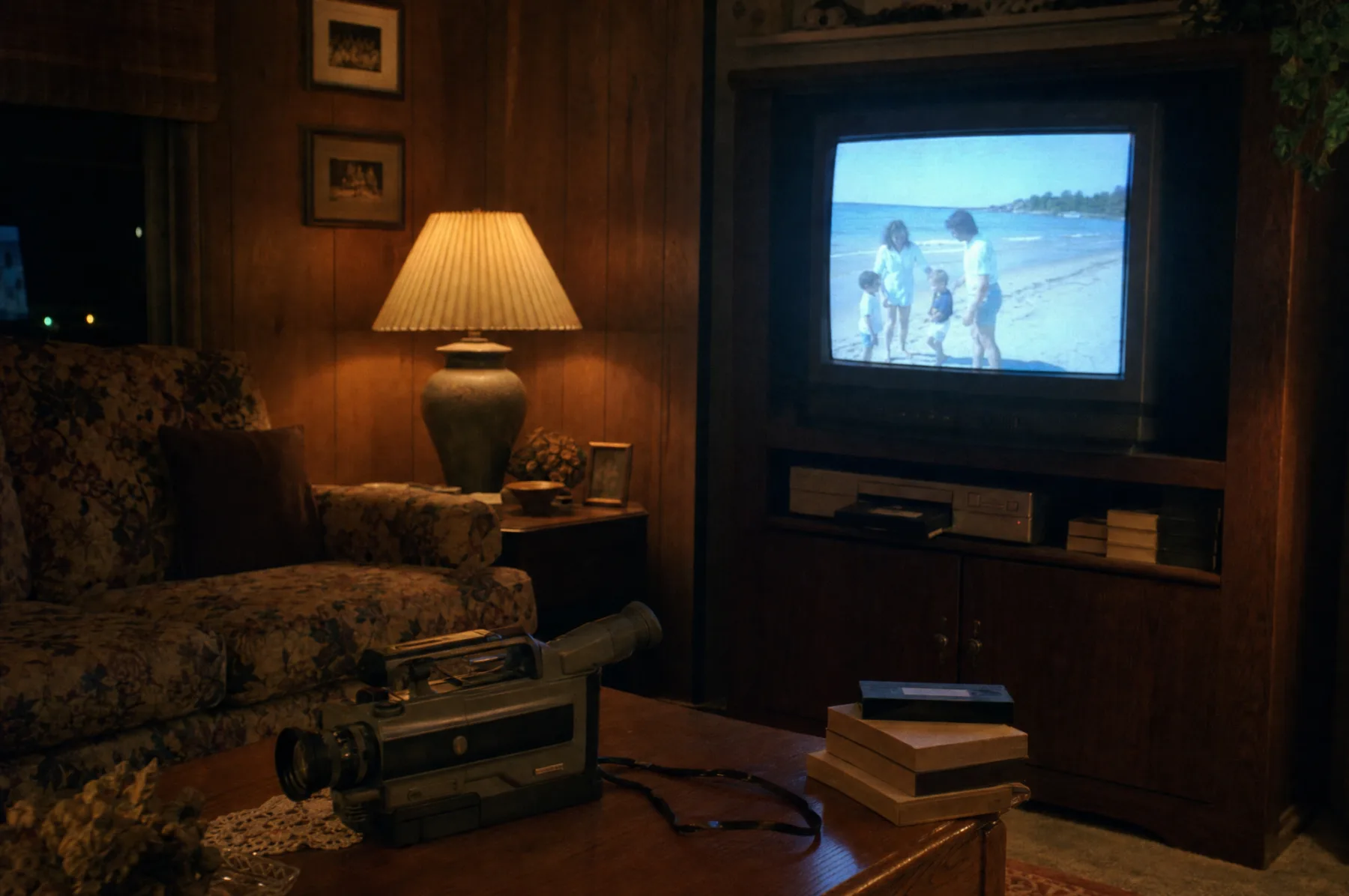
A retro photo only has to look old for a single frame. A retro video has to move old for every frame of it, and motion is where almost every AI-generated 80s or 90s clip gives itself away. Grain and colour can look right while the camera glides like a modern gimbal, the footage runs at a smooth 60 frames a second, and a drone swoops over a 1985 street. None of that existed, and viewers notice it even when they can't say what's wrong.
The fix is the same one that works for stills, applied to time. Every period video look came from physical limits: film running through a gate at 24 frames a second, camcorders recording interlaced fields onto tape, zoom rockers, auto-focus that hunted, tracking errors that rolled up the screen. Name those limits and the model renders their motion. Name a "retro vibe" and you get a modern clip with a filter on top.
Below are 26 prompts organised by format. They start with the most-requested use: bringing your own time-travel photo to life. If you haven't made that photo yet, the 80s and 90s ChatGPT image prompts cover the identity-locked stills these clips animate.
Film or Video: Pick One Before You Prompt
The single most important decision is which medium your clip was supposedly shot on. In the 80s and 90s these produced completely different motion, and people who lived through the era read the difference instantly.
| Shot on film | Shot on video | |
|---|---|---|
| Who used it | Feature films, music videos, most TV commercials, prime-time drama | News, soap operas, sports, talk shows, home movies |
| Frame rate | 24 frames per second (Super 8 home movies often 18) | NTSC 29.97 interlaced (59.94 fields); PAL 25 (50 fields) |
| Motion feel | Slightly stuttered, with natural motion blur | Fluid and immediate, the "live" look |
| Grain | Dances: a new pattern every frame | No grain; video noise, softness and smear instead |
| Frame stability | Gate weave: the image drifts very slightly | Rock steady, apart from tape jitter |
| Depth of field | Can be shallow on a real film camera | Nearly everything in focus on small camcorder sensors |
| Aspect ratio | 1.85:1 or 2.39:1 for features; 4:3 for TV | 4:3 |
| Signature failure | Flash frames at the end of a roll, dust, scratches, light leaks | Tracking noise, head-switching jitter, dropouts, colour smear |
A prompt that asks for "VHS footage with film grain" is asking for two things that can't coexist. Pick one and describe only that.
Seven Rules for Retro Video Prompts
1. Name the capture format
"Old footage" means nothing to a model. "Shot on a VHS-C camcorder in 1989" and "shot on 16mm color negative in 1981" each carry a whole set of motion, colour and artifact behaviour the model has seen thousands of times.
2. State the frame rate and how motion should feel
Modern video models default to smooth, high-frame-rate-looking motion. Say "24 frames per second with 180-degree shutter motion blur" for film, or "interlaced 29.97 video" for camcorder and broadcast footage. It's the single biggest lever for making a clip feel period-correct rather than modern.
3. Describe camera movement in period terms
Motorized gimbals and consumer drones didn't exist. Handheld 80s footage bobs and corrects itself. Camcorder operators zoomed constantly with a rocker switch and rarely moved their feet. The one smooth, floating move that is period-correct is the Steadicam, introduced in the mid-1970s and everywhere in 80s films and music videos. It floats with a slight bob, which is different from a gimbal's perfectly locked glide.
4. Ask for artifacts that move
A static grain overlay reads as a filter. Real film grain changes every frame. Real VHS tracking noise rolls through the picture. Real camcorders hunt for focus and pump exposure when the light changes. Asking for the artifact's behaviour over time, not just its appearance, is what separates convincing clips from filtered ones.
5. Keep it to one shot and a short duration
Five to ten seconds of a single continuous shot holds period look, and in image-to-video holds your face, far better than a long clip. Build sequences by generating shots separately and cutting them together, or use a model's multi-shot mode deliberately with the same look described for every shot.
6. Match the aspect ratio to the medium
Camcorder, broadcast and VHS footage is 4:3. A 16:9 "1987 home video" is wrong before anything moves. Feature film can be widescreen, and seen on a 1980s television it would have been letterboxed or cropped to fit.
7. Ban the modern tells explicitly
End every prompt with a short ban list: no drone shots, no gimbal smoothness, no 60fps motion, no smartphones, no LED lighting, no modern cars or clothing. Negative instructions work reliably here because you're removing a default, not competing with one.
Which Video Model to Use
These prompts work on any capable text-to-video or image-to-video model, but three current options suit retro work in different ways.
Kling 3.0 Omni generates clips of up to 15 seconds with native audio, multilingual lip sync, and an "AI Director" mode that produces up to six shots in one pass. That makes it the strongest choice for camcorder scenes with dialogue and for multi-shot montages that need one consistent look. The trade-offs against Google's model are covered in Kling 3.0 vs Veo 3.1.
Seedance 2.5 is widely used for longer image-to-video work, which suits animating a time-travel portrait. Its strengths and prompt structure are covered in our Seedance 2.5 prompt guide.
Veo 3.1 is strong on synchronised speech and sound, which matters for broadcast and talk-show recreations.
One model to avoid: OpenAI discontinued the Sora app on 26 April 2026, and the Sora 2 API shuts down on 24 September 2026. Don't build a retro video workflow on it.
Animate Your Time-Travel Photo (1–5)
These are image-to-video prompts. Upload the still you want to animate, ideally one generated with an identity-locked photo prompt, and keep the clip short. Identity drift, where the face slowly turns into someone else, gets worse the longer and more energetic a clip is. The identity clause in each prompt below is doing the most important work, so keep it.
1. The subtle-life loop
Animate the uploaded photo as a few seconds of real footage shot in [1985]
on a consumer camcorder.

Keep the person's face, bone structure, skin tone and apparent age exactly
as in the image in every frame. No slimming, smoothing, lightening or
reshaping, and no face drift over the clip.

Motion: minimal and natural. A slow breath, a blink, a slight weight shift,
hair moving a little in a breeze. Handheld camera with a gentle, uneven sway.
No gimbal smoothness.

Look: interlaced 29.97 video softness, slight red chroma bleed, auto-exposure
breathing very slightly. The date stamp stays fixed in the corner and does
not change.

5 seconds. No modern objects appear.
2. Turn to camera and smile
Animate the uploaded photo of me in [1986].

Identity locked in every frame: same face, bone structure, skin tone and age.
Do not beautify or reshape me at any point.

Action: I'm looking slightly away, then notice the camera, turn my head
toward it and break into a natural smile, as if a friend just called my name.

Camera: handheld, a small late reframe after I turn, as a real operator
would make.

Look: warm faded consumer film transferred to video, soft focus, light grain
that changes every frame.

6 seconds. No drone, no gimbal, no modern objects.
3. The busy street comes alive
Animate the uploaded 1986 street portrait of me into a short clip.

Keep my face and appearance exactly as in the photo in every frame.
I stay mostly still, leaning where I am, with small natural movements.

The world around me moves: people walk past in period clothing, an old car
pulls away in the background, a bicycle rolls through, dust catches the
afternoon light.

Camera: locked off on a tripod, the way a friend with a camcorder would set
it down and stand back.

Look: 4:3 frame, interlaced video softness, warm colour, slight tape noise.
8 seconds. No modern vehicles, signs or phones.
4. Two people, one moment
Animate the uploaded photo of the two of us in [1987].

Preserve both identities separately in every frame. Neither face drifts,
and our features don't blend together.

Action: we're laughing at something off camera. One of us leans in and says
something to the other, who laughs harder and looks down.

Camera: handheld, slightly too close, with one small zoom-in on the rocker
switch partway through.

Look: VHS-C camcorder footage, 4:3, soft, colours slightly smeared,
the camcorder date and time burned into the lower right.
6 seconds. No modern objects.
5. The photo comes alive
A 4x6 glossy photo print of [the uploaded image] lies on a wooden table under
warm lamp light.

The camera slowly pushes in over the print. As the frame fills with the
photograph, the image inside it begins to move: the people breathe, blink
and smile, and the scene continues as real 1985 footage.

The people keep exactly the faces shown in the uploaded image throughout.

Transition from still print to moving footage is seamless, with no cut.
Moving footage has the soft, warm look of consumer camcorder video.
8 seconds.
80s Film Footage (6–9)
Film prompts depend on camera movement vocabulary more than anything else. For deeper coverage of dollies, crane moves and lens language, see our cinematic Kling prompts, and swap in period-correct equipment.
6. 35mm city street, 1984
A 1984 city street at dusk, shot on 35mm film for a feature film.

24 frames per second with natural motion blur. Anamorphic lens: horizontal
blue flares from the streetlights and car headlights, oval out-of-focus
highlights. Gentle gate weave, film grain that changes every frame.

A slow dolly move alongside a character in a long coat walking past
neon-lit shop windows. Wet pavement reflecting red and blue signage.
Steam rising from a street grate.

Letterboxed 2.39:1 frame. No drones, no LED lighting, no modern cars.
7. Super 8 home movie, 1982
A family day at the beach in 1982, shot on a Super 8 home movie camera.

18 frames per second, so motion is visibly jerky. Heavy grain that changes
every frame, colours warm and faded, the sky overexposed to white.

Handheld and wobbly, with a sudden pan to follow a child running into
the waves. A light leak flares orange across one edge for a moment.

The clip ends with the white flash frames of the end of the film roll.
4:3 frame with soft rounded corners. No sound.
8. 16mm news film, 1981
A 1981 television news report filmed on 16mm color reversal film.

Handheld shoulder-mounted camera, a reporter in a period suit speaking to
camera outside a factory gate while workers walk past behind him.

Coarse grain, slightly muddy colour, contrast a little too high.
The operator zooms in slowly on the reporter mid-sentence.

Small dust specks and one faint vertical scratch pass through the frame.
4:3. No modern cars, signs or clothing.
9. Steadicam through a mall, 1986
A single continuous Steadicam shot following a teenager through a busy
indoor shopping mall in 1986.

The camera floats smoothly behind them with a slight natural bob, the way a
Steadicam operator walks, not the locked glide of a modern gimbal.

Brass railings, fountains, big ferns in planters, shoppers in bright 80s
clothing, a video arcade glowing in the background.

35mm film, 24 frames per second, warm colour, gentle grain.
10 seconds. No smartphones, no LED screens.
Camcorder and Home Video (10–13)
Home video is the most recognisable look of the era and the easiest to get wrong. Camcorders were operated by amateurs, and the "mistakes" are the look. The handheld realism techniques in our UGC video prompts transfer directly. Swap the smartphone for a shoulder camcorder.
10. Birthday party, 1989
Home video of a child's birthday party in a living room, 1989, recorded on
a VHS-C camcorder.

The camcorder's built-in light blows out faces in the foreground, the room
behind falls into shadow. Auto-focus hunts briefly when kids run past the
lens. The operator snap-zooms on the birthday cake as candles are blown out.

Interlaced 29.97 video, soft, colours smeared, faint tape noise.
The date and time burned into the lower right in blocky digits.
4:3. No smartphones, no flat-screen TV.
11. Christmas morning, 1993
Christmas morning in 1993, filmed on a Hi8 camcorder.

Tungsten room lighting turns everything orange. As the camera pans toward
the window, the auto white balance shifts slowly to blue and the exposure
dims, then corrects.

Kids tearing wrapping paper, a parent in a robe laughing, a Christmas tree
with large incandescent bulbs.

Handheld, a little shaky, one slow zoom out. Interlaced video softness.
Date stamp in the corner. 4:3.
12. Family road trip, 1996
Camcorder footage shot from the passenger seat of a moving car on a desert
highway in 1996.

Through the windscreen, then panning out the side window. Harsh sunlight,
lens flare sweeping across the frame, reflections on the glass. Exposure
pumps as the car passes through shadows.

The operator zooms in on a roadside sign and loses focus for a second.

Interlaced video, soft detail, faint tape noise, date and time burned in.
4:3. No modern cars.
13. School talent show, 1991
A 1991 school talent show in a gymnasium, recorded by a parent on a
camcorder from the back row.

The heads of the audience fill the bottom of the frame. The operator zooms
all the way in on the stage, so the image becomes shaky and soft.
Stage lights blow out the performer's face whenever they step forward,
then the exposure recovers.

Gym bleachers, a basketball hoop folded up, a handmade banner.
Interlaced video, washed-out colour, audio muffled. 4:3.
VHS and Broadcast TV (14–17)
14. Commercial recorded off TV, 1987
A 1987 television commercial for [PRODUCT], as seen on a VHS tape that was
recorded off air and copied twice.

Soft, low detail. Colour smears behind anything that moves quickly. A
horizontal tracking noise band rolls slowly from the bottom of the frame to
the top and disappears. Head-switching jitter along the bottom edge.

The commercial itself: bright studio set, upbeat presenter, a spinning
product shot, big outlined text reading [SLOGAN].
4:3. No widescreen, no modern graphics.
15. Local news live shot, 1992
A local television news live report from 1992, shot on broadcast video.

A reporter standing in front of a flooded street speaks to camera holding a
microphone with a station flag. Hard light from a camera-mounted lamp.

Interlaced video: fine combing lines along fast-moving edges when cars pass
behind. Colours saturated in the way of broadcast video.

A lower-third caption bar slides in with the reporter's name in a bold
condensed font and stays fixed. 4:3.
16. Flipping channels on a CRT, 1990
Filmed from the sofa: a hand holding a remote flips channels on a 1990
CRT television in a dark living room.

Each channel change shows a burst of static snow, a brief vertical roll of
the picture, then a new programme: a cartoon, a news anchor, a music video,
a cooking show.

A green on-screen channel number appears in the corner with each change.
The glass is curved and reflects a lamp. Visible scanlines. The TV's glow
lights the viewer's hand.
17. Fast-forwarding a VHS tape, 1988
A VHS tape being fast-forwarded on a 1988 VCR, showing on a CRT television.

The picture races at high speed, broken by thick horizontal noise bars that
drift up the screen. Colour flickers in and out. The image jitters sideways.

Then the play button is pressed: the noise bars sweep away, the picture
wobbles and settles, and normal playback of a [SCENE] begins.

Shot of the TV screen itself, with its curved glass and a dark room around it.
4:3.
Music Videos (18–20)
18. Synth-pop video, 1984
A 1984 synth-pop music video.

A singer in a sharp oversized suit stands in a smoke-filled warehouse, lit
by a hard white backlight that cuts through the haze, with magenta and cyan
gels from the sides.

The shot is in slow motion, overcranked film: hair and smoke move
dreamily. A brief video-feedback trail effect echoes the singer's
movement, the way early video effects units produced it.

35mm film, rich blacks, soft highlights. 4:3.
19. Alternative rock video, 1994
A 1994 alternative rock music video.

The band plays in a small, dimly lit rehearsal room. Handheld camera moves
restlessly between band members, occasionally going out of focus.

Intercut look: some moments desaturated and grainy like Super 8 film,
others harsh and blue under a strobing light.

Flannel, band t-shirts, messy hair, a battered amplifier. Deliberately raw
and unpolished. 4:3. No modern equipment.
20. Hair-metal arena show, 1987
A 1987 heavy metal concert video filmed from the front of the stage.

A singer with enormous teased hair and a leather jacket leans out over the
crowd. Wide-angle lens. Stage lights sweep through dry ice fog, throwing
star-shaped lens flares across the frame.

The crowd's raised hands are silhouetted against the lights.
Film footage, 24 frames per second, heavy grain in the shadows, highlights
blooming. 4:3.
90s Film and Skate Video (21–23)
21. Indie film on 16mm, 1995
A scene from a low-budget 1995 independent film shot on 16mm color negative.

Two friends sit on the hood of a car in a supermarket parking lot at night,
talking. Sodium streetlights give everything a greenish-orange cast.

A long, static wide shot with no camera movement. Grain is coarse and
visible in the dark areas. Slightly underexposed.
24 frames per second. 1.85:1. No smartphones.
22. Skate video, 1998
A 1998 skateboarding video clip filmed on a mini-DV camcorder with a
fisheye lens.

The filmer skates close behind a skater rolling toward a set of stairs,
holding the camera low. The fisheye bends the whole frame. The skater ollies
the stairs and lands.

Mini-DV look: sharper than VHS, slightly harsh, interlaced motion, highlights
clipping in the afternoon sun. 4:3. No modern skateboards or clothing.
23. Summer, 1997
A group of teenagers in 1997 jumping off a dock into a lake on a hot
afternoon.

Shot on 35mm film. Warm golden light, slightly faded colours, gentle grain.
The camera is handheld on the dock, following one jumper down into the water
as the others cheer.

Slow natural movement, 24 frames per second with motion blur on the splash.
No drones, no GoPro look, no modern swimwear. 1.85:1.
Retro CGI and Title Sequences (24–26)
24. Chrome logo animation, 1986
A 1986 television station logo animation.

Chunky chrome letters spelling [TEXT] fly in from deep space one at a time,
spinning to face the camera. Reflections sweep across the metal. A star
field drifts behind.

As the logo settles, a bright lens flare streaks across it and a glowing
line traces the outline of the letters.

Early computer graphics: slightly plastic shading, no motion blur, very
clean. Interlaced video. 4:3.
25. Arcade game attract mode, 1983
A 1983 arcade cabinet screen playing its attract mode, filmed with a video
camera in a dark arcade.

Pixel sprites move in simple patterns across a black background. Bright
colours bloom and glow on the CRT. The screen is curved, with visible
scanlines and a slight flicker from filming a CRT with a video camera.

Reflections of other cabinets' marquee lights on the glass.
The camera is still. 4:3.
26. Home video distributor ident, 1991
The opening company ident of a 1991 VHS rental tape, for a fictional
distributor called [NAME].

A glossy 3D logo rotates slowly against a deep blue gradient with a soft
spotlight sweeping behind it, then the name appears below in a gold serif.

Played back from a well-worn tape: soft, slightly shaky, a thin tracking
line near the top of the frame, colours a little bled.
4:3. Hold on the final logo for two seconds.
Sound: The Half Most Retro Clips Skip
If your model generates native audio, as Kling 3.0 Omni and Veo 3.1 do, sound sells a period clip as much as the picture. Add one of these lines to the end of the matching prompt. On models without audio generation they're simply ignored.
| Format | Add this line |
|---|---|
| Camcorder | "Audio from the camcorder's built-in mono microphone: automatic gain pumps the room noise up between voices, faint tape hiss, the motor whirring during zooms." |
| VHS playback | "Muffled mono audio with no high end, slight wow and flutter in pitch, a low hum underneath." |
| 80s film | "Warm optical soundtrack with a little crackle, period synthesizer score." |
| Broadcast TV | "Compressed mono broadcast audio, slightly boomy presenter voice." |
| Super 8 | "No sound except the projector's mechanical clatter." |
| 90s skate video | "Wheels on concrete, the board's clack, distant friends yelling, wind noise in the camera mic." |
Building a Retro Montage
A single retro clip works on social feeds. A sequence of them, a home-video montage or a fake 1986 commercial, is where the format really lands, and it needs one extra discipline: keep the technical half of every prompt identical.
Write the format, frame rate, colour, artifact and ban-list lines once, and paste them unchanged into every shot. Change only the subject and action. The moment you rephrase the technical half, the shots stop looking like they came off the same tape.
On Kling 3.0 Omni, the multi-shot mode can generate up to six shots in one pass with a shared look. That's the fastest route to a consistent sequence, as long as you describe the format once at the top rather than letting each shot invent its own. How the current models compare on multi-shot consistency is covered in Gemini Omni vs Seedance 2.0 vs Kling 3.0 vs Wan 2.7.
For vertical formats, generate in 4:3 and place the frame on a dark or blurred background in the edit rather than asking for a 9:16 camcorder clip. A vertical camcorder video is an anachronism, and a 4:3 frame inside a vertical post reads as authentic. The same approach works for viral AI shorts built from period footage.
Pro tip: Add the heaviest artifacts in the edit rather than the prompt. A light prompt-level VHS look plus a controllable tracking-noise overlay in your editor looks more convincing than a clip where the model has overdone the damage and smeared the subject.
Nine Mistakes That Make Retro Video Look Fake
- Drone shots. Smooth low aerials over a 1980s town are the fastest giveaway. Aerial footage existed, from helicopters, and looked higher and less agile.
- Gimbal-smooth handheld. A modern stabiliser's locked glide never existed in amateur footage. Ask for bob, sway and correction.
- High-frame-rate motion. Buttery smooth motion reads as modern instantly. State 24fps film or interlaced video.
- Frozen grain. Grain that sits still over moving footage is a filter. Real grain changes every frame.
- Shallow depth of field on camcorder footage. Small camcorder sensors kept almost everything in focus. Creamy background blur belongs to modern cinema cameras.
- Widescreen home video. Camcorders and televisions were 4:3.
- Mixing film and video. Film grain plus VHS tracking noise in one clip describes no real format.
- Moving text. Date stamps and captions that flicker or change characters mid-clip break the illusion. Ask for text that is "fixed and unchanging."
- Long image-to-video clips. Identity drifts over time. Generate short clips and cut them together.
Getting the Best Results
Retro video rewards the same research as retro photography, plus one extra dimension: time. The clips that convince people are the ones where the motion is right: film judders at 24 frames, camcorders pump and hunt, VHS tracking rolls, and nobody owns a drone.
Decide film or video first, name the exact format, describe how the camera and the artifacts move, and ban the modern defaults. For animating your own time-travel photo, keep the identity lock in every prompt and keep the clip short. Everything else in the 26 prompts above is detail built on those decisions.
Keep Reading
Hedra's full review covers talking-character animation if your time-travel clip needs dialogue, and 3D cartoon video prompts apply the same motion-first approach to animation. Browse all prompts on PromptsRush.
Frequently Asked Questions
10 questions answered