The PromptsRush journal
AI Tools20 Lead Generation Tools with Top-Notch AI Integrations
Most lead gen stacks pay for the same job three times. Twenty tools sorted by the layer they actually occupy — data, signal, execution, capture and CRM — with real September 2026 pricing from vendor pages, not roundups quoting each other.
Advertisement
Almost every "AI lead generation" tool sold in 2026 is doing one of five jobs, and most buyers pay for the same job three times. The category has stopped being a list and started being a stack, so the useful question is not "which tool is best" — it is "which layer am I missing."
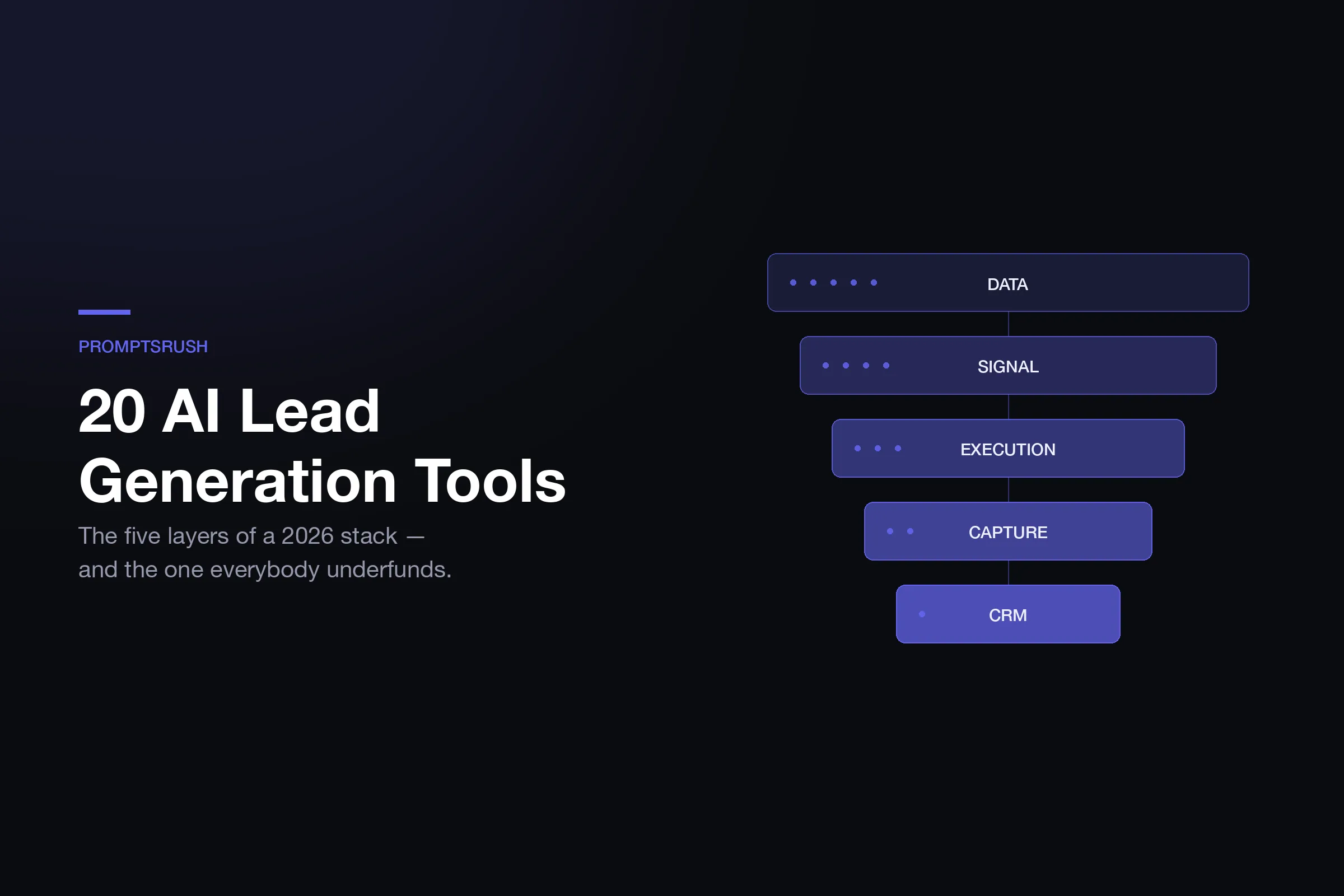
The five layers: capture (what happens when they arrive), data (who exists), signal (who is in-market right now), execution (the sending), and system of record (where it all lands). They are listed below in that order, capture first, because it is the one most stacks skip. AI has changed each layer differently. In data it mostly means agentic web research instead of a static database. In signal it means resolving anonymous behaviour to a person. In execution it means per-prospect copy that is no longer obviously templated. In capture it means pages and forms that adapt. In the CRM it means the record maintains itself.
Below are 20 tools, grouped by the layer they actually occupy, with real prices pulled from vendor pricing pages in September 2026 rather than from roundups quoting each other. Where a vendor does not publish pricing, that is stated instead of guessed — several of the most-hyped AI SDR products are in that bucket, and it matters.
The Layer Almost Everyone Underfunds
Before the list: the single most common way a lead gen stack fails is not bad data. It is a great campaign pointing at a bad destination.
Teams will spend $500 a month on enrichment credits and route every reply, every ad click and every LinkedIn profile visit to a homepage that was never designed to convert anyone — or to a form with eleven fields, three of which the enrichment tool they are already paying for could have filled in automatically. Building that destination is no longer the constraint it was — a campaign page can be prompted into existence in an afternoon — which makes leaving it undone harder to justify. The economics are brutal and boring: doubling reply rate is hard and expensive, and doubling the conversion rate of the page those replies land on is often a week of work. One of those is a data problem. The other is a page problem, and the page problem is cheaper.
This is why the capture layer belongs in a lead generation tool list at all, and why it is worth solving before you spend on the top of the funnel. If you are running campaigns without a dedicated page per campaign — because building one means a ticket, a sprint, or a developer who is busy — that constraint is the thing throttling your lead volume, not your data provider.
Onepage is the pragmatic answer for that specific gap: drag-and-drop pages that do not break their layout when you edit them, a lightweight CRM with lead notifications, unlimited email volume, and webhooks plus Zapier and Make so captured leads land wherever the rest of your stack lives. Multi-step forms and quiz funnels come from a separate Forms and Funnels add-on — free up to 100 responses a month, then from $39.90 — so budget both lines if quizzes are the reason you are buying. Paid plans start at $19.90/month for 7 pages, $39.90/month gets you 50, and every tier includes monthly AI credits for the AI writer and SEO tooling. It is not trying to be your CRM or your sequencer — it is trying to make "spin up a page for this campaign" a thing you do without asking anyone.
Pro tip: Before buying anything below, check your current conversion rate from landing-page visit to form submit. Under 2% on targeted traffic means your problem is downstream of every tool on this list, and more leads at the top will just cost you more per lead.
Quick Comparison
| Tool | Layer | Entry price | The AI part |
|---|---|---|---|
| Intercom Fin | Capture (inbound) | $0.99/resolution | Autonomous resolution agent |
| Onepage | Capture (pages/forms) | Free; $19.90/mo | AI writer, SEO, vibe coding |
| Clay | Data / orchestration | Free; $167/mo | Claygent web-research agents |
| Apollo.io | Data + execution | Free; $49/user/mo | Research, writing, call scoring |
| Cognism | Data (EU/phone) | Custom, ~$15–25K/yr | Intent + phone verification |
| Lusha | Data (light) | Free; $49.90/mo | Enrichment for agent workflows |
| ZoomInfo | Data (enterprise) | Custom, five figures | Copilot account prioritisation |
| RB2B | Signal (visitor ID) | Free; $79/mo | Person-level US resolution |
| Warmly | Signal + engagement | Custom | Inbound and TAM agents |
| Common Room | Signal aggregation | $2,500/mo | RoomieAI briefs, Person360 |
| Leadfeeder (Dealfront) | Signal (EU-safe) | Free; €79/mo | Company ID + scoring |
| Instantly | Execution (email) | $47/mo | Reply agent, web researcher |
| Smartlead | Execution (deliverability) | $39/mo | Warmup, rotation, reply triage |
| Lemlist | Execution (multichannel) | $69/user/mo | lemAgent, intent agents |
| HeyReach | Execution (LinkedIn) | $79/mo | Multi-account orchestration |
| Amplemarket | Execution + data | Custom | Duo copilot, duplicate detection |
| Regie.ai | AI SDR (augmented) | $180/user/mo | Agent-assisted sequencing |
| Unify | AI SDR (warm outbound) | Custom | Signal-triggered agent plays |
| HubSpot Breeze | CRM-native | Credits, $10/1,000 | Outcome-priced prospecting agent |
| Attio | CRM (AI-native) | Free; $44/user/mo | Ask Attio, agents on every tier |
Layer 1 — Capture and Conversion
Every other layer in this article generates attention. This one converts it, and it leads the list because that is where the compounding returns live: a conversion-rate improvement multiplies every channel feeding it simultaneously, while a better data provider only improves one.
1. Intercom Fin
Fin is the most credible autonomous agent in this whole list, largely because its scope is narrow and its pricing is honest. It answers across email, live chat and phone, takes actions in external systems, and costs $0.99 per resolution — where a resolution means the customer confirmed they were helped, did not ask again, or the workflow completed. You are charged once per conversation.
Seats are separate: Essential $29, Advanced $85, Expert $132 per seat monthly, with Fin available on all three. Outcome-based pricing is the right model for an agent, because it aligns the vendor with the thing you actually want. For lead gen specifically, Fin qualifies and books from inbound conversations that would otherwise sit in a queue overnight.
2. Onepage
Onepage is the capture layer from the top of this article, and it leads this list on a specific argument: campaign-level page velocity. Most teams have one landing page because making a second one is a project. That constraint quietly caps everything — you cannot run message-match experiments, you cannot give a segment its own page, and every ad and email lands somewhere generic.
Free covers 3 pages, Essential $19.90/month for 7, Standard $39.90/month for 50, Advanced $69.90/month for 150, Expert $179.90/month unlimited, with 17% off annually. Multi-step forms and quizzes, an integrated CRM with lead notifications, autoresponders and double opt-in from Standard up, webhooks from Essential, plus Zapier and Make coverage. Every tier includes AI credits for the writer and SEO tooling.
If you are choosing between page builders on features rather than fit, our comparison of AI landing page builders puts it against the alternatives, and the funnel builder roundup covers the multi-step case where a page is only the first screen.
Layer 2 — Data and Enrichment
This layer answers "who exists and how do I reach them." The 2026 change is that the best products stopped being databases and became research engines: instead of returning a stale field, they dispatch an agent to go find the answer now. That is a real architectural shift rather than a marketing one, and it is worth understanding what separates an agent from a packaged skill before you evaluate any vendor's claims about theirs.
3. Clay
Clay is the tool that redefined this layer, and it is genuinely different from a data vendor. It is a spreadsheet where every column can be an enrichment provider, a scraper, or an AI agent. Claygent — its web-research agent — will visit a company's site, read their careers page, and answer a question you wrote in plain English, per row, across thousands of rows.
The practical use is waterfall enrichment: try provider A for a mobile number, fall back to B, then C, and only pay for the one that hits. That single pattern usually beats any individual data vendor's coverage while costing less.
Pricing: free tier with 100 data credits and 500 actions monthly. Launch is $167/month (2,500 credits, 15,000 actions), Growth $446/month (6,000 credits, 40,000 actions), Enterprise custom. Notably, Claygent, AI formulas and account agents are on every tier including free — you are buying volume, not features.
The honest caveat: Clay has a real learning curve and a credit model that punishes sloppy table design. Teams who treat it as "a list tool" overspend badly in month one. Budget a week to learn it or the credits evaporate on enrichments you did not need.
4. Apollo.io
Apollo is the default starting point for most teams because it collapses three layers into one: a large contact database, a sequencer, and enough CRM to run without one. Its AI does research summaries, email drafting, and call scoring.
Pricing is unusually transparent for this category: Basic $49/user/month with 30,000 credits a year, Professional $79/user/month with 48,000, Organization $119/user/month with 72,000 and a 3-user minimum, all on annual billing — monthly costs about 20% more. There is a functional free tier.
Apollo's data is broad and shallower than the enterprise vendors, particularly on mobile numbers and non-US coverage. For a startup selling to US tech, that trade is almost always correct. For a team selling to European mid-market or into industries the tech-centric datasets ignore, it is not.
5. Cognism
Cognism's pitch is phone numbers that are actually verified and a data posture built for European selling — GDPR handling and DNC screening as a core feature rather than a compliance footnote. If your reps dial and your market is EMEA, this is the category leader and there is not a close second.
Cognism does not publish pricing. Reported deals cluster around $15,000–$25,000 a year with an annual contract, typically structured as a platform fee plus per-seat cost, and its phone-verified tier adds meaningfully on top. Treat those as third-party reports, not company-confirmed figures — you will get a custom quote and it will depend on seats and volume.
6. Lusha
Lusha is the lightweight option: a browser extension and API for pulling a verified email or a mobile number, without the platform commitment. Free gives 40 credits; Starter is $49.90/month for 400 credits, Professional $69.90 for 600, Premium $399.90 for 3,400, with annual billing roughly 25% cheaper. An email costs 1 credit, a phone number 5.
It is not a prospecting platform and does not pretend to be. Where it earns a place in 2026 is as an enrichment endpoint inside someone else's workflow — a step in a Clay table or an automation, not a place your reps live.
7. ZoomInfo
The incumbent, and still the most complete dataset for US enterprise, with intent data and org charts that the challengers approximate rather than match. Its Copilot layer prioritises accounts and drafts outreach off signals already in the platform.
Pricing is custom, opaque, five figures annually, and contractually rigid — multi-year terms and seat minimums are standard. The strategic read for 2026 is that ZoomInfo's moat is now depth in enterprise and compliance rather than raw coverage, because Clay-style waterfalls let a small team assemble comparable coverage for a fraction of the cost. If you are under 20 reps, you almost certainly should not be here.
Layer 3 — Signal and Visitor Identification
The highest-converting lead is someone already looking at you. This layer's whole job is to stop that person leaving anonymously. It is also the layer with the most legal nuance, so read the jurisdiction notes carefully.
8. RB2B
RB2B identifies individual people visiting your site — not just companies — and pushes them to Slack in real time. That person-level resolution is the differentiator, and it is US-only by design for exactly the reason you would expect.
Free covers 150 monthly resolutions; Starter is $79/month for 300; Pro at $149/month and Pro+ at $199/month unlock contact-level identification at roughly 15–20% coverage, with Pro+ pushing company-level to 35–45%.
Two honest notes. Coverage percentages mean most of your traffic still goes unidentified, so treat it as a bonus channel rather than a pipeline forecast. And person-level identification of anonymous visitors is exactly the kind of processing European regulators take an interest in — RB2B's US-only scope is a deliberate answer to that, not an oversight.
9. Warmly
Warmly sits between signal and execution: it de-anonymises visitors, then runs agents that act on them — an inbound agent handling on-site chat, meeting booking and routing, and a TAM agent that scores accounts, maps buying committees and coordinates email and ads. Its Context Graph unifies visits, email, meetings and CRM into one record.
Warmly does not publish plan pricing. The product is genuinely ambitious and the "AI-native, human-supervised" framing is the right instinct for this category — but an unpublished price on a usage-driven product means you should model your own volume before the call, not after.
10. Common Room
Common Room aggregates signals most tools ignore: job changes, GitHub and community activity, social engagement, product usage, website visits. Person360 handles waterfall enrichment plus identity resolution, and RoomieAI produces account briefs and answers research questions across the whole graph.
Essential starts at $2,500/month billed annually, with Advanced and Enterprise custom. That price makes it a deliberate choice for companies with a real community or product-led motion, where the signals it uniquely sees are the pipeline. For a straightforward outbound team, it is expensive coverage of signals you will not action.
11. Leadfeeder (Dealfront)
Leadfeeder identifies the companies visiting your site — not individuals — which is precisely why it works in Europe where person-level tools cannot operate. It is now part of Dealfront, a German-registered group, and the European data posture is the product's core argument.
Lite is free after a 14-day trial; Discover starts at €79/month, Activate at €369/month, Scale at €599/month, all billed annually. All plans include unlimited users, which matters when you want marketing and sales both watching the same feed.
Building signals nobody else has
The signals above are the ones vendors package. The highest-value signals are usually the ones specific to your market that no vendor sells — a company adding a particular integration, publishing a certain job spec, changing pricing, or shipping a competitor's badge on their footer. Watching for those means reading the web on a schedule and turning pages into structured fields, which is a scraping problem with a compliance dimension rather than a data-vendor purchase.
That is what an extraction API is for: point it at a list of URLs, get back clean structured data you define a schema for, and feed it into the same Clay table as everything else. It turns "I wish I knew which of our target accounts just started hiring an RevOps lead" into a column.
Firecrawl handles that job specifically — scrape, crawl, map and search through one API that returns LLM-ready markdown or JSON rather than raw HTML you have to parse. Our breakdown of Firecrawl's credit model covers how the pricing maps to real crawl volume, which is the part people get wrong when they budget for this.
Layer 4 — Execution
This layer sends. The AI story here is the least impressive and the most oversold: models write plausible outreach, but plausible outreach is exactly what the market is drowning in. The tools that matter compete on deliverability infrastructure, and the AI is a feature on top rather than the reason to buy.
12. Instantly
Instantly built its reputation on cold email at volume with unlimited email accounts and unlimited warmup, and has since layered on a 450M+ lead database and AI agents for research and reply handling.
The pricing is unusually segmented: outreach-only Growth is $47/month (5,000 emails, 1,000 contacts, unlimited mailboxes), Hypergrowth $97/month (125,000 emails), Lightspeed $358/month. Credits for lead data and AI are sold separately from $47/month, and bundles combining both start at $94/month. Read carefully — comparing Instantly's headline price to a competitor's all-in price is not a like-for-like comparison.
13. Smartlead
Smartlead's differentiator is infrastructure: unlimited email accounts on every plan with no per-mailbox fee, automatic rotation across them, a warmup pool, and private infrastructure on higher tiers. It is the choice for people whose problem is landing in the inbox rather than writing the email.
Base is $39/month (2,000 contacts, 6,000 sends), Pro $94/month (30,000 contacts, 90,000 sends, adds CRM and warmup pool), Unlimited Smart $174/month and Unlimited Prime $379/month, with 17% off annually. Note that the Base tier lacks CRM access and the warmup pool — the feature most people are buying Smartlead for — so Pro is the real entry point.
14. Lemlist
Lemlist is the multichannel option: email, LinkedIn and calls in one sequence, with a 650M+ lead database included. Email is $69/user/month (50,000 emails), Multichannel $109/user/month (unlimited), both 20% cheaper annually.
Its pricing model is the interesting part: the database is included, but enrichment runs on pay-per-success credits at $0.01 each — 5 credits for a verified email, 20 for a phone number, 100 for hiring or fundraising signals, 400+ for LinkedIn engagement data. You only pay when the lookup succeeds, which is more honest than burning credits on misses, but signal-heavy workflows add up faster than the headline suggests. lemAgent and the intent agents are on every plan.
15. HeyReach
HeyReach does one thing: LinkedIn outreach across many sender accounts without getting them restricted, with a unified inbox across all of them. That multi-account orchestration is the whole product and it is why agencies use it.
Growth is $79/month per sender seat, Agency $999/month for 25 senders, Unlimited $2,999/month capped at 300 senders under a fair-use policy. There is a 14-day trial with 3 accounts. LinkedIn automation always carries platform risk regardless of vendor — HeyReach manages that risk well, it does not eliminate it.
16. Amplemarket
Amplemarket bundles data, multichannel sequencing and its Duo copilot, with a genuinely useful duplicate-and-conflict detection layer that stops two reps hitting the same account. Pricing is custom, which puts it in the "book a call and model your own volume" bucket alongside Warmly and Cognism.
Whatever you send with, the copy still has to earn a reply, and that is a prompt problem more than a tool problem — our 60 cold email prompt templates covers the patterns that survive contact with a real inbox.
Layer 5 — Autonomous AI SDRs
This is the loudest category of 2026 and the one where buyers get burned most often. The useful distinction is between augmentation — AI that makes a human rep faster, with the human still deciding — and autonomy — an agent that prospects, writes and sends end to end.
Augmentation works. Full autonomy has a mixed public record: several high-profile AI SDR vendors have faced churn complaints and disputed case studies, and the pattern is consistent — the agent generates volume, volume generates replies, and the replies are not qualified. The same gap shows up in the wider "AI employee" category — our Sintra AI review walks through what happens when the marketing promises a headcount replacement and the product delivers a prompt wrapper. Buy accordingly, and insist on a pilot with your own list before an annual commitment.
17. Regie.ai
Regie sits on the augmentation side and is upfront about it. Reported pricing is roughly $180/user/month for its AI SEP tier on an annual contract with a 10-seat minimum, and a higher "force multiplier" tier around $499/user/month with a 5-seat minimum. Those are third-party reported figures — Regie does not publish a self-serve price — so treat the seat minimums as the real constraint. This is not a tool a three-person team buys.
18. Unify
Unify's angle is warm outbound: watch intent signals, and only trigger an agent-run play when an account actually does something. That sequencing — signal first, outreach second — is the correct architecture for this category and avoids the failure mode above, because the agent is not inventing reasons to contact people.
Pricing is custom and reportedly lands in the low thousands per month depending on volume. As with every unpublished price here: model your volume before the demo.
Layer 6 — The System of Record
19. HubSpot Breeze
Breeze is HubSpot's AI layer — enrichment, intent and form shortening via Breeze Intelligence, plus prospecting and customer agents. The notable 2026 change is that HubSpot moved these agents to outcome-based pricing: the prospecting agent charges roughly $1 per lead it recommends for outreach, billed as 100 credits, with credits at about $10 per 1,000. Agents are available on Pro and Enterprise tiers.
The strategic point is that outcome pricing is spreading — Intercom, HubSpot — and it is a good sign for buyers. A vendor willing to be paid per result is a vendor confident the result happens.
20. Attio
Attio is the AI-native CRM that people who dislike CRMs actually keep using: a flexible data model, real-time sync, and Ask Attio plus AI agents included on every tier including free. Plus is $44/user/month, Pro $99/user/month, 20% off annually, with a credit pool powering AI features and workflows.
Against HubSpot it trades ecosystem depth for speed and modelling flexibility. For a startup building a GTM motion that does not look like the standard template, that trade is usually right. For a marketing team that wants email, CMS, forms and reporting in one place, HubSpot still wins.
Picking Without Overbuying
| If your bottleneck is… | Buy this layer | Reasonable starting spend |
|---|---|---|
| Not enough named accounts | Data (Apollo, or Clay for waterfall) | $49–$167/mo |
| Traffic that leaves anonymously | Signal (RB2B US, Leadfeeder EU) | $0–$149/mo |
| Emails not landing | Execution infra (Smartlead Pro) | $94/mo |
| Replies that never convert | Capture (pages + forms) | $19.90–$39.90/mo |
| Reps drowning in admin | CRM with agents (Attio, HubSpot) | $44/user/mo |
| Dialling into EMEA | Data (Cognism) | Five figures/yr |
| Inbound queue overnight | Inbound agent (Fin) | $0.99/resolution |
Five Mistakes That Waste the Budget
- Paying for the same contact three times. Apollo, Lusha and a Clay waterfall all resolve overlapping data. Pick one primary source and use the others as fallbacks inside it, not as parallel subscriptions.
- Buying volume before fixing conversion. If your page converts at 1.5%, tripling traffic triples your cost per lead problem. Fix the denominator first — it is the cheapest lever in the stack.
- Treating unpublished pricing as a detail. Cognism, Warmly, Amplemarket, ZoomInfo, Unify and most AI SDR vendors quote custom. That is not neutral: it means the price depends on what they think you will pay, and annual commitments are the default. Model your volume before the demo, not after the proposal.
- Ignoring jurisdiction. Person-level visitor identification is a US-market product. Running it against European traffic is a compliance question, not a growth hack, and the vendors that restrict it are being careful rather than limited.
- Buying an autonomous SDR to fix a positioning problem. If humans cannot get replies with your message, an agent sending ten times as many will produce ten times as much silence — faster, and with your domain reputation attached.
The Verdict
For most teams under 30 people in 2026, the honest stack is smaller than the market wants you to believe: Apollo or Clay for data, Smartlead or Instantly for sending, RB2B or Leadfeeder for the visitors you already have, Attio to hold it, and a real capture layer so none of it leaks. That is roughly $250–$400 a month, and it outperforms most $3,000-a-month stacks because every layer is actually being used.
Spend the difference on the destination. Enrichment credits get consumed; a page that converts twice as well keeps paying every month you leave it up.
Keep Reading
If your bottleneck turns out to be the message rather than the list, SEO and copy prompts for commerce covers the demand-capture side. Or browse all guides on PromptsRush.
Frequently Asked Questions
10 questions answered