Best AI Prompts for Cold Email Outreach: 60 Templates That Get Replies (2026)
60 production-tested AI prompts for cold email outreach — pre-outreach research, first touches, subject lines, follow-up sequences, sponsorship pitches, and reply handling. Templates that actually get replies in 2026.
Advertisement
Cold email is the highest-leverage channel in B2B and creator-economy outreach — and the most ruined by AI. The vast majority of "AI cold emails" sent in 2026 still look like AI cold emails: generic openers, structurally identical bodies, and CTAs that trigger spam filters before they ever reach a human inbox.
The fix is not turning AI off. The fix is using AI at the right layer — research, personalization, sequencing, reply handling — and stopping at the right layer too. The 60 prompts below are the exact templates we run at PromptsRush for our own outbound: B2B sales, partnership outreach, podcast bookings, sponsorship deals. Battle-tested, not theoretical.
Three numbers anchor everything that follows. 1–3%: the industry baseline reply rate for genuinely cold emails. 8–15%: what well-researched, well-personalized first touches get — a 5× lift. 30–45%: what a 5-touch sequence with the right cadence delivers cumulatively. Every prompt below is engineered to move you up that ladder, fast.
Use them with any model. Gemini 3.6 Flash for cheap batch personalization, Claude Opus 5 for high-stakes accounts and sponsorship pitches, GPT-class models if that is already where your stack lives. Each template is built around what AI is genuinely good at: synthesis, pattern matching, voice mimicry. The strategic judgment — trigger-event timing, list selection, the final taste check before send — stays with you.
How to Use This Cheat Sheet
- Templates use
[BRACKETS]for variables. Replace with your actual prospect, offering, and context before sending. Many prompts assume you paste in real research, LinkedIn snippets, or a prior email thread. - Run them anywhere a chat model lives. ChatGPT, Claude, Gemini, Perplexity, or via the API behind your outreach tool (Apollo, Instantly, Smartlead, Lemlist).
- Pair them with real signal. The best prompt in the world cannot rescue a bad list. Spend disproportionate time on prospect selection and trigger-event timing.
- Always read the output before sending. Every email below should pass a 5-second sniff test: would I open it? Would I reply? If no, regenerate.
Why AI Belongs in Your Cold Email Stack — And Where It Does Not
AI is exceptional at three jobs in the cold-email pipeline:
- Synthesis at scale. Reading a LinkedIn profile, a company about-page, three recent posts, and a funding announcement, then compressing them into one usable opener — in 8 seconds, at $0.001 per prospect.
- Voice mimicry. Matching the tone of a reference email you have already validated, applied across thousands of new prospects without drift.
- Pattern interrupt generation. Producing five subject-line variants in five different styles so you can A/B test instead of guessing.
AI is poor — and you should stop using it — at three jobs:
- Strategic targeting. Who is on the list and why is a human call. Bad targeting + great prompts = great-sounding emails landing in the wrong inboxes.
- Trigger-event timing. Knowing when to send is half the game. AI can detect triggers, but the decision to act on them is yours.
- The final taste check. Every AI draft should pass through a human read before send. Always.
10 Meta-Rules That Make Every Cold Email Prompt Better
- Feed the model real research, not assumptions. Paste the actual LinkedIn excerpt, the actual press release, the actual job posting. Vague inputs produce vague outputs.
- Specify the tone explicitly. "Peer-to-peer professional," "irreverent founder," "respectful and brief" — vague defaults to bland.
- Hard-cap the word count. "Max 90 words" beats "keep it short." Models obey numbers.
- Ban the AI-cold-email vocabulary. Add: "Do not use 'I hope this finds you well,' 'circling back,' 'quick question,' 'just wanted to,' or any em-dash where a period would do."
- Name the CTA explicitly. "15-min call this week" vs "share a thought in reply" vs "yes/no/maybe response" — the CTA shapes the whole email.
- Force one specific number into the body. A real stat, a real outcome, a real time-to-value. Generic claims read as AI.
- Use a reference email as a style sample. Paste a real email of yours that worked. Tell the model: "Match this voice, not your default."
- Generate 3 variants, pick the best, regenerate that one. The first draft is rarely the best draft. Iterate before sending.
- Validate against spam triggers. After generation, ask the model: "Flag any words or patterns in this draft that commonly trigger spam filters." Edit accordingly.
- Lower temperature for sequences, raise it for first touches. Sequences want consistency. First touches want variety to test against.
Pro tip: The single highest-ROI move in AI cold email is keeping a "reference library" of your 3–5 best-performing emails ever, and pasting one as a style sample in every prompt. It cuts AI-cold-email-voice drift by an order of magnitude.
1. Pre-Outreach Research & List Building (Prompts 1–8)
1. The ICP Refiner
Sharpen your Ideal Customer Profile from real wins and losses.
You are a B2B sales strategist. Refine my Ideal Customer Profile. Current ICP: [DESCRIPTION]. Best-fit customers from the last 12 months: [LIST 3–5 NAMES + WHY THEY ARE GREAT]. Bad-fit customers we sold to but regret: [LIST 2–3 + WHY]. Output: (1) revised firmographic criteria, (2) 3–5 trigger events that signal best-fit timing, (3) what segments to deprioritize, (4) the single sharpest signal of fit you would bet money on.
2. The Account Research Summary
Compress a target account into a usable briefing.
I am about to write a cold email to [TITLE] at [COMPANY]. Below are the company website excerpts, recent press, and the prospect LinkedIn profile. Synthesize: (1) what the company actually does in plain language, (2) their stated priorities for the next 12 months, (3) what this person likely owns and is measured on, (4) the most personalized hook for my email. Max 200 words. No filler.
===INPUTS===
[PASTE WEBSITE / PRESS / LINKEDIN]
===END===
3. The Prospect Persona Extractor
Turn a LinkedIn profile into a usable persona JSON.
From the LinkedIn profile and last 5 posts below, infer: (1) what this person cares about professionally, (2) what they signal expertise in, (3) what they complain about or wish were different, (4) their likely tone preference (formal/casual/contrarian). Output as a JSON object with fields: cares_about, expertise, frustrations, tone_preference. No commentary.
===PROFILE===
[PASTE]
===END===
4. The Trigger Event Detector
Scan a news item for outreach openings.
Scan the article below. Flag any of these trigger events: funding round, leadership change, expansion to a new market, layoff, new product launch, acquisition, regulatory pressure, public PR issue. For each detected trigger, output: (1) trigger type, (2) one-sentence summary, (3) why this creates an outreach opening for [MY OFFERING], (4) recommended speed-to-outreach window (24hr / 1wk / 1mo).
===ARTICLE===
[PASTE]
===END===
5. The LinkedIn-to-Icebreaker
3 different openers from one profile, all human-sounding.
Below is a LinkedIn profile. Generate 3 different opener lines I could use to start a cold email — each referencing something specific from the profile (post, comment, role change, shared connection, company news). Each opener: 1–2 sentences, no flattery, no "loved your post," must lead naturally into a pitch about [OFFERING].
===PROFILE===
[PASTE]
===END===
6. The Tech Stack Inferrer
Infer a company tech stack from public signals.
Below is a company website, job postings, and engineering blog excerpts. Infer their likely tech stack: frontend, backend, database, cloud, observability, comms. For each: name the tool, confidence (high/medium/low), what tipped you off. Flag any gap where they might be in market for [MY CATEGORY]. Output as a markdown table.
===INPUTS===
[PASTE]
===END===
7. The Pain Point Hypothesis Generator
Three testable pain hypotheses, ranked.
My offering: [DESCRIPTION]. Below is research on a target company. Generate 3 specific pain-point hypotheses they likely have, ranked by likelihood. For each: (1) the hypothesized pain in one sentence, (2) the signal in the research that supports it, (3) the question I could ask in a cold email to validate without sounding presumptuous.
===RESEARCH===
[PASTE]
===END===
8. The Decision-Maker Identifier
Who to actually target inside the company.
For my offering [DESCRIPTION] sold to [INDUSTRY], identify the typical buying committee: economic buyer, technical evaluator, end user, internal champion. For each role: typical title, what they care about, what gets them to say yes, what gets them to say no. Then recommend: who to make the first cold email target and why.
2. The Cold Email — First Touch (Prompts 9–18)
9. The Classic Problem-First Cold Email
The reliable workhorse: problem → proof → low-friction ask.
Write a cold email to [TITLE] at [COMPANY]. Structure: (1) opener referencing [SPECIFIC TRIGGER OR DETAIL], (2) one-sentence problem statement aligned to their role, (3) one-sentence value proof with a number, (4) low-friction CTA (15-min call OR a one-question reply). Max 90 words. No "I hope this finds you well." No emojis. Banned phrases: "circling back," "just wanted to," "quick question."
10. The Social-Proof Cold Email
Lead with relevant logos and outcomes.
Write a cold email to [TITLE] at [COMPANY]. Lead with relevant social proof: "[2–3 SIMILAR COMPANIES] use [MY OFFERING] to [SPECIFIC OUTCOME WITH NUMBER]." Then one sentence on why this might be relevant to them based on [TRIGGER OR DETAIL]. Soft CTA: "Worth a 10-min look?" Max 80 words.
11. The Mutual-Connection Cold Email
Warm-leaning cold with a real name dropped naturally.
Write a cold email to [TITLE] at [COMPANY] where my opener references [MUTUAL CONNECTION NAME] (who mentioned them / is a colleague / introduced us at [EVENT]). Make the reference natural and specific, not forced. Transition to one sentence on what I help with and a low-friction CTA. Max 90 words. Do not over-claim the relationship.
12. The Hyper-Personalized Opener
Earn the read in the first two sentences.
Write a cold email opener (2–3 sentences) that proves I actually read [SPECIFIC ARTIFACT — their podcast episode, blog post, talk, tweet thread]. Reference one specific point they made, then add a thought or ask a related question that connects to my pitch about [OFFERING]. The opener must work on its own — that is, it must earn the read even if the rest of the email is mediocre.
===ARTIFACT===
[PASTE]
===END===
13. The Industry-Specific Cold Email
Native-sounding to insiders, foreign-sounding to outsiders.
Write a cold email to [TITLE] at a [INDUSTRY] company sized [N] employees. The email must: (1) use 2–3 industry-specific terms naturally, not for jargon's sake, (2) reference an industry-specific challenge most companies in this space face, (3) frame my offering [DESCRIPTION] in industry-native language. Max 100 words. A reader should not be able to tell this is templated.
14. The Contrarian-Take Cold Email
Pattern interrupt with a defensible opinion.
Write a cold email that opens with a contrarian-but-defensible claim about [INDUSTRY OR PRACTICE]. Connect that claim to my offering [DESCRIPTION]. The claim must be a real opinion I could defend in a meeting, not a cheap pattern interrupt. Close with a question that invites disagreement — that is the hook. Max 100 words.
15. The Case-Study Cold Email
Make the customer the hero, not the pitch.
Write a cold email anchored on this case study: [CUSTOMER NAME / DESCRIPTION] achieved [SPECIFIC NUMBER] using [MY OFFERING]. Structure: (1) one-sentence opener tying the reader to the case study's archetype, (2) headline result in one sentence with the number, (3) one sentence on the mechanism (why it worked), (4) CTA: a link to the full case study OR a 15-min walkthrough call. Max 100 words.
16. The Soft / Medium / Direct CTA Variants
Three versions of the same email to test CTA strength.
Write 3 versions of the same cold email body to [TITLE] at [COMPANY] about [OFFERING]. Identical opener and value prop. Vary only the CTA: (1) very soft — "reply with a thought," (2) medium — "worth 10 minutes?" (3) direct — "[DAY] at [TIME] for a 15-min call?" Each version max 90 words. Output as numbered variants.
17. The Senior-to-Peer Cold Email
VP to VP. Respectful but matter-of-fact.
Write a cold email from a [MY TITLE — e.g., VP Eng] to a peer [THEIR TITLE — also VP] at [COMPANY]. Tone: peer-to-peer, respectful but matter-of-fact, no asymmetric flattery. Lead with shared context (industry challenge or recent industry event). Pitch [OFFERING] briefly. CTA: a 20-min call between equals. Max 110 words.
18. The Senior-to-C-Level Cold Email
Numbers-first, brief, respects executive time.
Write a cold email from a [MY TITLE] to a [C-LEVEL TITLE] at [COMPANY]. C-suite reading: short, numbers-first, no jargon, respects their time. Structure: (1) headline outcome we deliver in one sentence with a number, (2) one sentence on relevance to their specific company (must be researched, not generic), (3) ask: a 15-min intro with me OR a referral to the right person on their team. Max 80 words.
3. Subject Lines & Preview Text (Prompts 19–26)
19. The Subject Line A/B Generator
10 variants across 4 styles, ready to split-test.
Generate 10 subject line variants for a cold email to [TITLE] at [COMPANY] about [OFFERING]. Constraints: 3–7 words each, no clickbait, no all-caps, no fake Re:/Fwd: prefixes. Mix styles: 3 question subjects, 3 specific-number subjects, 2 first-name subjects, 2 direct-statement subjects. Output as a numbered list with the style in brackets.
20. The Curiosity-Gap Subject
Genuine curiosity paid off by the body.
Write 5 subject lines that create a genuine curiosity gap for a cold email about [OFFERING] to [INDUSTRY]. The gap must be paid off by the email body — no bait-and-switch. Each 4–6 words. Skip question marks unless the body actually delivers the answer.
21. The First-Name Subject Line
"FirstName, [hook]" subjects that do not feel mail-merged.
Generate 5 first-name-prefix subject lines (format: "[FirstName], [hook]") for a cold email about [OFFERING]. The hook part must be 3–5 words and earn its place — banned: "a quick question," "are you the right person," "5 minutes?" Make each one feel like a human with something to actually say wrote it.
22. The Question Subject Line
Questions a real prospect could actually answer.
Generate 5 question subject lines for a cold email about [OFFERING] to [TITLE]. The question must be: answerable (the reader can imagine the answer), specific enough to feel real, relevant to the prospect's likely priorities. No rhetorical "Did you know..." subjects. Max 7 words each.
23. The Specific-Number Subject Line
Sharp numbers, not rounded marketing fluff.
Generate 5 subject lines that lead with a specific, non-round number tied to [OUTCOME OR CLAIM] from my offering. Numbers must be "sharp" (e.g., 47%, $1,830, 12 minutes), not round (50%, $2,000, 15 minutes). Each subject 4–6 words. Output as a numbered list.
24. The Mobile Subject + Preview Pair
Subject + preview that reads coherently in the mobile inbox.
Generate 5 (subject line + preview text) pairs for a cold email to [TITLE]. Subject ≤ 35 characters (mobile cutoff). Preview text ≤ 60 characters, extends the subject's hook rather than repeating it. The pair must read coherently as one unit in a mobile inbox preview. Output as a markdown table with columns: subject, preview, total characters.
25. The Subject Line Rewriter
Rewrite a weak subject five ways, each fixing one weakness.
Below is my current subject line and its reply rate. Rewrite it 5 ways, each correcting a different likely weakness: too long, too vague, too salesy, lacks specificity, lacks relevance. For each: the new subject and a one-line note on what weakness it addresses.
===CURRENT===
Subject: [PASTE]
Reply rate: [N]%
Email body context: [PASTE OR DESCRIBE]
===END===
26. The Reply-Bait Subject
Subjects designed to provoke a one-word response.
Generate 5 subject lines designed to elicit a one-word reply ("yes," "no," "who?") rather than open-and-ignore. The subject should make the reader want to respond before they finish reading. The email body must match by ending in a binary question. Output: each subject + the suggested closing question.
4. Follow-Up Sequences (Prompts 27–36)
27. The Day-3 Nudge
The first follow-up, polite and short.
Write a day-3 follow-up to a cold email that got no reply. Original email below. Constraints: (1) reference the original explicitly ("following up on my note from [day]"), (2) add one new piece of value (a relevant article, a specific question, a fresh angle), (3) softer CTA than the original, (4) max 50 words.
===ORIGINAL===
[PASTE]
===END===
28. The Day-7 Value-Add Follow-Up
Give before you ask again.
Write a day-7 follow-up that does not ask for anything. Format: (1) acknowledge no reply briefly, (2) share one piece of value relevant to their role — a stat, a resource, a brief insight, (3) optional one-line PS reopening the original ask. Max 80 words. The reader should think "huh, this person is actually useful."
29. The Day-14 Break-Up Email
Close the loop with grace — and often re-open the door.
Write a day-14 break-up email signaling I am closing the loop. Structure: (1) brief "I have not heard back, so I will stop reaching out," (2) restate the original value in one sentence, (3) leave the door open ("if priorities change, my door is open"), (4) one-line PS that often re-engages: a single specific question. Max 70 words.
30. The Bump Follow-Up
The 12-word reply that surfaces the email again.
Write the shortest possible follow-up to a cold email. The "bump." One sentence. It must: (1) signal I am still around, (2) re-surface the email, (3) invite a yes/no/maybe response. No more than 12 words including the greeting. Output 3 variants.
31. The Case-Study Follow-Up
Re-engage with a customer outcome, not a re-pitch.
Write a follow-up that leads with a customer case study: "[CUSTOMER] just achieved [SPECIFIC OUTCOME] with [OFFERING]." Tie it to the prospect's likely situation in one sentence. Restate the original ask in one sentence. Max 80 words. The case study is the hero, not the pitch.
32. The Pattern-Interrupt Follow-Up
Break the cold-email-ignore loop with a real twist.
Write a follow-up email designed to interrupt the standard cold-email-ignore pattern. Use one of: an unexpected one-line opener, a self-deprecating remark, a contrarian question, or a "should I stop?" frame. The body must still earn the read — pattern interrupt is not gimmick. Max 80 words.
33. The Executive-Style Brief Follow-Up
Brief, declarative, no apologies for the follow-up.
Write a follow-up email in the voice of a senior executive sending it themselves. Tone: brief, declarative, no apologies for the follow-up, no "just checking in." Format: (1) one-sentence reminder, (2) one-sentence value restatement with a number, (3) one-sentence ask with a specific time. Max 50 words.
34. The "Wrong Person" Pivot
Ask for the right contact without sounding accusatory.
Write a follow-up that pivots to ask if there is a better person at [COMPANY] to talk to. Frame respectfully — not "you ignored me" but "I may have aimed at the wrong contact." Include the original value in one sentence so the redirect target also gets context if forwarded. Max 70 words.
35. The Seasonal / Timely Follow-Up
Use timing as a real reason to re-engage.
Write a follow-up tied to [SEASONAL EVENT — e.g., end of quarter, budget planning season, industry conference, fiscal year end]. The timing must create a real reason to re-engage now, not feel forced. Format: (1) reference the seasonal context, (2) tie it to the prospect's likely priorities, (3) low-friction CTA aligned to the timing. Max 90 words.
36. The Reactivation Restart
For prospects who went cold 3–6 months ago.
Write a "restart" email to a prospect who went cold 3–6 months ago. Acknowledge the gap honestly without dwelling on it. Lead with what has changed since then on my side or in the market that makes this relevant again. Restate the original value with one fresh data point. Soft CTA. Max 100 words.
5. Sponsorship & Creator Outreach (Prompts 37–46)
37. The Brand-to-Creator First Touch
Brand outreach that does not sound like a mass DM.
Write a cold email from a brand [BRAND] to a creator [CREATOR NAME] about a paid sponsorship for [PRODUCT / CAMPAIGN]. Constraints: (1) reference 1–2 specific pieces of their content to prove I watched, (2) explain why this fit is genuine and not random outreach, (3) propose a clear deliverable and timeline, (4) state we have budget without naming the number yet. Max 130 words.
38. The Creator-to-Brand Pitch
Creator pitching their own audience to a brand.
Write a pitch from a creator [MY HANDLE, MY NICHE, MY AUDIENCE SIZE, KEY ENGAGEMENT METRIC] to a brand [BRAND] for a paid sponsorship. Structure: (1) brief intro of who I am and audience size plus one engagement stat, (2) why their product fits my audience specifically, (3) proposed deliverable and content format, (4) what makes my audience uniquely valuable to them. Max 150 words.
39. The Rate Negotiation Opener
Counter a low offer without burning the deal.
Brand has offered [AMOUNT] for [DELIVERABLE]. My typical rate for that deliverable is [HIGHER AMOUNT]. Write a polite, professional reply that: (1) thanks them for the offer, (2) states my standard rate with a one-line justification rooted in audience value not ego, (3) proposes a counter or alternative package (bundle, longer term, performance bonus), (4) keeps the door open warmly. Max 130 words.
40. The Cross-Promo Pitch
Mutual-value swap between two creators or publications.
Write a cold email to another creator or publication [TARGET] proposing a cross-promotion: [FORMAT — newsletter swap, podcast guest exchange, joint webinar]. Lead with audience overlap and mutual value. Include specific reach numbers from both sides. Propose a concrete first step (calendar booking, kickoff call). Max 120 words.
41. The Newsletter Sponsorship Pitch (Sponsor → Publisher)
Brand approaching a newsletter about ad slots.
Write an email from a brand [BRAND] to a newsletter publisher [PUBLISHER] requesting sponsorship slot info. Include: (1) why their audience fits our product, (2) type of slot we want (primary, classified, dedicated send), (3) budget range, (4) campaign window, (5) one example of past sponsorships we have run that performed. Max 130 words.
42. The Newsletter Sponsorship Pitch (Publisher → Sponsor)
Newsletter selling slots to a brand.
Write an email from a newsletter publisher [MY NEWSLETTER, AUDIENCE SIZE, NICHE] to a brand [BRAND] pitching sponsorship. Include: (1) audience size plus 1–2 demographic specifics, (2) average open and click rate, (3) why their product fits this audience, (4) available slots and rates, (5) a recent comparable advertiser's results. Max 140 words.
43. The Podcast Sponsorship Outreach
Brand outreach to a podcast for host-read ads.
Write a cold email from a brand [BRAND] to a podcast host [PODCAST] for a 60-second host-read sponsorship. Reference one specific episode that resonated with our brand. Propose: a 4-episode flight, host-read mid-roll, with promo code tracking. Include a budget range OR "happy to align with your standard rate." Max 130 words.
44. The YouTube Integration Pitch
Paid integration with a YouTube creator.
Write a cold email to a YouTuber [CHANNEL] proposing a paid integration for [PRODUCT]. Structure: (1) reference a recent video that ties to our brand, (2) propose integration format (60-sec mid-roll OR full dedicated video OR product showcase), (3) timeline and content guidelines (emphasize creative freedom), (4) compensation framing (flat fee OR fee + affiliate). Max 150 words.
45. The Affiliate Partnership Outreach
Affiliate program pitch to a creator or website.
Write an outreach email to a [CREATOR / WEBSITE / NEWSLETTER] proposing an affiliate partnership for [PRODUCT]. Lead with the natural fit between their audience and our product. Detail the commission structure ([RATE]%, cookie window, payment terms). Offer support: creative assets, custom promo codes, dedicated affiliate manager. Max 130 words.
46. The Long-Term Ambassador Pitch
Multi-month brand ambassador retainer proposal.
Write an email proposing a long-term brand ambassador deal to a creator [CREATOR]. Format: (1) why we want them specifically (not just any creator with their reach), (2) the ambassador term (e.g., 6 months, 12 deliverables, category exclusivity), (3) compensation structure (retainer + per-piece OR equity + cash), (4) the relationship benefits beyond money (early product access, collaboration, events). Max 160 words.
6. Personalization at Scale (Prompts 47–52)

47. The Recent Post / Tweet Referencer
3 openers from one piece of content, all substantive.
Below is a recent LinkedIn post or tweet from [PROSPECT]. Generate 3 different one-line openers I could use for a cold email that reference this post substantively — not "great post!" Each opener should add a thought, ask a question, or extend the argument they made. None should read as flattery.
===POST===
[PASTE]
===END===
48. The Company News Hook
Tie a news item to a role-specific implication.
Below is a recent news item about [COMPANY]. Generate 3 one-line cold email openers tied to the news. Each should: (1) reference the news specifically, (2) infer a likely implication for the prospect's role, (3) bridge naturally to a brief pitch about [OFFERING]. Avoid generic "congrats on the news!" openers.
===NEWS===
[PASTE]
===END===
49. The Funding-Round Hook
Outreach after a funding announcement, done right.
Below is a funding announcement for [COMPANY]. Write 3 cold email opener options for outreach to their [ROLE — e.g., VP Eng, Head of Marketing]. The openers must: (1) acknowledge the funding without over-celebrating, (2) connect the funding context to a likely priority for that role, (3) bridge to a relevant pitch for [OFFERING].
===ANNOUNCEMENT===
[PASTE]
===END===
50. The Job-Change Congrats + Pitch
The 90-day-in-role window is the highest-leverage outreach moment.
[PROSPECT] just started a new role as [NEW TITLE] at [NEW COMPANY]. Write a cold email that: (1) congratulates them briefly (one sentence, not effusive), (2) references the predictable challenges of the first 90 days in that role, (3) positions [OFFERING] as relevant to those challenges, (4) offers a low-friction resource or 15-min call. Max 100 words.
51. The Mutual Interest Discoverer
Real shared ground beyond "we both work in tech."
Below are LinkedIn profiles for me and a prospect. Identify 3 mutual interests beyond the obvious. For each: the specific shared interest, the evidence on both sides, and a natural way to bring it up in a cold email without sounding like I memorized their profile.
===MY PROFILE===
[PASTE]
===PROSPECT===
[PASTE]
===END===
52. The Industry Event Opener
"We were both at [EVENT]" as a real opening.
Both [PROSPECT] and I attended [EVENT — e.g., SaaStr Annual, INBOUND, RSA]. Write 3 cold email opener options: (1) referencing a session they may have attended, (2) referencing a theme or talk that connects to my pitch, (3) referencing the event as shared context without name-dropping a specific session. Each 2–3 sentences.
7. Reply Handling & Objection Handling (Prompts 53–60)
53. The "Not Interested" Reply Handler
Stay graceful, leave the door open, learn something.
Prospect replied "not interested." Write a graceful reply that: (1) thanks them for the directness, (2) asks one specific question that might surface a future opening (e.g., "is it timing or fit?" or "what does the right vendor in our space look like to you?"), (3) keeps the door open without pressuring. Max 50 words.
54. The "Send Me More Info" Reply Handler
Send the right two assets, not a 20-piece firehose.
Prospect replied "send me more info." Write a reply that: (1) sends 1–2 concrete pieces of info (not a 20-asset firehose), (2) frames each in one sentence with why I am sending it, (3) ends with a low-friction next step that moves toward a conversation rather than indefinite document review. Max 90 words.
55. The "Send to My Colleague" Reply Handler
Get the warm referral without losing your champion.
Prospect replied "this is more for [COLLEAGUE]." Write a reply that: (1) thanks them for the redirect, (2) asks if they would mind a brief intro or if I should reach out directly, (3) optionally restates the most relevant value sentence so the colleague gets context if forwarded. Max 60 words.
56. The "Bad Timing" Reply Handler
Respect the timing ask, clarify what unlocks it.
Prospect replied "bad timing — circle back in [TIMEFRAME]." Write a reply that: (1) respects the ask without sounding deflated, (2) asks one clarifying question about what makes the future timing better (so I re-engage with the right hook), (3) confirms I will follow up at the specified date. Max 50 words.
57. The Pricing Objection Reply
Reframe to value, surface the real concern.
Prospect replied that we are "too expensive." Write a reply that: (1) does not apologize for pricing or immediately discount, (2) acknowledges the objection genuinely, (3) reframes around value or ROI with one specific comparison, (4) asks a question that surfaces the real concern (is it total budget, comparison set, or deliverable scope). Max 100 words.
58. The Authority / Budget Objection Reply
Arm your champion, do not go around them.
Prospect said "I would need to get budget approval" or "this would need to go to [HIGHER UP]." Write a reply that: (1) offers to make their case-making easier (a one-pager, a custom ROI model, a brief async loom), (2) does not bypass them by going around to the higher-up, (3) suggests a specific next step (e.g., 30-min call where I prep them for the internal pitch). Max 100 words.
59. The Stalled-Deal Re-Engager
Bring new value, ask a small question to revive momentum.
Prospect was warm 2–4 weeks ago and has gone silent. Write a re-engagement reply that: (1) does not blame, (2) brings new value (relevant case study, market update, product change), (3) asks one specific question requiring a short answer to revive momentum. Max 80 words.
60. The Positive-Reply Momentum Builder
Lock in the meeting before enthusiasm fades.
Prospect just gave a positive reply ("yes, interested," "let me know more," "send a calendar link"). Write the follow-up that maximizes momentum: (1) brief enthusiasm without overdoing it, (2) the concrete next step inline (calendar link, agenda for the call, the specific resource), (3) one sentence setting expectations for what the meeting will cover so they show up prepared. Max 80 words.
How to Chain These Into Full Outbound Motions
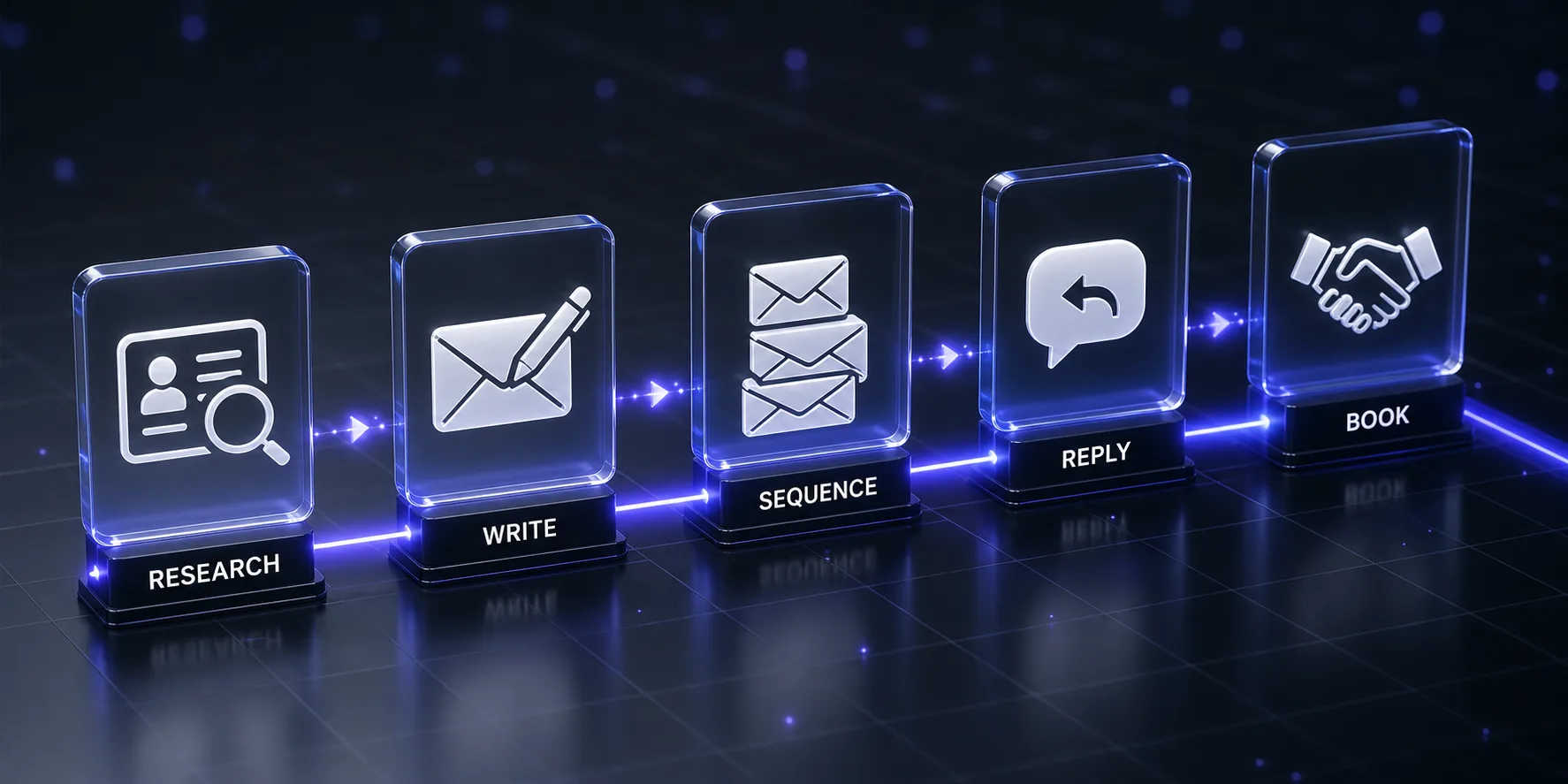
Single prompts get you single emails. Chains get you pipeline. Five plays we run weekly:
- Account-based opening play: Prompt 2 (Account Research) → Prompt 7 (Pain Hypothesis) → Prompt 12 (Hyper-Personalized Opener) → Prompt 9 (Classic Cold Email). One A-tier prospect, four model calls, one email that lands.
- 5-touch sequence build: Prompt 9 (Cold Email) → Prompt 27 (Day-3 Nudge) → Prompt 28 (Day-7 Value-Add) → Prompt 31 (Case-Study Follow-Up) → Prompt 29 (Day-14 Break-Up). The whole sequence in 10 minutes.
- Sponsorship full motion (brand side): Prompt 1 (ICP) → Prompt 37 (Brand-to-Creator) → Prompt 39 (Rate Negotiation) → Prompt 60 (Momentum Builder).
- Sponsorship full motion (creator side): Prompt 38 (Creator-to-Brand) → Prompt 39 (Rate Negotiation) → Prompt 46 (Long-Term Ambassador).
- Reply triage and route: Trigger on inbound → Prompts 53–60 cover every common reply pattern. Automate the draft, human-edit the send.
For teams running these at scale, an AI agent platform that can fetch prospect data, run the prompt chain, and queue drafts for human review is the multiplier. Genspark is one we have used to orchestrate the research-to-draft pipeline above.
The 8 Mistakes That Make AI Cold Emails Look Like AI Cold Emails
- Generic openers that anyone could have received. "Hi [Name], I came across your profile…" is a tell. If the opener does not contain something specific you could only know by researching, regenerate.
- The em-dash everywhere problem. Models love em-dashes. Humans rarely use more than one per email. Find-replace ruthlessly.
- Three-sentence openers before the actual point. Get to the value in the first 15 words or you are AI-coded.
- Asking for a 30-minute call in the first email. First-touch CTAs should be low-friction: a reply, a question, a "worth a look?" — not a calendar block.
- Identical structure across every prospect. Vary your templates by segment. The same email to 500 people, even if "personalized," reads as machine-mailed.
- Banned-vocabulary cluster. "Circling back," "just wanted to," "quick question," "touch base," "hope this finds you well." Each one is a flag. Ban them in your system prompt.
- No follow-up sequence. 70% of replies come from emails 2 through 5. If you only send the first touch, you are leaving most of the value on the table.
- Sending without spam-testing. Tools like Mail-tester or your platform's built-in spam check take 30 seconds. Use them on every new template.
Pro tip: Run every AI-generated email through this question before sending: "Would I reply to this if I received it?" If the honest answer is no, regenerate. Most cold-email teams skip this check and wonder why their reply rates are 1%.
Where to Go Next
Three companion posts to deepen the playbook:
- 40+ Gemini 3.6 Flash Prompts — the current-generation volume model, with batch personalization and extraction prompts that pair directly with outbound.
- 33+ Claude Opus 5 Prompts — the current flagship library for high-stakes outreach to A-tier prospects.
- Claude Opus 5 vs Gemini 3.6 Flash — the routing decision behind the two-model outbound stack recommended above.
- Best ChatGPT Prompts for AI Ads & Commercials — for the paid-acquisition side of the same growth motion.
Closing Note
Cold email is not dead. AI-generated cold email written like everyone else's AI-generated cold email is dead. The 60 templates above exist to keep your outreach in the small minority that still works — researched, varied, specific, and sent on the strength of real triggers rather than spray-and-pray volume.
Pick one prompt today, test it on five real prospects, and measure the reply rate against your baseline. Then layer in the follow-up sequence. Then the research chain. Pipeline compounds.
For the broader prompt library, head to PromptsRush Prompts. For more cheat sheets like this one, the PromptsRush Blog is the source.