The PromptsRush journal
AI ToolsSintra AI Review (2026): Features, Pricing & Verdict
Sintra sells 12 AI employees from $15.60/month — but every plan carries the same 250 credits, they never roll over, and helpers stop dead at zero. The full arithmetic and what the review record shows.
Advertisement
Product Review
PlayOS, Inc.
Sintra AI
Sintra offers 12 role-specialised AI helpers with a shared Brain AI knowledge store, and the concept is genuinely good for non-technical founders who want help across many functions without learning to prompt. The commercial model undercuts it: all three plans carry an identical 250 monthly credits, so you cannot buy capacity by upgrading, credits never roll over, helpers stop entirely at zero, and the only remedy is a recurring non-refundable top-up. Recent public reviews are dominated by credit complaints, and the Trustpilot profile has been flagged over incentivised reviews.
Excellent
Pricing
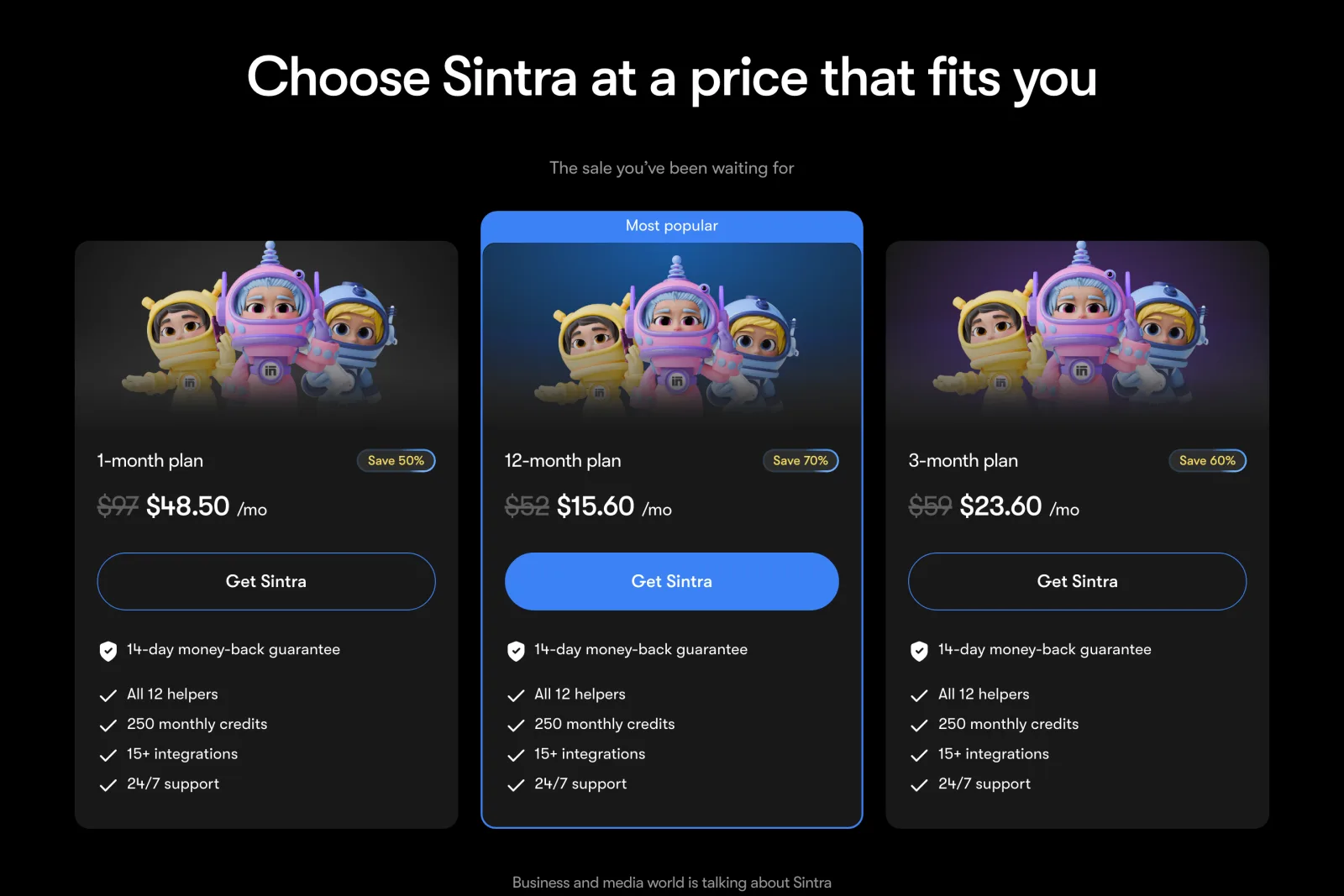
From $15.60 per month (12-month) to $48.50 (monthly)
What we liked
- Role-specialised helpers are genuinely easier than prompting a blank chatbot
- Brain AI keeps brand context across every helper — the best feature
- Use Cases turn common jobs into one-click actions
- Broad coverage across 12 business functions
- Zero technical setup, 100+ languages, 15+ integrations
- Mobile apps rate well: 4.6 iOS (~2,200 ratings), 4.4 Android (~900)
- Annual plan at $15.60/month is cheap for the breadth
What to watch for
- 250 credits is identical on every plan — upgrading buys no extra capacity
- Credits never roll over and helpers stop working entirely at zero
- Longer chat threads cost more per message, so the natural workflow is the expensive one
- Top-ups are recurring and non-refundable, including unused credits
- Recent Trustpilot dominated by credit complaints; profile flagged over incentivised reviews
- Repeated user reports of unlimited annual plans moved onto credits mid-term
- 14-day refund window is short against a 12-month commitment
- Uneven depth per helper; runs on Claude 4.5 Sonnet, two generations behind
Key Capabilities
- 12 role-specialised helpers: support, copy, SEO, sales, social, ecommerce, email, data, recruiting, admin
- Brain AI — shared brand knowledge store with file upload and website scraping
- Use Cases — one-click task templates per helper
- 250 monthly credits (identical on every plan)
- 15+ integrations
- Support for 100+ languages
- Scheduled tasks and automations
- iOS and Android apps
- 24/7 support and 14-day money-back guarantee
The Verdict
If you want to try it, buy the one-month plan at $48.50 and deliberately test your heaviest realistic workload inside the 14-day refund window. Do not let the 70% annual discount make that decision for you — that is the trade most complaints begin with. Skip it entirely for daily heavy use, or if you need AI video or website building at any volume.
Sintra AI sells a team of twelve named "AI employees" — Soshie for social, Penn for copy, Seomi for SEO, Cassie for support and so on — each with an avatar, a job title and a set of one-click tasks. For a solo founder wearing every hat, it is an appealing pitch, and the underlying idea is genuinely good — a different bet from aggregators that sell you raw model access.
The product has also changed in a way that most reviews still have not caught up with. Sintra moved to a credit system, and every plan now includes 250 credits a month regardless of what you pay. Understanding that number, and what it buys, is the whole review.
This is not a comfortable write-up. Sintra's own documentation and its public review record point the same direction, so I am going to lay out what each says and let you weigh it.
Pricing: All Three Plans Are the Same Product
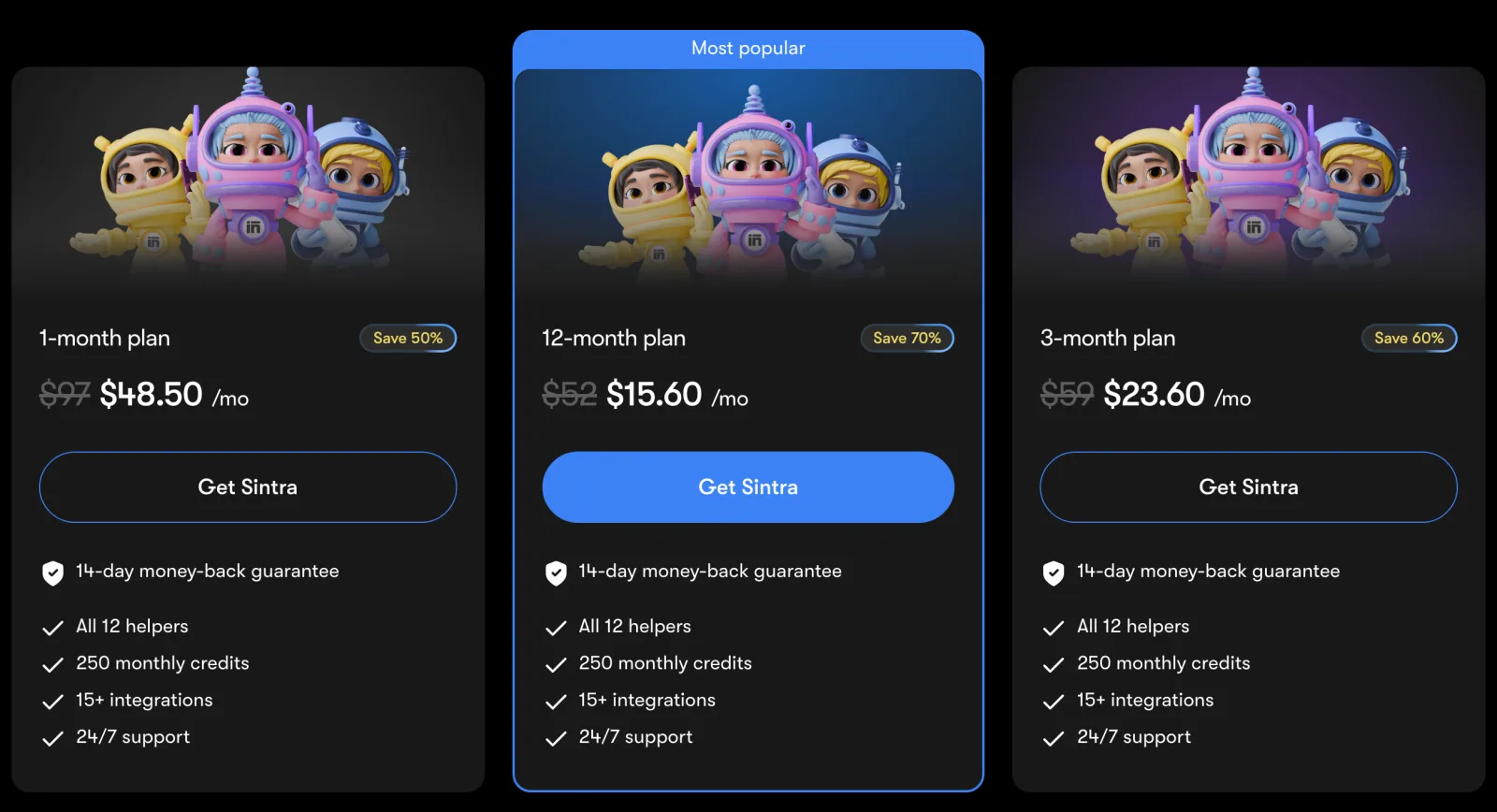
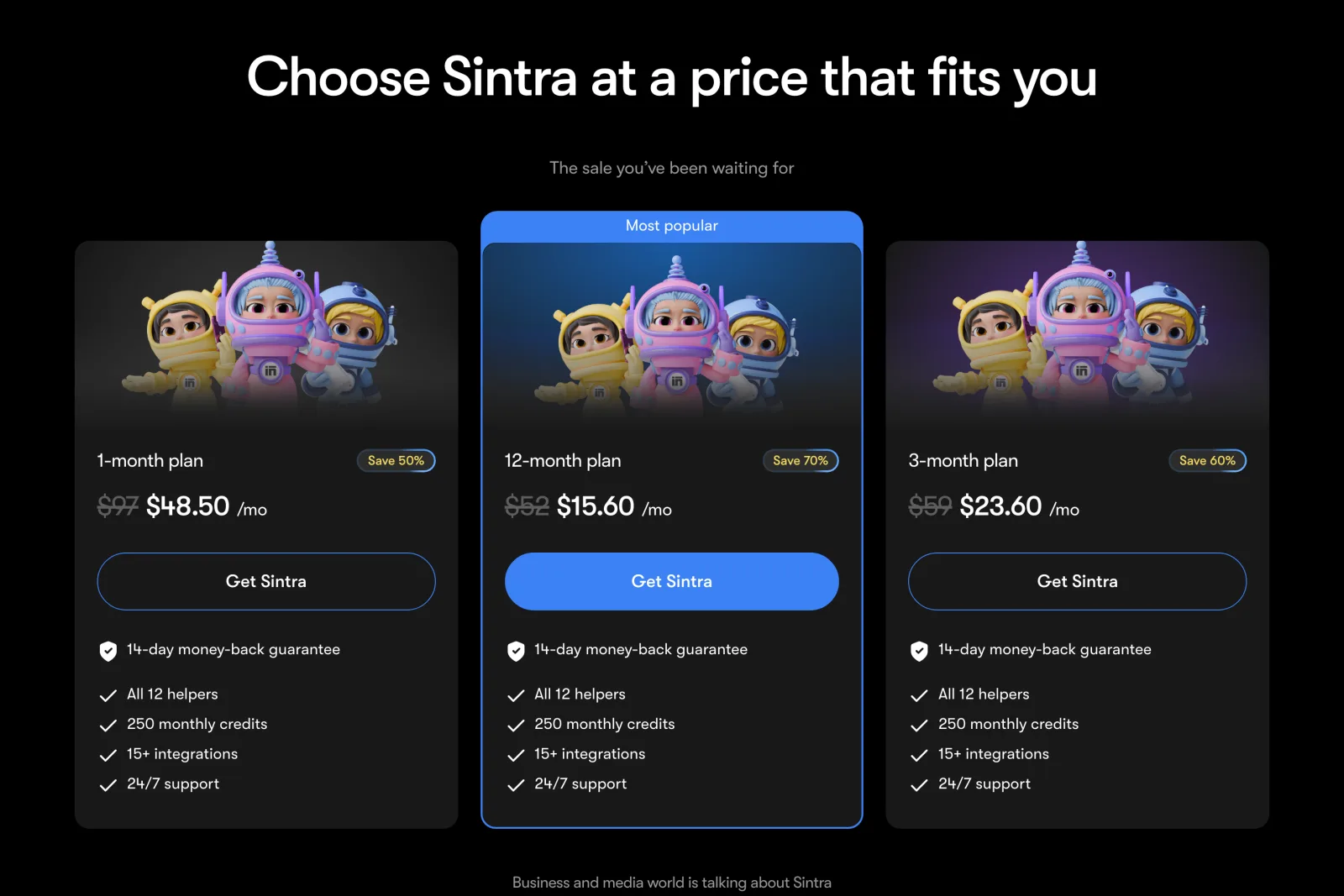
Sintra's pricing page runs a permanent sale — struck-through anchor prices next to the real ones:
| Plan | Anchor | Actual | Included |
|---|---|---|---|
| 1-month | $48.50/mo | All 12 helpers · 250 credits · 15+ integrations · 24/7 support | |
| 3-month | $23.60/mo | Identical | |
| 12-month (most popular) | $15.60/mo | Identical |
Read the right-hand column again. The three plans are not tiers — they are the same product at three commitment lengths. Same helpers, same 250 credits, same integrations. The monthly plan costs 3.1× the annual for identical capacity.
Individual helpers are sold separately at $39/month each, which exists mainly to make the $48.50 bundle look generous. Buying one helper for $39 when all twelve cost $48.50 is never the right call.
There is a 14-day money-back guarantee. A 3-day freemium trial grants a one-time 50 credits — once per account, never renewed.
The 250-Credit Question
Credits are the constraint, and Sintra's own help documentation is admirably specific about what things cost. Here is the published table, with the arithmetic against a 250-credit month added:
| Action | Credit cost | Per month on 250 credits |
|---|---|---|
| Helper sends a message response | 0.1 | ~2,500 |
| Message you send in chat | 0.1–1 (grows with thread length) | 250–2,500 |
| Saving info to Brain AI | 0.1 | ~2,500 |
| Scraping a website | 0.5 | 500 |
| Image created in chat | 0.5–1.8 | 139–500 |
| Social post created in chat | 1 | 250 |
| Scheduled task (basic → complex) | 1–20+ | 12–250 |
| Building a website with Commet | 15–40 | 6–16 |
| 15-second UGC video | ~40 | 6 |
| Complex custom Agent Helper task | up to 100 | 2 |
Compare that with a credit system that publishes per-operation costs and scales value with volume. Light chat is fine — hundreds of exchanges a month. But anything the product markets heavily is expensive: six short videos, or two complex agent tasks, and the month is gone.
Three rules from Sintra's documentation compound this:
- Credits do not roll over. Unused credits reset at each billing cycle.
- When credits hit zero, Helpers stop working. Not degraded — stopped, until the reset or a paid top-up.
- Longer threads cost more per message "due to memory cache." Sintra's own advice is to split tasks into separate chats — meaning the natural way to work with an "AI employee" is the expensive way.
The structural problem: 250 credits is identical on every plan, so you cannot buy more capacity by upgrading your subscription — only by adding a top-up, which becomes a recurring charge on top and is non-refundable, including any unused portion. Meanwhile the 14-day refund window covers the base plan only.
What the Public Review Record Says
I read through Sintra's recent Trustpilot page. Recent reviews are dominated by one-star ratings, and they converge on the same specific complaint with unusual consistency. Representative, in reviewers' own words:
- "Used it for one day to learn how it works. It charged me 170 credits."
- "I burned through my 400 credits in less than 2 hours."
- "They even charge credits for just talking to the AI, not even asking it to do anything."
- "You are charged credits for them to answer you that they made a mistake."
Two patterns recur often enough to flag, while being clear these are user allegations, not established fact:
1. A mid-contract change from unlimited to credits. Multiple long-term customers — several identifying as users since 2024 or 2025 — describe buying an unlimited annual plan and later being moved onto credits. One writes: "you pay for a year and then they change through contract to a credits arrangement." Another: "Sintra used to be great but now… They switched to credit based so you run out of credits in like one heavy day of use." Sintra's mechanics, documented above, are consistent with these accounts even if the contractual history is not something I can verify.
2. Difficult refunds. Several reviewers describe attempting to cancel inside the 14-day window and not receiving a refund. Sintra's published refund policy does state a 14-day guarantee, and separately that credits and top-ups — including unused ones — are non-refundable.
An important caveat about the score itself. Sintra's Trustpilot profile has been flagged in connection with incentivised reviews — one reviewer notes the company "breached the guidelines because they have been offering incentives for good reviews," and independent coverage corroborates the flag. That cuts both ways: it means the star average is unreliable as a summary, in either direction, and you should read individual reviews rather than trust the number.
For balance, the picture is not uniform. Sintra's mobile apps rate 4.6 on iOS across ~2,200 ratings and 4.4 on Android across ~900 — considerably better than its Trustpilot standing. Positive reviews exist and describe real value, particularly for social media consistency. And a detailed independent agency review rated it 4.7/5 — though that predates the current credit system, which is precisely the point.
What Sintra Genuinely Does Well
The criticism above is about the commercial model, not the concept. The concept is good:
- Role-specialised helpers beat one generic chatbot for people who do not want to write prompts. You are not re-explaining your business every session.
- Brain AI stores your brand knowledge, files and scraped sites, and every helper draws on it — the single best feature, and the reason outputs feel tailored.
- Use Cases turn common jobs into one-click actions: SEO audits, abandoned-cart flows, Shopify store analysis, resume screening, balance sheets.
- Zero technical setup, 100+ languages, 15+ integrations, and a clean chat interface.
- Genuine breadth — 12 helpers spanning support, copy, SEO, sales, recruiting, ecommerce, email, data and admin.
One caveat on depth: coverage is uneven. Penn has nine Use Cases and Milli has ten, while Seomi — the SEO specialist — has two. "12 AI employees" is a headline number, not twelve equally-built products.
Also worth noting: Sintra's site states its helpers are powered by Claude 4.5 Sonnet. That is a capable model but two generations behind current Sonnet 5, and it is bundled with a claim about "100b parameters" that Anthropic has never published. You are paying for orchestration and prompt engineering on top of an older model.
Pros and Cons
| Pros | Cons |
|---|---|
| Role-specialised helpers genuinely easier than prompting a blank chatbot | 250 credits is identical on every plan — you cannot buy capacity by upgrading |
| Brain AI keeps brand context across every helper | Credits do not roll over; helpers stop dead at zero |
| Use Cases make common tasks one-click | Longer threads cost more — the natural workflow is the expensive one |
| Broad coverage across 12 business functions | Top-ups are recurring and non-refundable, unused included |
| Zero setup, 100+ languages, 15+ integrations | Recent Trustpilot dominated by credit complaints; profile flagged over incentivised reviews |
| Mobile apps rate well (4.6 iOS / 4.4 Android) | Repeated user reports of unlimited annual plans moved onto credits mid-term |
| Annual at $15.60/mo is cheap for the breadth | 14-day refund window is short against a 12-month commitment |
| 14-day money-back guarantee on the base plan | Uneven depth per helper; runs on a two-generation-old model |
Who It's For, and Who Should Avoid It
| If you… | Verdict |
|---|---|
| Are a solo founder wanting light help across many functions | Try monthly — the concept may suit you |
| Want brand-aware output without learning to prompt | Brain AI is the real draw |
| Do one job deeply and often | Skip — a focused tool does it better for less friction |
| Need daily heavy AI use | Skip — 250 credits will not survive the week |
| Want AI video or website building at volume | Skip — ~6 videos or 6–16 sites exhausts a month |
| Are about to buy the 12-month plan | Test monthly first, whatever the saving looks like |
| Are choosing based on the Trustpilot score | Read the reviews instead — the average is flagged as unreliable |
The Verdict
Sintra has a good product wrapped in a pricing model that works against the people who like it most. The helper concept is sound, Brain AI is genuinely useful, and the breadth is real. If it stopped there this would be an easy recommendation at $15.60 a month.
It does not stop there. Every plan carries the same 250 credits, so enthusiasm is punished rather than rewarded: the more you use the thing you bought, the sooner it stops working, and the only remedy is a non-refundable recurring top-up. Sintra's own documentation confirms the mechanics, and the public review record shows what they feel like in practice.
The pattern that concerns me most is the number of long-term customers describing the same experience — a product they loved, changed underneath them. That is not something I can verify from the outside, but it recurs too often to leave out of a review.
If you want to try it, buy the one-month plan at $48.50 and spend the first fortnight deliberately testing your heaviest realistic workload. You will know inside two weeks — while the refund still applies — whether 250 credits covers how you actually work. Do not let the 70% annual discount make that decision for you; that is precisely the trade the pricing page is designed to encourage, and it is the one most complaints begin with.
If the credit ceiling is the dealbreaker, Genspark covers similar ground on a different usage model.
Keep Reading
Claude Max vs ChatGPT Pro compares the two flat-rate alternatives if unlimited usage is what you actually want. Or browse all guides and prompts on PromptsRush.
Frequently Asked Questions
10 questions answered