The PromptsRush journal
AI ToolsClaude Opus 5 vs Gemini 3.6 Flash
A flagship against a workhorse at 3.3x the price: where Opus 5 earns the premium, where 3.6 Flash is genuinely enough, and the routing rule that beats picking one.
Advertisement
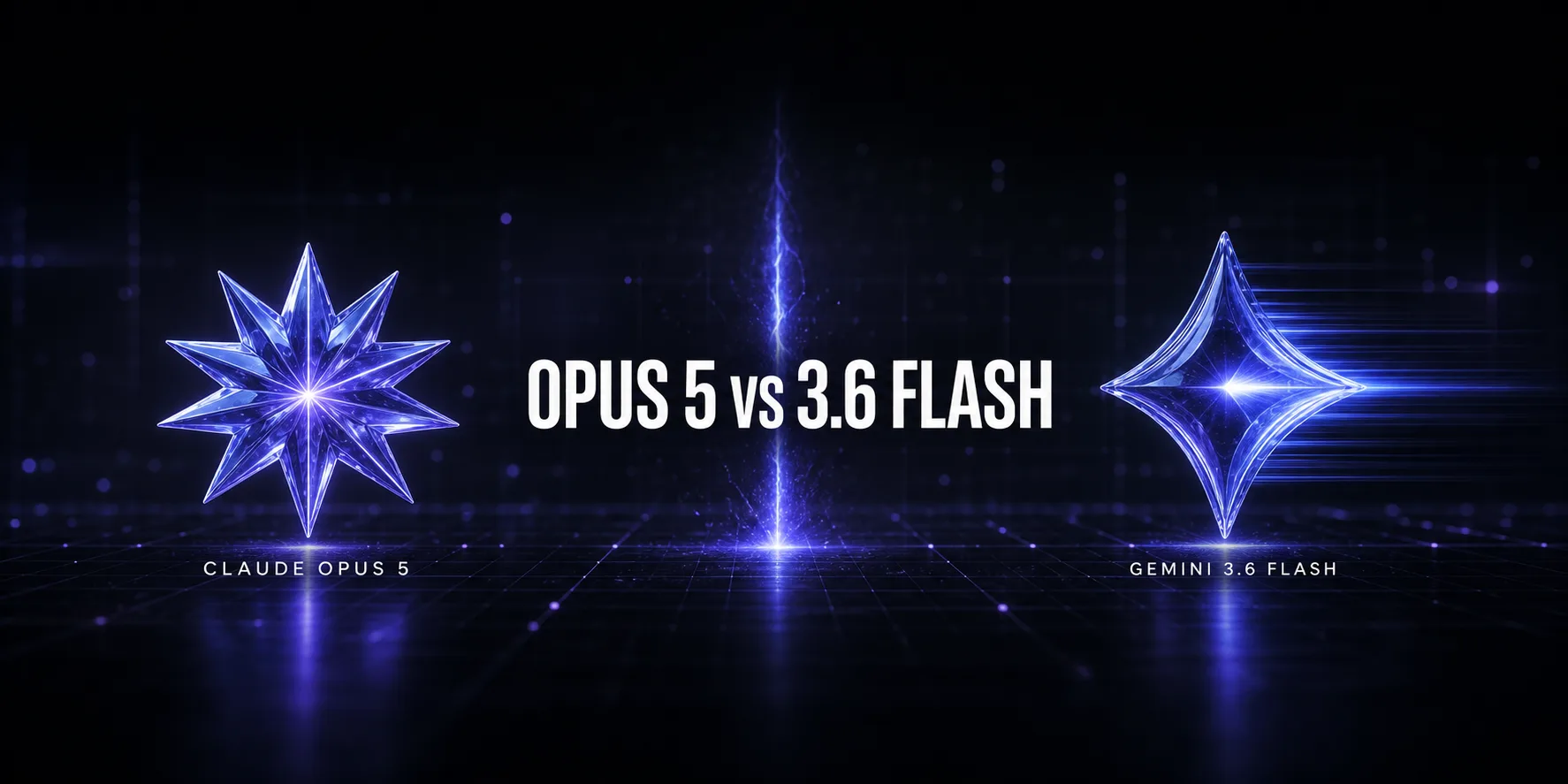
This is not a fair fight, and that is exactly why it is the most useful comparison in AI right now. Claude Opus 5 is a frontier flagship at $5 in / $25 out per million tokens. Gemini 3.6 Flash is a workhorse at $1.50 in / $7.50 out — precisely 3.3x cheaper on both sides. Different tiers, different jobs.
The reason people compare them anyway is that 3.6 Flash got good enough to make the question real. It scores 58.7% on SWE-Bench Pro and 83% on OSWorld Verified, and its long-context retrieval — 91.8% on MRCR v2 at 128k — is genuinely elite, not elite-for-the-price. So the honest question is not "which is better." It is: which slice of your work actually needs the flagship? Our answer, after running both: usually about 20% of it.
Head to Head
| Dimension | Claude Opus 5 | Gemini 3.6 Flash |
|---|---|---|
| Maker / released | Anthropic | Google — July 21, 2026 |
| Price per 1M tokens | $5 in / $25 out | $1.50 in / $7.50 out |
| Cached input | 512-token minimum to cache | $0.15 per 1M |
| Context window | 1M in / 128K out | 1,048,576 in / 65,536 out |
| Coding (SWE-Bench Pro) | Step change over Opus 4.8 | 58.7% (up from 55.1%) |
| Long-context retrieval (MRCR v2 @128k) | Strong across the full window | 91.8% (up from 77.3%) |
| Computer use (OSWorld Verified) | Strong; vision + tool-driven | 83% (up from 78.4%) |
| Input modes | Text, image, PDF (high-res vision) | Text, image, video, audio, PDF |
| Reasoning control | Five effort levels, thinking on by default | Fast by design |
| Knowledge cutoff | Recent | March 2026 |
Figures as of late July 2026. Both companies iterate fast — treat specifics as a snapshot.
The Price Gap Is the Whole Argument

3.3x is a large multiplier, and it compounds in ways the sticker price understates. Flash's cached input runs $0.15 per million — a tenth of its own fresh input rate — so any workload that re-reads the same corpus (an agent walking a codebase, a pipeline over a fixed policy set) gets dramatically cheaper again. Flash also emits roughly 17% fewer output tokens than 3.5 Flash did to say the same thing, which is a second, quieter discount on every call.
Run the arithmetic on a realistic pipeline — say 50 million input and 5 million output tokens a month — and it is roughly $75 + $37.50 on Flash against $250 + $125 on Opus 5. That is not a rounding difference; it is the difference between a line item and a conversation with finance.
The gap narrows in one specific case: when Opus 5's output is right the first time and Flash's needs a second pass. A task that takes Opus 5 one call and Flash three is not 3.3x cheaper on Flash — it is roughly break-even, and worse once you count your own review time. That is the entire routing decision in one sentence.
Where Opus 5 Earns the Premium
Long-horizon agentic coding. This is the clearest gap. Opus 5 completes multi-file features and larger refactors rather than leaving stubs, and it sustains coherence across long autonomous runs. Give it a full specification up front and it works the whole task; the gap over cheaper models is smallest on easy single-file edits and widest exactly where the work is hard. Our Opus 5 prompt sheet is built around that pattern.
Code review with real recall. Opus 5 finds a high rate of genuine bugs per pass, and the extra findings are mostly real rather than false positives. Precision and recall together is the rare combination — plenty of models get one.
Work you cannot cheaply verify. Strategy, legal preparation, research synthesis, financial models. When checking the output costs nearly as much as producing it, you are buying trustworthiness, and that is what the premium is for. Opus 5 also verifies its own work unprompted, which is a real reduction in your review burden.
Adjustable depth. The five-level effort ladder — low through max — lets one model serve latency-sensitive and correctness-critical routes. Notably, low and medium on Opus 5 are unusually strong, which means the honest cost comparison is not always flagship-rate-versus-Flash.
Multi-agent coordination and long deliverables. Subagent teams that do not overwrite each other, and 128K max output — double Flash's 65,536 — for genuinely long artifacts.
Where Gemini 3.6 Flash Is Genuinely Enough
Volume, obviously. Classification, extraction, summarization, normalization, tagging — per-item work where the task is well-defined and the output is checkable by schema. Paying flagship rates here is waste.
Long-context retrieval. 91.8% at 128k is the number that should change minds. If your job is "find the thing in the enormous pile," Flash now does it accurately, and the pile is a million tokens deep at a third of the price. This was the weakest link in cheap models a year ago; it is not anymore.
Video and audio input. The capability Opus 5 does not match: Flash takes native video and audio alongside text, images, and PDFs. Meeting recordings, screen captures, demo walkthroughs, lecture audio — all first-class inputs at Flash pricing. For media-heavy pipelines this is not a cost argument, it is a capability argument.
Computer use at scale. 83% on OSWorld Verified makes browser and desktop automation viable on volume runs where flagship pricing per step would not pencil.
Anything you were going to verify anyway. If a schema validator, a test suite, or a human already checks the output, you are paying a flagship to be careful about something you re-check regardless.
The Routing Rule

The teams getting the most from both run neither exclusively. The rule we use:
Send it to Flash unless the task is hard to specify, hard to verify, or expensive to get wrong. Those three failure modes are what the flagship premium actually buys.
| Workload | Route to | Why |
|---|---|---|
| Multi-file features, larger refactors | Opus 5 | Completion and coherence over long runs |
| Batch extraction, classification, tagging | Gemini 3.6 Flash | Schema-checkable output at a third the cost |
| Code review before merge | Opus 5 | Precision and recall together |
| Video, audio, or screen-recording input | Gemini 3.6 Flash | Native modes Opus 5 does not take |
| Search across a huge corpus | Gemini 3.6 Flash | 91.8% retrieval at 128k, cheap cached re-reads |
| Strategy, legal prep, research synthesis | Opus 5 | Hard to verify — trust is the product |
| High-volume browser automation | Gemini 3.6 Flash | 83% OSWorld at volume-friendly pricing |
| Long deliverables (over ~65K output) | Opus 5 | 128K output ceiling vs 65,536 |
| Anything already validated downstream | Gemini 3.6 Flash | You are re-checking it regardless |
A pattern worth stealing: use Flash as the first pass and the filter, Opus 5 as the closer. Flash reads the corpus, extracts candidates, and drafts; Opus 5 handles the twenty percent that survived triage. You pay flagship rates only on work that earned them.
The Comparison Nobody Runs
Most head-to-heads stop at benchmarks. Two things matter more in practice.
Verification cost is part of the price. A model that is 3.3x cheaper but needs a review pass you would otherwise skip is not 3.3x cheaper. Price your workflow, not your tokens — and note that this cuts both ways: on genuinely well-specified batch work, Flash needs no more review than the flagship would.
Effort changes the arithmetic. Opus 5 at medium is a different cost profile from Opus 5 at max, and it is unusually capable at the lower rungs. Before concluding the flagship is unaffordable, run an effort sweep — the answer is often that you were buying more depth than the task needed.
The Verdict
Gemini 3.6 Flash is the better default; Claude Opus 5 is the better escalation. Flash should handle the volume of your work — the extraction, the retrieval, the media, the automation — because it is now accurate enough that paying more is hard to justify. Opus 5 should handle the work where a wrong answer is expensive, the task is hard to specify, or verification would cost as much as the output: real agentic engineering, pre-merge review, and judgment calls you are going to act on.
If you must pick one: teams shipping software should take Opus 5, because coding is where the gap is widest and the cost of a bad merge is highest. Teams running data, media, or automation pipelines should take Gemini 3.6 Flash, because their work is checkable by construction and their volume is where the price gap compounds.
But the real answer is that in 2026 you do not have to choose, and the two-model stack costs less than either model used badly.
Keep Reading
The prompt sheets for both: 33+ Claude Opus 5 prompts and 40+ Gemini 3.6 Flash prompts. More comparisons: GPT-5.6 vs Fable 5, Kimi K3 vs Fable 5, and Claude pricing explained. Or browse all guides and AI models on PromptsRush.
Frequently Asked Questions
9 questions answered