Hedra Pricing 2026: Plans, Credits, Trial & Discounts
Hedra costs $15 to $75 a month — but Basic delivers half the credits per dollar of every other tier. The full plan breakdown, the credit maths, and which tier is actually worth buying.
Advertisement
Hedra's pricing looks simple — three consumer tiers, one business tier, custom above that. The interesting part is what the credit maths does to that ladder, and it points somewhere the page does not.
The Basic plan is the worst value in the lineup by a wide margin, and the jump from Basic to Creator buys you 80% more credits per dollar. After that the curve flattens almost completely: Professional gives you roughly 7% more per dollar than Creator. So the real decision is not "which tier" — it is "am I past Basic, and do I need speed or seats?"
Everything below comes from the live pricing page, captured while writing this.
Every Plan at a Glance
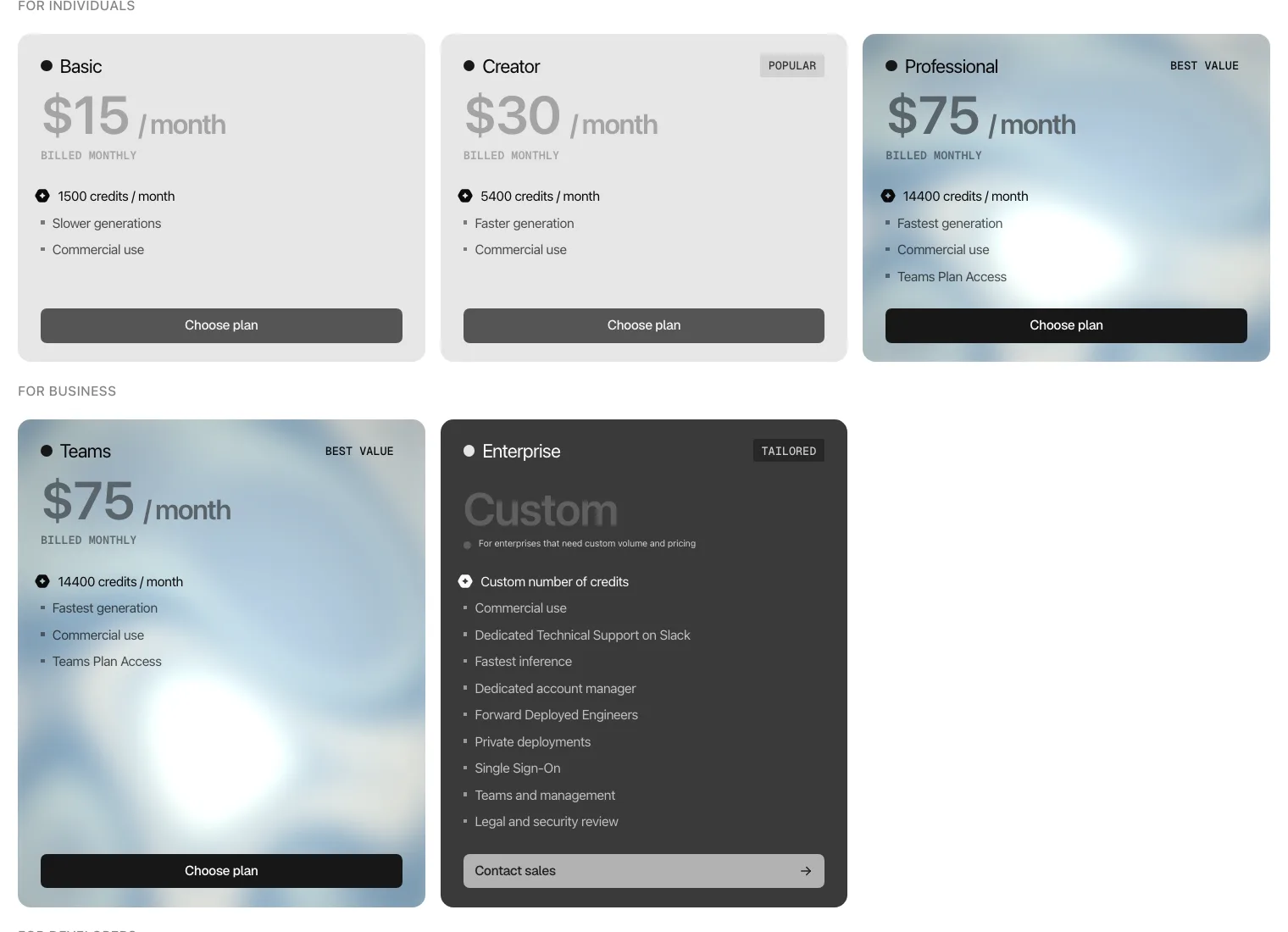
| Plan | Price | Credits/month | Generation speed | Notes |
|---|---|---|---|---|
| Basic | $15/mo | 1,500 | Slower | Commercial use |
| Creator | $30/mo | 5,400 | Faster | Commercial use · marked Popular |
| Professional | $75/mo | 14,400 | Fastest | Commercial use · Teams Plan Access |
| Teams | $75/mo | 14,400 | Fastest | Business tier · Teams Plan Access |
| Enterprise | Custom | Custom | Fastest inference | SSO, private deployments, dedicated support |
All four paid tiers display as billed monthly. Hedra also runs a separate developer platform for API access, priced independently of these plans, and the site states it serves over 20 million users, developers and businesses.
The Credit Maths Nobody Shows You

Divide credits by price and the ladder stops looking evenly spaced:
| Plan | Credits per dollar | Change vs the tier below |
|---|---|---|
| Basic | 100 | — |
| Creator | 180 | +80% |
| Professional | 192 | +7% |
| Teams | 192 | same as Professional |
Three things follow from that table.
Basic is a trap for anyone producing regularly. At 100 credits per dollar you are paying nearly twice the unit rate of every other tier. It makes sense as a way to try the product with commercial rights attached, and very little sense as a plan to stay on.
Creator is where the value lands. Doubling your spend from $15 to $30 gets you 3.6× the credits. That is the only step on this ladder where the money works that hard.
Professional is not bought for cheaper credits. Seven percent is noise. You move to Professional because you need 14,400 credits, because you want the fastest generation queue, or because you need Teams Plan Access — not because the credits got meaningfully cheaper.
Professional vs Teams: The Confusing Bit
Worth addressing directly because the page invites the question. Professional and Teams are both $75 a month with 14,400 credits, both list fastest generation, both list commercial use, and Professional itself lists Teams Plan Access as a feature.
The split is presentational: Professional sits under "For Individuals" and Teams under "For Business", so the difference is about seats and team management rather than what a single user gets. If you are one person, Professional is your tier and the Teams card is not a better deal hiding in plain sight. If you are adding colleagues, that is what the Teams framing is for — and it is worth confirming the per-seat behaviour with Hedra before you buy for a group, because the pricing cards do not spell it out.
The Free Tier and Trial
Hedra's pricing page says "Start free, upgrade anytime", and there is a free way in — but no free plan appears as a card on the pricing page, so the allowance is not stated where you would expect to find it. You sign up and see what you get.
What that means practically: treat the free tier as a way to judge output quality on your own material, not as a way to plan capacity. If you need to know the exact free allowance before committing, check it in-product after signing up rather than trying to find it on the pricing page.
Note also that commercial use is listed from the Basic plan upward. Anything you make on a free tier should not be assumed to carry commercial rights — verify before you publish client work made on it.
Discounts
Here is where I have to be straight about the limits of what I can verify. Every paid card on the pricing page displays "billed monthly", and no annual toggle or annual discount was visible on the page as captured. Many tools in this category discount 15–25% for annual commitment, so it is worth asking — but I am not going to quote a number I did not see.
What is visible:
- No public promo codes on the pricing page itself.
- Enterprise is negotiable by definition — custom volume and pricing is the entire proposition of that tier, so if you are spending at Professional or Teams level across several seats, a conversation is likely to beat the list price.
- The developer platform is priced separately. If your usage is programmatic rather than through the studio, API pricing may work out very differently from these subscription tiers, and that is the comparison worth running.
Before you buy: ask Hedra directly whether annual billing is available and what it saves. A discount that is not advertised on the pricing page is still often available on request, particularly above the entry tier.
What a Credit Actually Buys
This is the number that matters most and the one the pricing page does not answer. Credits are consumed per generation, and the cost of a generation varies with what you are making — length, resolution, and which model handles it all move the figure.
So the honest guidance is to calibrate rather than calculate. Run a handful of generations at the settings you actually use, note what each one costs, and divide your tier's monthly allowance by that figure. That gives you a real output-per-month number for your work, which is far more useful than any per-second estimate someone quotes you second-hand.
Do that on the free tier or on Basic before committing to a bigger plan. It takes twenty minutes and it is the difference between buying the right tier and discovering in week three that you bought two tiers too small.
Which Plan Should You Buy?
| If you... | Buy |
|---|---|
| Want to test output quality on your own material | Free tier first |
| Need commercial rights but produce occasionally | Basic, $15 |
| Produce regularly and want your money to work | Creator, $30 |
| Are hitting the Creator ceiling every month | Professional, $75 |
| Need the fastest queue for deadline work | Professional, $75 |
| Are adding colleagues | Teams, $75 — confirm per-seat terms |
| Need SSO, private deployment or a security review | Enterprise |
| Are generating programmatically | Compare the developer platform instead |
The Verdict
Creator at $30 is the plan to buy for most people. It is the only step on the ladder where the price-to-credit ratio improves dramatically, it carries commercial use, and it moves you off the slow generation queue. Basic exists to get you in the door with commercial rights; it is not where you should still be in three months if the tool is working for you.
Go to Professional when you run out of credits, not before. The unit economics barely move, so the only good reasons are volume, speed and team access. Paying $75 while using half of Creator's allowance is money doing nothing.
And do the calibration run before you commit. Hedra's tiers are cheap enough that guessing feels harmless, but the difference between Basic and Professional is $60 a month — and knowing what a generation costs you in credits turns that from a guess into a decision.
For what the product is actually like to use, our Hedra review covers the features and where it falls short. If you are comparing across the category, Higgsfield pricing and HeyGen pricing use the same lens.
Keep Reading
More pricing breakdowns and reviews: the Hedra review, Higgsfield pricing, HeyGen pricing explained, ElevenLabs pricing, best HeyGen alternatives, and AI cartoon video prompts. Or browse all guides and prompts on PromptsRush.
Frequently Asked Questions
10 questions answered